To save content items to your account,
please confirm that you agree to abide by our usage policies.
If this is the first time you use this feature, you will be asked to authorise Cambridge Core to connect with your account.
Find out more about saving content to .
To save content items to your Kindle, first ensure no-reply@cambridge.org
is added to your Approved Personal Document E-mail List under your Personal Document Settings
on the Manage Your Content and Devices page of your Amazon account. Then enter the ‘name’ part
of your Kindle email address below.
Find out more about saving to your Kindle.
Note you can select to save to either the @free.kindle.com or @kindle.com variations.
‘@free.kindle.com’ emails are free but can only be saved to your device when it is connected to wi-fi.
‘@kindle.com’ emails can be delivered even when you are not connected to wi-fi, but note that service fees apply.
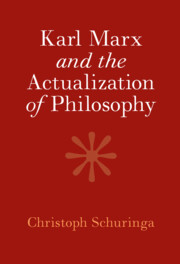
It is indisputable that Marx began his intellectual trajectory as a philosopher, but it is often thought that he subsequently turned away from philosophy. In this book, Christoph Schuringa proposes a radically different reading of Marx's intellectual project and demonstrates that from his earliest writings his aim was the 'actualization' of philosophy. Marx, he argues, should be understood not as turning away from philosophy, but as seeking to make philosophy a practical force in the world. By analysing a series of texts from across Marx's output, Schuringa shows that Marx progressively overcame what he called 'self-sufficient philosophy', not in order to leave philosophy behind but to bring it into its own. This involves a major reinterpretation of Marx's relationship to his ancestors Aristotle, Kant and Hegel, and shows that philosophy, as it actualizes itself, far from being merely a body of philosophical doctrine, figures as an instrument of the revolution.
This study examines the role of art as a crucible of capital and property during the First World War and constructs a large-scale historical narrative of European auctions held between 1910 and 1925. By combining sources such as auction reports, newspaper articles, caricatures, individual memoirs, and financial and legal documents with an analysis of art prices, this study allows for making new observations about the evolution of European art markets, their disruption by the events of the First World War, and their transnational entanglements. Far from focusing solely on reconstructing the collecting patterns of prominent individuals or shedding light on specific histories of appropriation and looting, this book explores broader cultural and social developments across the British, French, and German art markets and their milieus and also touches upon trade spheres such as Italy, Switzerland, the Netherlands, Scandinavia, and Russia. While the First World War has often been neglected in scholarly studies as a phase of stagnation and stasis, this study shows that it had a disruptive impact on the art trade in the twentieth century and introduces a new transnational methodology for historical inquiries into cultural and artistic markets.
This chapter surveys one of the most significant enterprises of the Committee of Instruments and Proposals, established by the Board of Longitude following the Longitude Act of 1818. This was the management of a new observatory proposed for the Cape of Good Hope. Several Commissioners of Longitude had direct interests: John Barrow had been administrator and surveyor at the Cape; Joseph Banks advised on maritime surveys there; Davies Gilbert lobbied actively for a southern equivalent of the Royal Observatory. Commissioners successfully negotiated the scheme with the Admiralty and the Colonial Office. Though funds were forthcoming from the Navy, long-distance management proved difficult. The resulting issues reached the Committee and the Board, as did increasing costs of equipment from London’s finest instrument makers. These challenges had not been resolved at the Board’s dissolution in 1828; indeed, that moment coincided with discussions as to the possibility of closing the observatory. The affairs of the Cape Observatory thus reveal both opportunities and challenges in issues of scientific and geographical management in the epoch of empire and reform.
The epilogue provides a summary of the main arguments of the book. Old merchant homes of Gujarat that are located on the ocean’s edge are physical locations and conceptual sites for understanding capitalism across the Indian Ocean during the era of British colonialism and into the present day. The epilogue also revisits the concept of critical inhabitation, a historical method developed in the book to identify and interpret spaces (like merchant homes) that connect disparate archives. The epilogue ends with a story about a merchant home in Variav, a coastal town near the larger port of Surat, to emphasize the ongoing nature of histories charted in the book.
In the first book-length history of the Board of Longitude, a distinguished team of historians of science brings to life one of Georgian Britain’s most important scientific institutions. Having developed in the eighteenth century following legislation that offered rewards for methods to determine longitude at sea, the Board came to support the work of navigators, instrument makers, clockmakers and surveyors, and assembled the Nautical Almanac. The authors use the archives and records of the Board, which they have recently digitised, to shed new light on the Board’s involvement in colonial projects and in Pacific and Arctic exploration, as well as on innovative practitioners whose work would otherwise be lost to history. This is an invaluable guide to science, state and society in Georgian Britain, a period of dramatic industrial, imperial and technological expansion.
This chapter covers the two decades from the first minuted meeting of the Commissioners of Longitude in 1737. During this time, small groups of Commissioners were called together sporadically for ad hoc meetings, principally to agree funding for specific projectors, notably clockmaker John Harrison and longitude veteran William Whiston. Over this initial period, relations with Harrison were cordial and supportive. Despite these promising developments, it was a period in which public opinion gradually reverted to mockery of those seeking the seemingly impossible longitude dream. The chapter seeks to emphasise in addition the value of looking at some of the schemes that more recent authors have dismissed as invalid. This has occurred not only when proposals seem unlikely to modern eyes but also when their authors were partly or wholly motivated by factors such as religion or financial need, and overlooks the reception of those proposals. The books published by Jane Squire are a particular focus, since they contain some of the best records of the Commissioners’ activities and thoughts during the earlier decades.
Parallel to Chapter 2, this section reconstructs the socio-economic history of the art market after the First World War. The immediate postwar year, marked by political and economic instability, posed unique challenges for the losers of the war. Germany, in particular, faced hyperinflation, a phenomenon that contributed to accelerate changes initiated by the war. In contrast, the stagnation of the French art market was aggravated after 1918 due to nationalisation, bureaucratisation, and new distribution patterns that only cemented its isolation. Meanwhile, the British market remained relatively stable and less reliant on foreign buyers. The rise of neutral parties’ purchasing power, notably in Switzerland, Sweden, and the Netherlands, highlighted the new dynamics of a fragmented market. Overall, the war altered the trade dynamics of the European art market, with uncontrollable expansion in Germany, French decline, and British stability reflecting its economic impact.
This chapter details the creation and management of the Nautical Almanac, one of the Board of Longitude’s most important concerns. Appointed Astronomer Royal and thus a Commissioner of Longitude in 1765, Nevil Maskelyne oversaw its publication and that of associated texts, directing the work of a group of mathematical computers overseen by comparers. Hierarchical organisation and increasing costs preoccupied much of the Board of Longitude’s subsequent affairs. Calculated up to a decade in advance, the Nautical Almanac became a symbol of the Board’s repute among foreign academies and observatories, although its accuracy was later subject to satire and criticism. After Maskelyne’s death, work seems to have suffered and its management was overhauled by the Longitude Act of 1818 that brought it under Thomas Young’s management. Controversy wracked the Board’s direction of the Nautical Almanac for the next decade. Its assignment from 1831 to the astronomer William Stratford as superintendent was a major element of the aftermath of the Board’s abolition.
This chapter explores broader cultural European trends following the First World War, including the consequences of currency dynamics and market speculation. These postwar changes culminated in a heightened financialisation of the culture of the art market, reflecting broader shifts in capitalist economies towards financial forms of revenue and profit. The saturation of financial language that accompanies financialisation processes was also a characteristic of this period: the aftermath of the war saw debates revolving around themes of profit, money-making, and an inflation of art production. This chapter parallels previous chapters by examining how cultural and artistic changes were linked to socio-economic developments. The war had acted as a catalyst and accelerator, inflaming cultural tensions within the art markets. It continued to shape market discourses, embedding wartime mentalities into post-war cultural landscapes.
This chapter offers a survey of the ways in which the British Board of Longitude handled the range of schemes and projects that were presented by mathematicians and mariners, inventors and entrepreneurs during its final decades to 1828. Labels of impracticality, eccentricity and derangement have long been assigned to many of these proposals, notably in the classification scheme imposed by Astronomer Royal George Airy in his reorganisation of the Board’s archives from the 1840s. This chapter favours close reading of the ways in which schemes were assessed and managed at the time. In the bulky correspondence received, schemes for new devices, calculation methods or navigation techniques were mixed with projects for squaring the circle or endless mechanical power. The Board distinguished between those projects reckoned impossible or unsound, and those it judged irrelevant or beyond its scope. It is shown how much discretionary power the Board exercised, and how its accumulated papers preserve a wide range of protagonists’ technical and scientific interests.
Chapter 4 is grounded in an old Parsi house in the port city of Bharuch. The chapter argues that old Parsi houses, complicate Parsi colonial histories that became normative sources of Parsi belonging and emphasized the boundary of religious identity. The chapter draws on participant observation in Bharuch, Urdu and Gujarati histories of the port that feature the old house, and colonial administrative reports from the Maharashtra State Archives, Mumbai, to provide a plural account of belonging that weaves Parsi domesticity into larger frames of the political and economic history of the region. The chapter argues that an old house on a hill offers a historiographical location from where archives that are separated in the postcolonial present can be drawn together to show plural pasts. Nationalist accounts erase these layered pasts and assert a singular Hindu present. In contrast, old homes archive multiple histories that we can access by engaging with the built space of ports once involved in Indian Ocean capitalism.