To save content items to your account,
please confirm that you agree to abide by our usage policies.
If this is the first time you use this feature, you will be asked to authorise Cambridge Core to connect with your account.
Find out more about saving content to .
To save content items to your Kindle, first ensure no-reply@cambridge.org
is added to your Approved Personal Document E-mail List under your Personal Document Settings
on the Manage Your Content and Devices page of your Amazon account. Then enter the ‘name’ part
of your Kindle email address below.
Find out more about saving to your Kindle.
Note you can select to save to either the @free.kindle.com or @kindle.com variations.
‘@free.kindle.com’ emails are free but can only be saved to your device when it is connected to wi-fi.
‘@kindle.com’ emails can be delivered even when you are not connected to wi-fi, but note that service fees apply.
This chapter examines a series of texts in which Marx (sometimes in collaboration with Engels) is working to free himself from what he comes to call ‘self-sufficient philosophy’. In The Holy Family the emphasis is negative, focusing on the criticism of ‘Critical Criticism’, in which thought replaces thinkers. The Theses on Feuerbach start to break apart the Feuerbachian abstract conception of Gattungswesen. In The German Ideology Marx and Engels start to bring real human individuals into the picture as the agents of history. The Poverty of Philosophy, directed against Proudhon, notably criticizes a deficient kind of ‘self-sufficient’ Hegelianism, in favour of the work of new proletarian theoreticians who can carry forward the work of history.
The afterword draws together arguments made in previous chapters about the creation, publication, and reception of Pepys’s diary. It briefly surveys the reputation and uses of the diary in the early twenty-first century and considers what the future of the diary might hold.
This chapter explores how selective service laws for World War II both built on and changed the relationship between youth, education, and national security that had been developed in the preceding decades. Through nationwide debates over what made the disproportionate draft of young men aged eighteen to twenty-five as American and democratic, adults reinterpreted the characteristics of “youth” that had been deemed serious problems in the 1930s. That is, the lack of advanced work experience now indicated immediate availability for military service, unstable lifestyle meant mobility, and mental malleability now signified adaptability to military discipline. The supporters of the youth draft also formalized the link between military duty and education, advocating for the formation of military-educational training for young soldiers with military value as a democratic and American method of conscripting youth.
This chapter tells the story of how the uncensored text of Pepys’s diary was finally published in the late twentieth century, before turning to the diary’s online presence in the twenty-first century. The complete text, edited by Latham and Matthews, appeared between 1970 and 1983. However, the decision to publish the diary in full was made much earlier, at the time of the controversial Lady Chatterley trial (1960). Getting all the diary into print required navigating the new law against obscene publications, with implications for how the diary is read today. International collaboration – and behind-the-scenes controversy – also shaped this edition. Collaboration is likewise a feature of the site pepysdiary.com (2003-present), which attracts an international community of readers. As the COVID-19 pandemic hit, this site became a record of how readers worldwide used Pepys’s history to interpret a contemporary plague.
An examination of the role of monasticism in material culture, especially following the important role of Odo of Cluny in introducing the Benedictine rule to Roman monasteries. Examples covered include mural paintings in the churches of S. Maria Antiqua and S. Saba, and the silver covers of a Gospels manuscript created for the convent of SS. Ciriaco e Nicola.
Business-led conservation of wildlife based on private property rights and formal governance has often yielded inconsistent results. In pursuit of alternative approaches that prioritize long-term sustainability in wildlife exploitation, this paper studies the novel case of the Nivkh people’s bear hunting enterprise, which functioned in the Lower Amur Basin and Sakhalin from the seventeenth to the early twentieth century. I demonstrate that the Nivkh ran their bear enterprise sustainably via a conglomeration of traditional ecological knowledge, religious beliefs, and informal social institutions, satisfying their personal demand for the animal while successfully selling bear furs and gallbladders to foreign merchants. Such developments were also supported by the regional political economy in which the Nivkh retained a large degree of autonomy. The paper highlights the productive impact that ideas of sacrality, human–animal kinship, and reciprocity exert on sustainability in wildlife enterprises while also stressing the importance of careful government policy in relation to Indigenous conservation systems. The study validates its claims through field notes, expeditionary journals, state reports, and historical and ethnographic research.
The resettlement of Hungarian refugees who had fled the Soviet invasion in 1956, from Austria to the United States, is generally perceived as a success story. Austria received extensive international support and most of the refugees were integrated quickly into American society. This great willingness to help is usually explained by reference to the Cold War dichotomy. But beyond political considerations, a close look at the admission processes also reveals that economic interest and labour power were significant factors that favoured reception and integration. And, although religious relief organizations played a major role in co-ordinating the resettlement process, religion was not a main criterion for emigration to the United States. This article looks at the process of resettlement of Hungarian refugees from Austria to the United States in 1956–7. It thereby locates the movement of Hungarians within the broader context of Cold War history, economic growth, labour demand, and international relief.
Using previously uncited archival evidence from the US, the UK, and Czechia, we highlight Bohuslav Ečer’s significant impact on the Charter of the International Military Tribunal held at Nuremberg from 1945 to 1946. A politically motivated jurist from Czechoslovakia, Ečer proved a key innovator in international criminal law, pushing for bold new precedents at Nuremberg. We highlight multiple legal arguments that Ečer innovated and championed. These include the prosecution of individuals for the crime of aggression, the forfeiting of sovereign immunity during wartime, a broader definition of war crimes that included “crimes against humanity,” and the collective responsibility of certain “criminal” Nazi organizations as a means of streamlining individual-level prosecutions. We trace Ečer’s political thought and activism, including how his arguments joined with those of other prominent legal thinkers outside the US, including Hersch Lauterpacht and Aron Trainin. The article thus adds an important, yet often overlooked, voice to Nuremberg’s intellectual history and helps remedy the Anglo-American bias of dominant histories of international criminal law.
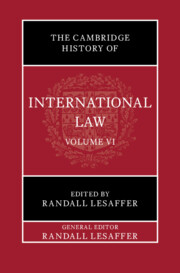
Volume VI of The Cambridge History of International Law offers a survey of the law of nations in early modern Europe through a balanced treatment of legal theory and diplomatic practice. Bringing together a wide range of scholars, this volume builds on recent historiographical insights from different disciplines, including legal history, diplomatic history, and the history of political thought. It considers all major themes ranging from the allocation of jurisdiction over land and sea, war- and peace- making, trade and navigation to diplomacy and dispute settlement. A unique overall synthesis of early modern law across nations in Europe.
This article examines the work habits of saleswomen in West Germany's retail and describes the amorphous yet evolving boundaries of working and non-working time. During the 1960s, women employed in retail began to work part-time to combine their domestic duties and a career. In their non-working hours, these women attended to childcare and household duties. This much is known, but this article shows that, in addition, female workers in retail often had to face irregular extensions of their working hours. This enabled companies to reduce the paid time of their employees. Moreover, some employment qualifications associated with women (smiling, engaging in conversation, displaying fine motor skills) were not properly appreciated, much less financially rewarded, but were instead regarded as natural traits and not subject to compensation. All these micro mechanisms led to women being held back from full work life participation, and therefore reinforced gender inequalities in general.
The China–Pakistan Economic Corridor (CPEC), a key component of China’s Belt and Road Initiative, has the potential to transform Pakistan’s economy through economic cooperation, large-scale infrastructure projects and other forms of investment. Many observers fear, however, that the CPEC will become the “New East India Company,” effectively turning Pakistan into a Chinese client state. Through extensive interviews with key stakeholders in Pakistan as well as documentary research, we weigh the arguments on both sides of this debate. While the CPEC has the potential to become what many fashionably term a “game changer” for Pakistan, economic and social problems will likely prevent the country from fully realizing the CPEC’s transformative potential. On the other hand, the CPEC seems likely to expand the China–Pakistan relationship beyond its historical military and security emphasis to bring substantial social and economic benefits to Pakistan, while the complexity of the Pakistan case makes comprehensive “colonization” unlikely.
Especially as regards Commonwealth restrictions, Ireland's immigration policy has been seen as (surreptitiously) dependent on UK policy. Although the Common Travel Area imposed serious limits, Irish discretion was in fact significant and restrictive. In 1948–9 the United Kingdom secured Ireland's public commitment to extend reciprocal citizenship rights to all the Commonwealth, notwithstanding its secession, but Ireland avoided this vis-à-vis the ‘new’ Commonwealth and left its aliens exemption law deliberately opaque. Whilst broadly mirroring the UK Commonwealth Immigrants Act 1962, Ireland retained apartheid South Africa as partially privileged and only comprehensively exempted British citizens born within the United Kingdom. From 1973, the United Kingdom largely abandoned any privileged treatment but, in entirely removing this in 1975 and selectively imposing visas from 1976, Ireland went beyond even this. These divergences reflected that, compared to the United Kingdom, it had left an increasingly diverse Commonwealth in 1949 and had a stronger homogenous nationalism.
Since its inception in 1831, the French Foreign Legion, a specialised unit within the ranks of the French military, has played a prominent role in the wars of both colonisation and decolonisation. This article seeks to trace the origins, development and eventual decline of an Italian and international ‘Legionary issue’ regarding the recruitment and employment of Italian volunteers in a foreign military force deployed in the French decolonisation war in Indochina. Through the examination of archival sources as well as autobiographical narratives by Italian legionnaires, this study offers a novel perspective on the interplay between Italy’s political, economic and sociocultural trends, the enlistment of Italian volunteers into the French Foreign Legion, and the evolution of Italo-French relations in the postwar period.
The relationship between Zapatismo and women’s liberation has sparked heated debates between academics and activists alike. Although the Zapatistas’ official communiqués have promoted gender parity, criticism has been aimed at Zapatista fiction for accentuating gender stereotypes and for contradictions regarding women’s rights. This article discusses the children’s books Habrá una vez (2016) and Hablar colores (2018), encountered during archival and ethnographic research in Zapatista territory, and examines how “Zapafiction” embraces contradiction as constructive revolutionary politics. The children’s books analyzed here depict ecofeminist characters, including Defensa Zapatista (an approximately eight-year-old schoolgirl), Gato-Perro (a cat-dog symbolizing nonbinary identities), a disabled horse, and Loa Otroa (embodying queer identities). Instead of solving contradictions, I argue that these characters reject the romanticization of progressive political movements while viewing Zapatismo as the venue for advancing dignity as a way of life (jch’uleltik). Through the concept of imperfect politics, Zapafiction leverages the principle of caminando y preguntando, “walking, we ask questions,” to reimagine the governing structures of the organization through fiction, moving beyond theoretical doctrines on how politics should be.