To save content items to your account,
please confirm that you agree to abide by our usage policies.
If this is the first time you use this feature, you will be asked to authorise Cambridge Core to connect with your account.
Find out more about saving content to .
To save content items to your Kindle, first ensure no-reply@cambridge.org
is added to your Approved Personal Document E-mail List under your Personal Document Settings
on the Manage Your Content and Devices page of your Amazon account. Then enter the ‘name’ part
of your Kindle email address below.
Find out more about saving to your Kindle.
Note you can select to save to either the @free.kindle.com or @kindle.com variations.
‘@free.kindle.com’ emails are free but can only be saved to your device when it is connected to wi-fi.
‘@kindle.com’ emails can be delivered even when you are not connected to wi-fi, but note that service fees apply.
This chapter is concerned with the question why conversational interaction has been described as orderly and supportive in some contexts but is perceived as chaotic or interruptive in others. After scrutinising the data for signs of ‘interruptiveness’ it can be shown that this concept is often confused with a preference for more direct turn-taking strategies. The chapter concludes with a discussion of the apparent dichotomy of cooperation and competition and suggests regarding turn-taking as an instance of coopetition instead.
This chapter provides a quantitative analysis the strategy clusters Southeast Asian and Caribbean interactants use for claiming or holding a turn at talk. It can be shown that speaker groups essentially use the same strategy combinations, although some differences also become apparent. The second part of the chapter zooms in on the frequency of selected phonetic and syntactic resources and compares their usage across the two speaker groups. Again, both similarities and differences between the speaker groups become apparent; for example, with respect to the usage of tempo downsteps or direct requests. These findings support the notion of a locally inflected conversational infrastructure, which is influenced by both cultural context and variety-specific preferences.
This chapter provides an in-depth analysis of the resources Southeast Asian and Caribbean speakers of English use to claim or hold a turn at talk. Four larger strategy groups are described and compared: latches and overlaps, phonetic resources, lexical resources, and syntactic strategies. The chapter describes how these are realised by the individual speaker groups and compares this to previous research on Inner Circle Englishes. It can be shown that speaker groups essentially have access to the same set of resources but exhibit different preferences with respect to which strategies they prefer for organising turn-taking in conversational interaction.
This chapter provides a detailed analysis of the different types and scenarios of speaker change in Southeast Asian and Caribbean conversations. The three general types of turn allocation – next speaker selection, self-selection, and current speaker continuation – and their concrete realisations in the data are examined both qualitatively and quantitatively. It can be shown that turn-taking in Southeast Asian and Caribbean English interactions is rule-governed and exhibits patterns similar to those that have been found in Inner Circle English conversations. Nevertheless, some differences between the speaker groups are found; for example, when it comes to how likely conversationalists are to yield the floor to a current speaker.
This chapter describes the theoretical foundations of the study. The study is located at the interface of two scientific areas that had not had much contact before: Conversation Analysis and World Englishes. In the first two sections of the chapter, central theoretical and methodological tenets in both fields are introduced. The last section addresses epistemological differences between the traditions and provides a rationale for why and how Conversation Analysis and World Englishes can still be reconciled in a fruitful way.
This chapter describes the process of choosing and preparing the data investigated in the present study. It starts with a definition of the notion of ‘culture’ and then introduces the data that form the basis for the analysis. The interactions analysed were extracted from two larger corpora, the Asian Corpus of English (ACE) and two components of the International Corpus of English (ICE) – ICE-Jamaica and ICE-Trinidad and Tobago. The chapter then describes how a collection of unscripted natural conversations was compiled for the project and briefly comments on the transcription process involved. It illustrates how qualitative analysis can be successfully combined with subsequent quantification and shows why this is essential in comparative conversation analytic research. The last part of the chapter provides a detailed description of the codification procedure and the formal coding system developed for the project, before summarising the steps involved in the quantitative part of the analysis.
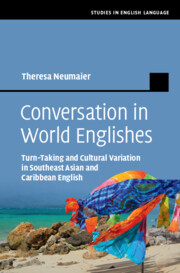
Turn-taking is a fascinating feature of conversational interaction, due to its systematic and ordered nature. However, research has so far focused mainly on American and British conversations, with other varieties of English receiving much less attention. This pioneering book addresses this gap by exploring turn-taking patterns and cultural variation in Southeast Asian and Caribbean English. Bringing together research from the fields of Conversation Analysis and World Englishes for the first time, Neumaier conducts an empirical study based on authentic audio data of interactions in these global varieties of English, and demonstrates that conversational strategies differ between speaker groups with different cultural backgrounds. Shedding new light on the impact of cultural and sociolinguistic factors on conversational patterns, it is essential reading for advanced students and scholars interested in language, variation, and social interaction, as well as those working in the fields of Conversation Analysis, Interactional Linguistics, and World Englishes.
This Element outlines current issues in the study of the pragmatics of fiction. It starts from the premise that fictional texts are complex and multi-layered communicative acts which deserve attention in pragmatic research in their own right, and it highlights the need to understand them as cultural artefacts rich in possibilities to explore pragmatic effects and pragmatic theorising. The issues covered are (1) the participation structure of fictional texts, (2) the performance aspect of fictional texts, (3) the interaction between readers and viewers and the fictional texts, as well as (4) the pragmatic effects of drawing on indexical linguistic features for evoking ideologies in characterisation. This title is also available as Open Access on Cambridge Core.
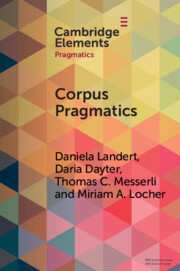
This Element discusses the challenges and opportunities that different types of corpora offer for the study of pragmatic phenomena. The focus lies on a hands-on approach to methods and data that provides orientation for methodological decisions. In addition, the Element identifies areas in which new methodological developments are needed in order to make new types of data accessible for pragmatic research. Linguistic corpora are currently undergoing diversification. While one trend is to move towards increasingly large corpora, another trend is to enhance corpora with more specialised and layered annotation. Both these trends offer new challenges and opportunities for the study of pragmatics. This volume provides a practical overview of state-of-the-art corpus-pragmatic methods in relation to different types of corpus data, covering established methods as well as innovative approaches. This title is also available as Open Access on Cambridge Core.
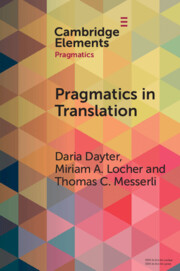
This Element addresses translation issues within an interpersonal pragmatics frame. The aims of this Element are twofold: first, we survey the current state of the field of pragmatics in translation; second, we present the current and methodologically innovative avenues of research in the field. We focus on three pragmatics issues – relational work, participation structure, and mediality – that we foreground as promising loci of research on translational data. By reviewing the trajectory of pragmatics research on translation/interpreting over time, and then outlining our understanding of the Pragmatics in Translation as a field, we arrive at a set of potential research questions which represent desiderata for future research. These questions identify the paths that can be productively explored through synergies of the linguistic pragmatics framework and translation data. In two case study chapters, we offer two example studies addressing some of the questions we identified as suggestions for future research. This title is also available as Open Access on Cambridge Core.