To save content items to your account,
please confirm that you agree to abide by our usage policies.
If this is the first time you use this feature, you will be asked to authorise Cambridge Core to connect with your account.
Find out more about saving content to .
To save content items to your Kindle, first ensure no-reply@cambridge.org
is added to your Approved Personal Document E-mail List under your Personal Document Settings
on the Manage Your Content and Devices page of your Amazon account. Then enter the ‘name’ part
of your Kindle email address below.
Find out more about saving to your Kindle.
Note you can select to save to either the @free.kindle.com or @kindle.com variations.
‘@free.kindle.com’ emails are free but can only be saved to your device when it is connected to wi-fi.
‘@kindle.com’ emails can be delivered even when you are not connected to wi-fi, but note that service fees apply.
These lectures are about private property and the Rule of Law. But, instead of starting with abstract definitions of these terms, I want to begin with a case.
It’s a 1992 decision of the Supreme Court of the United States, Lucas v. South Carolina Coastal Council. Like many American property cases, it concerns the application of what we call the “Takings Clause” of the Fifth Amendment. These lectures are not about American constitutional law and I won’t ask you to venture very far into the morass that constitutes American Takings Clause jurisprudence. It is a mess and, if only you knew how much of a mess, you would thank me for steering us away from this aspect of litigation. But the facts in Lucas v. South Carolina Coastal Council are going to be very helpful for our discussion of ownership and its relation to the Rule of Law.
The Hamlyn Trust owes its existence today to the will of the late Miss EmmaWarburton Hamlyn of Torquay, who died in 1941 at the age of eighty. She camefrom an old and well-known Devon family. Her father, William Bussell Hamlyn,practiced in Torquay as a solicitor and Justice of the Peace for many years, andit seems likely that Miss Hamlyn founded the trust in his memory. Emma Hamlynwas a woman of strong character, intelligent, and cultured, well-versed inliterature, music, and art, and a lover of her country. She traveled extensivelyin Europe and Egypt, and apparently took considerable interest in the law andethnology of the countries and cultures that she visited. An account of MissHamlyn by Professor Chantal Stebbings of the University of Exeter may be found,under the title “The Hamlyn Legacy”, in volume 42 of the publishedlectures.
Miss Hamlyn bequeathed the residue of her estate on trust in terms which it seemswere her own. The wording was thought to be vague, and the will was taken to theChancery Division of the High Court, which in November 1948 approved a Schemefor the administration of the trust. Paragraph 3 of the Scheme, which followsMiss Hamlyn’s own wording, is as follows:
The object of the charity is the furtherance by lectures or otherwise amongthe Common People of the United Kingdom of Great Britain and NorthernIreland of the knowledge of the Comparative Jurisprudence and Ethnology ofthe Chief European countries including the United Kingdom, and thecircumstances of the growth of such jurisprudence to the Intent that theCommon People of the United Kingdom may realise the privileges which in lawand custom they enjoy in comparison with other European Peoples andrealising and appreciating such privileges may recognise theresponsibilities and obligations attaching to them.
Some people think that the Rule of Law is a purely formal/procedural ideal, neutral as between different kinds of law, provided that the law to whatever ends it is directed satisfies formal constraints of generality, prospectivity, clarity, etc., and is applied in a procedurally fair and respectable manner.
Others, however, believe in a substantive dimension for the Rule of Law and, of these, there are some who believe that there is a special affinity between the Rule of Law and the vindication and support of private property rights. Those who take this view believe that the Rule of Law looks with a jaundiced eye, rather than a neutral eye, on legislation of the kind we are considering – the conservation statute, for example, that was at stake in Lucas v. South Carolina Coastal Council in 1992. It is part of the mission of the Rule of Law, on this account, to support private property; so, to that extent, the Rule of Law provides a basis for criticizing legislative intervention. In Chapter 1, I associated something approaching this position with theorists like Richard Epstein, F. A. Hayek, and John Locke.
I incurred many debts in the writing and delivery of the 2011 Hamlyn Lectures and in preparing them for publication. My greatest debts are to my audiences in Oxford, Coventry, and London, who listened patiently and responded with helpful and insightful questions. I am particularly grateful to Kim Economides for the initial invitation, Avrom Sherr for making many of the arrangements, and Finola O’Sullivan for being a patient editor at Cambridge University Press for such a dilatory author.
Timothy Endicott organized and chaired the first lecture at Oxford; Julio Faundez did the same at the University of Warwick for the second lecture, and Sir Stephen Sedley chaired the third lecture in London. New York University’s D’Agostino Fund for Faculty Research helped support the rewriting of the lectures in Summer 2011. Carol Sanger helped me inestimably throughout the process, as always, with her support, insight, and love.
The first lecture in this series used the facts of an American case, Lucas v. South Carolina Coastal Council, to pose a question about the possibility of a special relation between private property and the ideal we call the Rule of Law. The case concerned a property developer, who bought ocean-front real estate intending to develop it as residential property for resale. Unfortunately (or fortunately, depending on your point of view), his plans were thwarted by new environmental regulations intended to protect the coastline from erosion. The developer sued under the Takings Clause of the US Constitution, on the ground that the regulations deprived his property of all or almost all of its value, and his argument was accepted by a majority in the Supreme Court of the United States.
I said that I was not interested in arguing about American constitutional law, but that I wanted to use the facts of Lucas v. South Carolina Coastal Council to raise a question about the relation between private property and the Rule of Law. Is the property developer’s complaint one that can be made in the name of the Rule of Law? Can he proceed with it on the assumption that the Rule of Law should protect his property against this sort of regulation? Or is the ideal of the Rule of Law neutral in this matter, given that there is law on both sides of the equation – law inasmuch as Mr. Lucas’s property rights are legal rights but law also inasmuch as the restriction on development that he faces represents the application of a properly enacted statute?
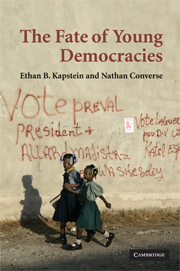
The recent backlash against democracy in such countries as Bolivia, Venezuela, Russia, and Georgia poses renewed concerns about the viability of this regime type in the developing world. Drawing on a unique data set of every democratization episode since 1960, this book explores the underlying reasons for backsliding and reversal in the world's fledgling democracies and offers some proposals with respect to what the international community might do to help these states stay on track toward political stability. Rejecting earlier scholarship on this topic, Kapstein and Converse argue that the core of the problem is found in the weak institutions that have been built in much of the developing world, which encourage leaders to abuse their power. Understanding the underlying reasons for democratic failure is essential if we are to offer policy recommendations that have any hope of making a difference on the ground.
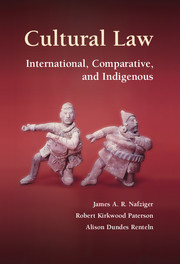
Cultural law is a new and exciting field of study and practice. The core themes of linguistic and other cultural rights, cultural heritage, traditional crafts and knowledge, the performing arts, sports, and religion are of fundamental importance to people around the world, engaging them at the grass roots and often commanding their daily attention. The related legal processes are both significant and complex. This unique collection of materials and commentary on cultural law covers a broad range of themes. Opening chapters explore critical issues involving cultural activities, artifacts, and status as well as the fundamental concepts of culture and law. Subsequent chapters examine the dynamic interplay of law and culture with respect to each of the core themes. The materials demonstrate the reality and efficacy of comparative, international, and indigenous law and legal practices in the dynamic context of culture-related issues. Throughout the book, these issues are presented at multiple levels of legal authority: international, national, and subnational.
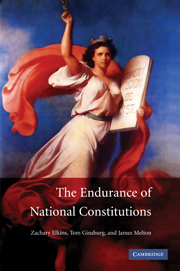
Constitutions are supposed to provide an enduring structure for politics. Yet only half live more than nine years. Why is it that some constitutions endure while others do not? In The Endurance of National Constitutions Zachary Elkins, Tom Ginsburg and James Melton examine the causes of constitutional endurance from an institutional perspective. Supported by an original set of cross-national historical data, theirs is the first comprehensive study of constitutional mortality. They show that whereas constitutions are imperilled by social and political crises, certain aspects of a constitution's design can lower the risk of death substantially. Thus, to the extent that endurance is desirable - a question that the authors also subject to scrutiny - the decisions of founders take on added importance.
The constitutional question is of paramount importance in the political and nationalist agenda of late twentieth-century Europe. Professor van Caenegem's new book addresses fundamental questions of constitutional organisation: democracy versus autocracy, unitary versus federal organisation, pluralism versus intolerance, by analysing different models of constitutional government through an historical perspective. The approach is chronological: constitutionalism is explained as the result of many centuries of trial and error through a narrative which begins in the early Middle Ages and concludes with contemporary debates, focusing on Europe, the United States, and the Soviet Union. Special attention is devoted to the rise of the rule of law, and of constitutional, parliamentary, and federal forms of government. The epilogue discusses the future of liberal democracy as a universal model.
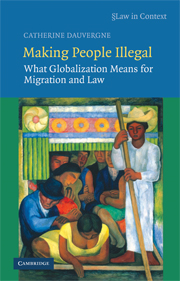
This book examines the relationship between illegal migration and globalization. Under the pressures of globalizing forces, migration law is transformed into the last bastion of sovereignty. This explains the worldwide crackdown on extra-legal migration and informs the shape this crackdown is taking. It also means that migration law reflects key facets of globalization and addresses the central debates of globalization theory. This book looks at various migration law settings, asserting that differing but related globalization effects are discernible at each location. The 'core samples' interrogated in the book are drawn from refugee law, illegal labor migration, human trafficking, security issues in migration law, and citizenship law. Special attention is paid to the roles played by the European Union and the United States in setting the terms of global engagement. The book's conclusion considers what the rule of law contributes to transformed migration law.
This volume challenges the conventional wisdom about judicial independence in China and its relationship to economic growth, rule of law, human rights protection, and democracy. The volume adopts an interdisciplinary approach that places China's judicial reforms and the struggle to enhance the professionalism, authority, and independence of the judiciary within a broader comparative and developmental framework. Contributors debate the merits of international best practices and their applicability to China; provide new theoretical perspectives and empirical studies; and discuss civil, criminal, and administrative cases in urban and rural courts. This volume contributes to several fields, including law and development and the promotion of rule of law and good governance, globalization studies, neo-institutionalism and studies of the judiciary, the emerging literature on judicial reforms in authoritarian regimes, Asian legal studies, and comparative law more generally.