To save content items to your account,
please confirm that you agree to abide by our usage policies.
If this is the first time you use this feature, you will be asked to authorise Cambridge Core to connect with your account.
Find out more about saving content to .
To save content items to your Kindle, first ensure no-reply@cambridge.org
is added to your Approved Personal Document E-mail List under your Personal Document Settings
on the Manage Your Content and Devices page of your Amazon account. Then enter the ‘name’ part
of your Kindle email address below.
Find out more about saving to your Kindle.
Note you can select to save to either the @free.kindle.com or @kindle.com variations.
‘@free.kindle.com’ emails are free but can only be saved to your device when it is connected to wi-fi.
‘@kindle.com’ emails can be delivered even when you are not connected to wi-fi, but note that service fees apply.
In only a limited number of small companies is it possible for all the members to participate in management. This task has to be delegated to directors and managers, who have the power of taking binding decisions on behalf of the company. The national laws of the EU Member States under consideration provide for suitable management bodies for their companies. They also provide for controlling mechanisms which endeavour to ensure that the directors and managers do not make improper use of their extensive powers. Thus, rights may be vested in such bodies as the general meeting, the supervisory board or the works council to require information, be consulted about certain matters, and to give their consent to certain important proposals, for example the alteration of the company articles (statute), its merger with another company, or its conversion into a company of a different type.
In all the Member States under consideration, there are significant legal controls on the activities of the directors and managers, which are intended to ensure that such officers act within their powers, and conduct their business efficiently. Such controls vary in their detail and in the sanctions provided for in case of their breach. Furthermore, in all the relevant states, requirements exist as to financial disclosure, and the accounts of most companies have to be audited by a qualified auditor who has to report on them. The latter requirements should, but do not inevitably, succeed in guarding against financial irregularities.
It is now recognised generally that although there is no question of the total approximation or harmonisation of the company laws of the Member States, a considerable body of European company law has been brought into existence. This has come about mainly through the enactment of directives under Articles 44(2)(g) and 95 EC (former Articles 54(3)(g), 100a EC). The first mentioned Article is set out in Chapter 2, ‘Right of establishment of Title II EC, “free movement of persons, services and capital”’. It provides:
The Council and the Commission shall carry out the duties devolving on them under the preceding provisions, in particular (g) by coordinating to the necessary extent the safeguards which for the protection of the interests of members and others, are required by Member States of companies within the meaning of Article 48(2) with a view to making such safeguards equivalent throughout the community.
Article 44(2)(g) EC is the basis for nearly all enacted directives in European company law. Despite its position in Chapter 2 of the Treaty, the Community institutions pursue a broad interpretation which is orientated towards the aims of the Treaty. In that view also measures with the purpose of approximating the prevailing conditions of company law can be based on it as long as they have beneficial effect on cross-border transactions.
This book is a contribution to the emerging discipline of comparative European company law. The new discipline remains rooted in the company laws of the different Member States. European Union directives provide a framework and more and more detail. Free movement is important: the directives and regulations adopted by the EU gives effect to the right of establishment and the free movement of capital. The further internationalisation of capital markets is another important factor. Academic scholarship has provided insights that contribute to the reform process. In parallel, the transformation to a market economic system in former communist countries has provided a rich field for scholarship. Knowledge about other Member States' company laws has a central role here. Knowledge may be necessary in order to understand provisions of an EU directive, or the functioning of a feature of one's own or another country's company law.
New features of company law in the EU include incorporation in one Member State under another Member State's laws, cross border mergers and new EU company forms. EU law and more than one Member State jurisdiction are involved at the same time. Also here, knowledge of the laws of the other Member States is required, both in policy making, law reform, corporate planning and transactions.
The present chapter will concentrate on cross-border mergers, which are the subject matter of the Tenth Directive which has to be implemented in the Member States, and takeovers, which are governed by the Thirteenth Directive on Takeovers, the transposition date for which expired on 20 May 2006. Cross-border cooperation may be occasioned by economic factors, and take a number of different forms, for example through the medium of contracts, partnerships, European economic interest groupings, or through the grant of intellectual property rights. It may also take place through the medium of joint ventures, which may be subject to Article 81 EC and to the Merger Regulation. Such joint ventures may take the form of a contractual partnership or a European Economic Interest Grouping. These forms of cooperation between different enterprises are clearly distinct from mergers and takeovers. Mergers involve the assets and liabilities of an acquired company being transferred to the acquiring company. They may take place by means of acquisitions or through the medium of the formation of a new company. Takeovers involve the acquisition by a company (the bidder) of sufficient shares in another company (the target) to result in the purchaser obtaining control over the other company.
This is also the case with cooperation between companies. Mergers may be motivated by a number of economic considerations, they may also be motivated by a desire to reduce liability to transactions.
The types of business organisation discussed in the present chapter are all governed by national law. However, the laws governing public limited liability companies and the more rarely encountered hybrid forms between a public company and a limited partnership, which are sometimes regarded as public companies with personally liable directors or limited partnerships with shares, perhaps more properly called sociétés en commandite par actions or Kommanditgesellschaften auf Aktien, as well as private limited liability companies, have been frequently influenced by provisions of Community directives, which have required implementation in the Member States. Partnerships have not generally been made subject to such directives and the same is true of the new French business entity, the société par actions simplifiée (SAS) as well as for the new German partnership form for use by the liberal professions, the Partnerschaftsgesellschaft.
The present chapter will not contain any detailed account of the European Economic Interest Grouping (EEIG), which is governed by a Community Regulation, or the European Company, or of the less well known proposals for a European Private Company. These three matters are considered in a later chapter.
The substantive part of this chapter will begin with a discussion of public limited companies, which will be followed by one on the new French entity, the société par actions simplifiée, which is in essence a simpler form of the public (or share) company having a more flexible character than the French Société anonyme (SA).
The involvement of employees by such process as giving information to, or the consultation of such employees or their representatives, and the participation or that of their representatives in decision making, takes place in a number of Member States. The methods and intensity of such participatory processes varies in the different Member States. Thus, in Germany, the representatives of employees have a right to participate in decision making on the supervisory boards of certain types of undertakings. The Dutch system of participation on the supervisory boards of large public and private companies involved a system of cooption, which system of participation has been recently amended, and which differs from that provided for by German law. In Belgium and Spain participation takes place solely through the medium of works councils, whilst in Germany the same enterprise may be governed by the Works Councils Act 1972, as amended, and also be subject to one of the forms of employee participation at board level. Works councils are also provided for by French and Dutch legislation.
In France, the employer (chef d'entreprise) is a member of the works council, but the position is different in Germany and the Netherlands. The powers of works councils differ in different countries. Thus mandatory consultation may only be required (if at all) in a limited number of cases in some states while the works council's participation in certain forms of decision making may not exist in certain countries, such as Spain.
Groups of companies have become increasingly common, and may come into existence as the result of mergers, takeovers and the acquisition of controlling shareholdings. Groups of companies may also be made use of where a large company wishes the different businesses carried on by it to be managed by different companies, in which case each company will normally only be liable for its own transactions. Research, investments, sales and marketing activities are sometimes carried on by subsidiaries. Both large companies, and medium-sized and small companies, sometimes make use of group structures.
The present chapter will be primarily concerned with vertical groups which have a single controlling company which is the controlling company of the various subsidiaries. Horizontal groups occur where legally separate enterprises are subject to common direction, and none of such enterprises controls the others. They usually come about as the result of contractual arrangements, or provisions in the articles of the relevant companies. The existence of a group of companies gives rise to many problems, which arise largely because the interests of the parent company and its creditors, shareholders and employees may be different from those of individual subsidiaries. The question arises whether the interests of the subsidiary may be subordinated by those who manage it to those of the controlling company in any circumstances.
The present chapter discusses the procedure for the formation of public and private limited liability companies in the United Kingdom, France, Germany, Italy, Spain, Belgium and the Netherlands. There are considerable differences between the process for the formation of public and private companies in France and Germany, and these processes will need to be more clearly differentiated from one another than in certain other cases. Because of the comparative rarity of such entities the process of formation of public companies with personally liable directors, such as the French société en commandite par actions, the German Kommanditgellschaft auf Aktien and the Italian Società in accomandita per azioni have not been considered in this chapter.
By reason of the impact of the First Company Law Directive, which applies to both public and private companies, there are similarities in the laws of the Member States concerning the disclosure of the basic documents on formation. There are however marked differences between these laws concerning other matters. The rules regarding the share and loan capital are considered in a subsequent chapter.
In all the countries considered in the present text, it is necessary to establish one or more documents which form the company's constitution. In all the relevant states the formation of the new company has to be registered in an official register. As already indicated, certain elements of the law relating to disclosure on formation of public and private companies have been harmonised by the First Company Law Directive.
Member States of the European Union have followed very different models for investor protection. The extent to which company legislation provides protection for investors in shares and bonds, and for minority shareholders, has varied considerably. The regulatory regimes dealing with the control of the prospectus, with financial reporting and with different aspects of the primary markets (new issues) and secondary markets (trading in shares and bonds and related derivatives) has varied even more. The distinction between what is considered to belong to company law and to market regulation is also drawn differently. All Member States have seen a strengthening of the regulatory protection of investors, whatever their starting point. There has been a considerable convergence in the level and form of investor protection. European Union Law has played an important part in this, and the regulatory regime is now based on a set of directives. As discussed in previous chapters, minority shareholders' rights and the liability of directors is not yet harmonised in the way financial reporting and the further regulatory regime are. The present chapter will be concerned most principally with Directive 2003/6/EC of the European Parliament and the Council on insider dealing and market abuse. The Directive has amended and extended the previous rules of Community law relating to insider dealing, and also covers market manipulation, as defined in Article 1(2). The new rules on insider dealing are similar to those contained in the 1989 Directive in many ways.
Company law is undergoing fundamental change in Europe. All European countries have undertaken extensive reform of their company legislation. Domestic company law reform has traditionally been driven by initiatives to remedy weaknesses that have come to light in larger corporate failures or scandals. Initiatives to make corporate governance more effective is one such feature of recent European company law reform. In parallel, company law reform has been taken in the opposite direction by the wish to simplify and lessen the burdens in particular on smaller and medium-sized businesses (SMEs). The new Member States have gone through even more fundamental reform to facilitate a modern market economy and then to implement the acquis communautaire in company law. The prospect of regulatory competition increasing the number of domestic businesses incorporating abroad, has increased the pressure to reduce capital requirements.
The case law of the European Court of Justice on the right of establishment and to provide services and the free movement of capital, has in recent years been brought to bear on national company law and corporate practice. National company law has been set aside as restricting the free movement of companies or restricting the exercise of the fundamental freedoms in other ways. As European Union law gradually opens up the choice of country of incorporation for businesses in Europe, the competition between national company laws is increasing.
A wide variety of shares, other equity securities and debt securities may be issued under the laws of the Member States. There are considerable differences in the nature of the rights appertaining to, the methods of transfer, and the forms of such securities. The variety of such instruments appears especially extensive in France. The public issue of shares and other securities may be rendered impossible by law in the case of private companies and often proves to be difficult for small and medium sized enterprises. Such companies may have to rely at least temporarily on their retained earnings and borrowings from banks as sources of finance.
In the present chapter a brief account will be given of the types of equity securities issued in the relevant Member States. This will be followed by an account of the increase and reduction of shares, and certain other matters relating to share capital. The phrase ‘equity security’ is generally (but not always) used in the present chapter to denote a security which may usually be regarded as the counterpart to the shareholder's contribution to the company's capital, and which generally confers both patrimonial (proprietary) and personal rights. Some securities are difficult to classify. The phrase ‘equity security’ is used in a restrictive sense in section 560 of the UK Companies Act 2006, which excludes shares which with respect to dividends and capital carry a right to participate only up to a specified amount in a distribution from the definition of such a security.
Recently, the role of courts has changed dramatically. Not only do courts now have to decide cases between parties, they also often have to choose between competing fundamental values. Judges may have to balance the potentially conflicting interests of human life and human dignity; freedom of speech and the right of privacy; or free trade and the protection of the environment. The courts may have to circumscribe freedom of religion, and decide when religious dress may be worn. With the non-specialist in mind, and starting from the basic notion of the rule of law, this book explores how judges can and should address such issues. Both the European Convention on Human Rights and the European Union often play a decisive role, and the book points out both the advantages and the difficulties posed by this. Above all, it seeks to promote a more informed debate.
This book examines the law of product liability from a comparative perspective. With the European Directive on Product Liability enacted over 20 years ago, this publication analyses the state of product liability in a number of key jurisdictions including both Western European countries and New Member States. Account is also taken of developments further afield, including the United States and Japan. Distinguished contributors, including a high court judge, European Commission official, leading litigators and academics, provide individual country reports and a number of integrated comparative studies. The book is designed for practical use by legal practitioners, academics, students and others interested in the area of contract, tort, civil procedure and multi-party litigation. In particular, practitioners will find the country reports an essential reference point.
The right to property is an important part of most Commonwealth constitutions. This book examines the evolution of right to property and the changing trends in their interpretation by the courts. A number of specific issues are examined closely:Which interests are constitutionally protected as 'property'?When does the regulation of property amount to an acquisition of property?Are there limits on the purposes for which states may take the property of their subjects?What are the rules regarding compensation for property?The analysis is both practical and theoretical, and it should be useful to both academic and practising lawyers.
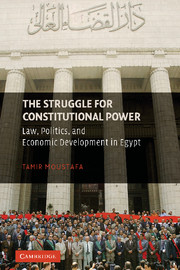
For nearly three decades, scholars and policymakers have placed considerable stock in judicial reform as a panacea for the political and economic turmoil plaguing developing countries. Courts are charged with spurring economic development, safeguarding human rights, and even facilitating transitions to democracy. How realistic are these expectations, and in what political contexts can judicial reforms deliver their expected benefits? This book addresses these issues through an examination of the politics of the Egyptian Supreme Constitutional Court, the most important experiment in constitutionalism in the Arab world. The Egyptian regime established a surprisingly independent constitutional court to address a series of economic and administrative pathologies that lie at the heart of authoritarian political systems. Although the Court helped the regime to institutionalize state functions and attract investment, it simultaneously opened new avenues through which rights advocates and opposition parties could challenge the regime. The book challenges conventional wisdom and provides insights into perennial questions concerning the barriers to institutional development, economic growth, and democracy in the developing world.