To save content items to your account,
please confirm that you agree to abide by our usage policies.
If this is the first time you use this feature, you will be asked to authorise Cambridge Core to connect with your account.
Find out more about saving content to .
To save content items to your Kindle, first ensure no-reply@cambridge.org
is added to your Approved Personal Document E-mail List under your Personal Document Settings
on the Manage Your Content and Devices page of your Amazon account. Then enter the ‘name’ part
of your Kindle email address below.
Find out more about saving to your Kindle.
Note you can select to save to either the @free.kindle.com or @kindle.com variations.
‘@free.kindle.com’ emails are free but can only be saved to your device when it is connected to wi-fi.
‘@kindle.com’ emails can be delivered even when you are not connected to wi-fi, but note that service fees apply.
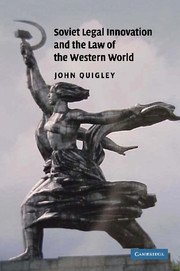
The government of Soviet Russia wrote new laws for Russia that were as revolutionary as its political philosophy. These new laws challenged social relations as they had developed in Europe over centuries. These laws generated intense interest in the West. To some, they were the harbinger of what should be done in the West, hence a source for emulation. To others, they represented a threat to the existing order. Western governments, like that of the Tsar, might be at risk if they held to the old ways. Throughout the twentieth century Western governments remade their legal systems, incorporating an astonishing number of laws that mirrored the new Soviet laws. Western law became radically transformed over the course of the twentieth century, largely in the direction of change that had been charted by the government of Soviet Russia.
Using a conceptual framework, this 2007 book examines the processes of legal reform in post-socialist countries such as China. Drawing on Bourdieu's concept of the 'field', the increasingly complex and contested processes of legal reform are analysed in relation to police powers. The impact of China's post-1978 legal reforms on police powers is examined through a detailed analysis of three administrative detention powers: detention for education of prostitutes; coercive drug rehabilitation; and re-education through labour. The debate surrounding the abolition in 1996 of detention for investigation (also known as shelter and investigation) is also considered. Despite over 20 years of legal reform, police powers remain poorly defined by law and subject to minimal legal constraint. They continue to be seriously and systematically abused. However, there has been both systematic and occasionally dramatic reform of these powers. This book considers the processes which have made these legal changes possible.
The South African Constitutional Court has issued internationally prominent decisions abolishing the death penalty, enforcing socio-economic rights, allowing gay marriage and promoting equality. These decisions are striking given the country's apartheid past and the absence of a grand human rights tradition. By contrast, the US Supreme Court has generally ruled more conservatively on similar questions. This book examines the Constitutional Court in detail to determine how it has functioned during South Africa's transition and compares its rulings to those of the US Supreme Court on similar rights issues. The book also analyzes the scholarly debate about the Constitutional Court taking place in South Africa. It furthermore addresses the arguments of those international scholars who have suggested that constitutional courts do not generally bring about social change. In the end, the book highlights a transformative pragmatic method of constitutional interpretation - a method the US Supreme Court could employ.
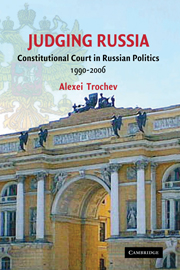
This is a study of the actual role that the Russian Constitutional Court played in protecting fundamental rights and resolving legislative-executive struggles and federalism disputes in both Yeltsin's and Putin's Russia. Trochev argues that judicial empowerment is a non-linear process with unintended consequences and that courts that depend on their reputation flourish only if an effective and capable state is there to support them. This is because judges can rely only on the authoritativeness of their judgments, unlike politicians and bureaucrats, who have the material resources necessary to respond to judicial decisions. Drawing upon systematic analysis of all decisions of the Russian Court (published and unpublished) and previously unavailable materials on their (non-)implementation, and resting on a combination of the approaches from comparative politics, law, and public administration, this book shows how and why judges attempted to reform Russia's governance and fought to ensure compliance with their judgments.
Providing a comprehensive analysis of environmental liability law in Europe, this book offers a general introduction to the status of environmental liability in Europe. It describes the relevant international treaties and the EC-Environmental Liability Directive and discusses the conflict of laws issues regarding transfrontier environmental damage. It also contains the results of a comparative project covering 14 jurisdictions in 13 European countries (Austria, Belgium, England and Wales, Finland, France, Germany, Greece, Ireland, Italy, Netherlands, Portugal, Scotland, Spain, Sweden) on the private law aspects of environmental liability. It addresses the main problems of the application of tort law in environmental law, such as the availability of non-fault liability, the establishment of causation, the scope of available remedies and the issue of legal standing. Due to the very limited harmonizing effect of the EC-Environmental Liability Directive national tort law will keep its importance in the field of environmental liability.
All indications are that the prevention of terrorism will be one of the major tasks of governments and regional and international organisations for some time to come. In response to the globalised nature of terrorism, anti-terrorism law and policy have become matters of global concern. Anti-terrorism law crosses boundaries between states and between domestic, regional and international law. They also cross traditional disciplinary boundaries between administrative, constitutional, criminal, immigration and military law, and the law of war. This collection is designed to contribute to the growing field of comparative and international studies of anti-terrorism law and policy. A particular feature of this collection is the combination of chapters that focus on a particular country or region in the Americas, Europe, Africa, and Asia, and overarching thematic chapters that take a comparative approach to particular aspects of anti-terrorism law and policy, including international, constitutional, immigration, privacy, maritime, aviation and financial law.
An in-depth study, originally published in 2006, of the careers and roles of judges in France, Germany, Spain, Sweden and England, this book is based on original language materials and investigations of judges and judicial institutions in each country. On the basis of these detailed case studies, the book suggests factors that shape the character of the judiciary in different countries, focusing on issues such as women's careers and the relationship between judicial careers and politics. Bell's investigations offer lessons on issues which the English judiciary was having to confront in the period of reform at the time of this book's publication.
There has recently been a remarkable growth in standard-setting with respect to the protection of minorities in international and European law. Layered on top of existing human rights standards relevant to minorities, these developments have resulted in a complex and multi-faceted regime, but one which still does not amount to an integrated and coherent system of minority protection. In addition to providing an up-to-date account of the relevant standards and their development in practice, this collection breaks new ground by seeking to identify the extent to which some integration and coherence (synergy) is emerging as a result of the work of treaty-monitoring bodies and other international institutions. Leading experts on the main instruments and institutions assess matters such as the application of similar principles, the emergence of common themes, explicit cross-referencing between treaty bodies and international institutions and the development of similar working methods.
New democracies around the world have adopted constitutional courts to oversee the operation of democratic politics. Where does judicial power come from, how does it develop in the early stages of democratic liberalization, and what political conditions support its expansion? This book answers these questions through an examination of three constitutional courts in Asia: Taiwan, Korea, and Mongolia. In a region that has traditionally viewed law as a tool of authoritarian rulers, constitutional courts in these three societies are becoming a real constraint on government. In contrast with conventional culturalist accounts, this book argues that the design and functioning of constitutional review are largely a function of politics and interests. Judicial review - the power of judges to rule an act of a legislature or national leader unconstitutional - is a solution to the problem of uncertainty in constitutional design. By providing 'insurance' to prospective electoral losers, judicial review can facilitate democracy.
Providing a detailed analysis of the legal principles in England & Wales, this book looks at governing compensation claims for the lasting trauma caused by child abuse. Its pages discuss the merits and demerits of different forms of action as mechanisms for imposing liability for abuse, how compensable psychiatric damage can be proved and how the law deals with complex issues of duty of care, causation and extending limitation periods in the context of abuse cases. Whilst a substantial portion of the book deals with civil claims by the abused for the psychological harm caused by the abuse, coverage also extends to litigation by other parties involved directly or indirectly in abuse allegations. Also included is a significant comparative element, drawing upon jurisdictions such as Canada, Australia and New Zealand, as a means of speculating how our own legal system might develop.
Constitutional courts have emerged as central institutions in many advanced democracies. This book investigates the sources and the limits of judicial authority, focusing on the central role of public support for judicial independence. The empirical sections of the book illustrate the theoretical argument in an in-depth study of the German Federal Constitutional Court, including statistical analysis of judicial decisions, case studies, and interviews with judges and legislators. The book's major finding is that the interests of governing majorities, prevailing public opinion, and the transparency of the political environment exert a powerful influence on judicial decisions. Judges are influenced not only by jurisprudential considerations and their policy preferences, but also by strategic concerns. By highlighting this dimension of constitutional review, the book challenges the contention that high court justices are largely unconstrained actors as well as the notion that constitutional courts lack democratic legitimacy.
Is there a place for religious language in the public square? Which institution of government is best suited to deciding whether religion should influence law? Should states be required to treat religion and non-religion in the same way? How does the historical role of religion in a society influence the modern understanding of the role of religion in that society? This volume of essays examines the nature and scope of engagements between law and religion, addressing fundamental questions such as these. Contributors range from eminent scholars working in the fields of law and religion to important new voices who add vital and original ideas. From conservative to liberal, doctrinal to post-modernist and secular to religious, each contributor brings a different approach to the questions under discussion, resulting in a lively, passionate and thoughtful debate that adds light rather than heat to this complex area.
Cross-border claims for personal injuries are becoming more common. Furthermore, European nationals increasingly join class actions in the USA. These tendencies have created a need to know more about the law of damages in Europe and America.Despite the growing importance of this subject, there is a dearth of material available to practitioners to assist them in advising their clients as to the heads of damage recoverable in other countries. This book aims to fill that gap by looking at the law in England, Germany and Italy. It sets out the raw data in the wider context of tort law, then provides a closer synthesis, largely concerned with methodological issues, and draws some comparative conclusions.
Justice systems increasingly rely on expert evidence. We are therefore obliged to justify the courts' ability to assess this evidence, especially when the courts must resolve disagreements between experts or address possible bias. By reintegrating contemporary evidence theory with applied philosophy, Deirdre Dwyer analyses the epistemological basis for the judicial assessment of expert evidence. Reintegrating evidence with procedure, she also examines how we might arrange our legal processes in order to support our epistemological and non-epistemological expectations. Including analysis of the judicial assessment of expert evidence in civil litigation (comparing practice in England and Wales with that in the United States, France, Germany and Italy), the book also provides the first detailed account of the historical development of English civil expert evidence and the first analysis of the use of party experts, single joint experts and assessors under the Civil Procedure Rules.
In the debate on the enforcement of competition law, many take the view that Europe should avoid the traps US law has fallen into by admitting excessive litigation. European law should not pave the way for judicial proceedings which ultimately serve the interests of lawyers or other agents rather than injured parties. This inquiry describes the state of remedies in competition law in fifteen European countries, analyses the underlying determinants, and proposes ways of improving the enforcement of competition law. The International and European legal frameworks are presented, as is the approach of US-American law. It is argued that efforts to strengthen private enforcement of antitrust law should benefit from the rich European experience in unfair competition law. The divergence between the two fields of law is not so huge that a completely different treatment is justified. Thus, a specifically European way of competition law enforcement could be developed.
Doping is the biggest problem facing sport. The World Anti-Doping Code has been adopted by sporting organisations worldwide at both national and international level to provide a consistent and harmonised approach to anti-doping measures. The adoption of the Code, and its interpretation and application by the Court of Arbitration for Sport, has brought about great changes in sports law. This book provides a guide to the Code, illustrated through summaries of decisions by the Court of Arbitration for Sport and national level tribunals which show the Code in operation. It will assist all those involved in sport, whether as administrators, coaches or players, together with those who advise in the area and those interested in the operation of the current anti-doping regime. The book also explains the Amendments to the Code agreed in 2007 which are scheduled to come into force by January 2009.
South Africa has disallowed capital punishment for more than a decade, yet violent crime there remains newsworthy even internationally. The crime rate is among the highest in the world. In 2000, a man broke into South African President Thabo Mbeki's house, despite heavy security, and made himself comfortable drinking brandy for several days while Mbeki was out of the country. During my year in South Africa as a Fulbright scholar in 2000, I was told about a man who began a walk across the country to bring national media attention to the high crime rate. Robbers supposedly mugged him on the first day.
Despite evidence that many South Africans favored the death penalty, the new South African Constitutional Court in 1995 ruled the death penalty unconstitutional in State v. Makwanyane & Another (Makwanyane). The Court's president, Arthur Chaskalson, authored the unanimous opinion, though all of the other Justices wrote separate concurrences. The national government supported the challengers because the government was made up of former apartheid opponents who had risked execution. An attorney general (AG) from one of South Africa's provinces defended the law. The decision contrasts sharply with the U.S. Supreme Court's 1976 landmark ruling in Gregg v. Georgia upholding the death penalty's constitutionality.
In 1966, Senator Robert Kennedy travelled to the University of Cape Town in South Africa at the invitation of an anti-apartheid student group. He delivered a speech containing this famous passage:
It is from numberless diverse acts of courage and belief that human history is shaped. Each time a man stands up for an ideal, or acts to improve the lot of others, or strikes out against injustice, he sends forth a tiny ripple of hope, and crossing each other from a million different centers of energy and daring those ripples build a current which can sweep down the mightiest walls of oppression and resistance.
Senator Kennedy's various South African speeches inspired his audiences because he addressed their subordination. Kennedy even alluded to South Africa one day teaching the world about social progress.
This book has compared one product of the post-apartheid era to which Senator Kennedy alluded, the South African Constitutional Court, with the U.S. Supreme Court. This chapter draws some conclusions regarding the South African cases, predicts what the future holds for the Constitutional Court, and briefly assesses recent U.S. Supreme Court developments.
SOUTH AFRICAN JURISPRUDENCE
The South African Constitutional Court's rulings regarding the death penalty, gay rights, and socioeconomic rights have been transformative.
The Court's gender discrimination and freedom of expression decisions are positive but not as significant. The religion and affirmative action cases have been disappointing.
South Africa is internationally known for its bizarre official position on AIDS. Apparently, former President Thabo Mbeki relied on Internet sites to conclude that HIV did not cause AIDS even though this view conflicts with the world's reputable scientific community. Moreover, his Minister of Health, Dr. Manto Tshabalala-Msimang, arrived at a prestigious 2006 international AIDS conference in Toronto promoting lemon and garlic as an AIDS remedy. These stories would be humorous if the government's slow response to the AIDS crisis had not led to so many deaths.
Among those at risk were the unborn babies of HIV-infected pregnant women. Fortunately, the Treatment Action Campaign (TAC), an AIDS advocacy organization, successfully brought suit claiming that the government must distribute the drug, nevirapine, to these women to block transmission of the virus. TAC relied on the South African Constitution's right to health care.
By contrast, the U.S. Supreme Court has rejected arguments favoring socioeconomic rights though it has read others into the U.S. Constitution, including a right to privacy, marriage, and abortion. The Supreme Court has questioned the feasibility of judicial enforcement of positive obligations and raised separation of powers concerns.
The South African Constitutional Court's approach is generally consistent with the International Covenant on Economic, Social, and Cultural Rights (ICESCR), as well as the approaches taken by a few nations like India. The ICESCR requires governments to affirmatively provide socioeconomic necessities on the theory that liberty presumes subsistence.
Affirmative action based on race is highly controversial both in South Africa and the United States. Moreover the South African Constitutional Court, as shown by its ruling in Hugo (see Chapter 4), analyzes affirmative action differently than does the U.S. Supreme Court. This chapter compares leading racial affirmative action cases from these countries to learn more about their approaches and to assess whether the decisions facilitate social progress.
There are important national differences. For example, South Africa's apartheid ended more recently than American slavery or American segregation, and South African blacks are a political majority. South Africa's recent history of oppression therefore makes it surprising that the country's courts have been tough on affirmative action, requiring that those burdened receive procedural and other protections. The U.S. Supreme Court's decisions in this area are also surprising in that acceptable American plans must support First Amendment values, not equalization. The Supreme Court's recent rejection of public school racial assignments highlights this limitation. Thus, the strong differences in social context do not result in precisely the distinctions in constitutional doctrine that one might expect.
SOUTH AFRICAN JURISPRUDENCE
The Bill of Rights affirmative action provision, section 9(2), reads as follows:
Equality includes the full and equal enjoyment of al rights and freedoms. To promote the achievement of equality, legislative and other measures designed to protect or advance persons, or categories of persons, disadvantaged by unfair discrimination may be taken.