To save content items to your account,
please confirm that you agree to abide by our usage policies.
If this is the first time you use this feature, you will be asked to authorise Cambridge Core to connect with your account.
Find out more about saving content to .
To save content items to your Kindle, first ensure no-reply@cambridge.org
is added to your Approved Personal Document E-mail List under your Personal Document Settings
on the Manage Your Content and Devices page of your Amazon account. Then enter the ‘name’ part
of your Kindle email address below.
Find out more about saving to your Kindle.
Note you can select to save to either the @free.kindle.com or @kindle.com variations.
‘@free.kindle.com’ emails are free but can only be saved to your device when it is connected to wi-fi.
‘@kindle.com’ emails can be delivered even when you are not connected to wi-fi, but note that service fees apply.
Chapter 4 juxtaposes two interpretations of The Concept of the Political which seek to clarify a few ambiguities that beset this seminal text: the exceptionalist and the concretist reading. The former reads The Concept of the Political against the background of Political Theology as a key complement to the exceptionalist decisionism of 1922. Conversely, the concretist reading advocated in this chapter teases out Schmitt’s growing interest in the issue of state pluralism and the threat he thought it was posing to the state monopoly on force. On the concretist reading, the state in The Concept of the Political is tasked with guarding against the actualisation of political conflicts, as they could draw the state community to destruction. This implies that, in Schmitt’s political theory, conflict is a condition that the state should strive to avert. State politics is, and should persist as, a pacified condition in which the members of the political community owe their full loyalty and allegiance to the state authority. By interpreting The Concept of the Political as inaugural of a whole new phase in Schmitt’s thinking, the concretist reading provides the ground for a thorough analysis of his institutional theory of the early 1930s.
Chapter 7 centres particularly on the works published after the end of World War Two. While Chapter 2 contended that Schmitt was not born as a decisionist, Chapter 7 advances the claim that he did not conclude his career by adopting (or revisiting) his former decisionist approach. Quite the opposite, from the post-war years onwards decisionism faded out. After the major amendment of the early 1930s, whereby the decision was turned into a selective filter, the last remnants of decisionism were expunged. Therefore, whilst the concrete-order thinking of 1934 was still marked by a difficult cohabitation of decisionism and institutionalism, post-war texts did away completely with it so as to pave the way for Schmitt’s last, juristic version of institutionalism. This peculiar kind of institutionalism culminates in an underrated essay, The Plight of European Jurisprudence, where Schmitt affirmed the independence of jurisprudence from any external force and thereby postulated its self-sufficiency even as a source of law. The political decision is replaced by a penetrating, meticulous and inherently acephalous legal practice that is meant to buttress the evolution of social phenomena with a view to obtaining a legal order that is internally consistent and materially sustainable.
Chapter 3 challenges the connection that is alleged to exist between Political Theology (1922) and The Concept of the Political (1927). It claims that this connection was a later construal by Schmitt himself, who self-interestedly recognised its relevance in the light of various remarks by coeval critics. To substantiate this claim, the chapter takes issue with three of the most serious among the numerous contemporary lines of criticism levelled against Schmitt’s decisionism. The first was that the idea of the autonomy of the political favoured an existential irrationalism that could open the Pandora’s box of the centrifugal forces yielded by the political. The second line of criticism, instead, centred on the fact that such a slippery slope could also be the consequence of another feature of exceptionalist decisionism – that is, the fact that it made no room for any normative criterion. A final and more radical critical line contended that in the way it was presented in his canonical texts, Schmitt’s exceptional decisionism did not stand on its own feet.
During his long and controversial life as a man and as a scholar, Schmitt presented himself in very different guises and with varying degrees of credibility. This attitude goes far beyond his countless, protean self-portraits (sometimes detailed, other times just sketched, and yet always revealing) which he created, mostly for self-serving reasons, throughout an existence and a career that were all but smooth – including those that were meant to debunk rather fanciful interpretations. On several occasions Schmitt engaged steadily in sustained confrontations with a number of authors, more often than not to the point of identifying himself with, and even of wearing the mask of, the counterpart. This is the case with at least six figures, each one being halfway between an alter ego and a Doppelgänger: three political philosophers, two fictional characters and a jurist. In order of historical appearance (real or fictional): Epimetheus (in the Christian version), Niccolò Machiavelli, Thomas Hobbes, Juan Donoso Cortés, Friedrich Carl von Savigny and Benito Cereno. Still, sooner or later, everyone loses their magic, and Schmitt was no exception. This is why in his last long interview – he had just turned 95 and his health was failing – Schmitt took all his masks off and proudly claimed: ‘I feel one hundred percent a jurist and nothing else. And I do not want to be anything else. I am a jurist and I remain a jurist and I die as a jurist … .’1 This is his last will as well as his last self-interpretation.
It is somewhat ironic that this book publishes with the centenary of Political Theology, first published in 1922. In the end, one of the main claims we shall make here is that Carl Schmitt’s celebrated essay has been unduly overemphasised and that it formulated a theory of law and a conception of normality that he himself dismantled a few years after its publication. A related claim will be that interpretations that identify a connection between Political Theology and successive works such as The Concept of the Political (1928) and Constitutional Theory (1928) are wrong in at least one important respect: through those works, Schmitt tried to pull himself out of the quagmire in which he was bogged down in 1922 – namely, the problematic conception that we shall dub ‘exceptionalist decisionism’. But we shall have to go further. Works that are coeval with Political Theology, such as Dictatorship (1921) and Roman Catholicism and Political Form (1923), offer much leeway for criticising exceptionalist decisionism, either because the notions of exception and decision are thinner and more tenable (as is the case with Dictatorship), or because there is no room at all for any of them (as is the case with Roman Catholicism and Political Form). In sum, as a celebration of Political Theology, this book cuts a poor figure.
Chapter 1 offers an unconventional reading of Schmitt’s emblematic work Political Theology (1922) – one that can be dubbed ‘jurisprudential’. Contrary to prevailing interpretative frames, the jurisprudential reading has it that in Political Theology the political, foundational problem of where the political order comes from was of minor interest to Schmitt. Rather, he concerned himself with the vexed jurisprudential question of what allows describing a set of different norms and procedures as a uniform legal order. In this light, Political Theology should be regarded as an inquiry into the identity and the unity of the legal order in the first place. The chapter goes on to argue that Schmitt’s mobilising theology and theological concepts were instrumental in vindicating his answer to this jurisprudential question. This argument will be propaedeutic to a far-reaching revision of Schmitt’s theory as an investigation into how the law ensures the stability of social life. If this reading holds true, then the role of Political Theology in Schmitt’s overall production should be largely scaled down.
Chapter 2 focuses on Schmitt’s early output (1910–21), in particular Über Schuld und Schuldarten. Eine Terminologische Untersuchung (On Guilt and the Types of Guilt: A Terminological Investigation) (1910) and Statute and Judgment: An Investigation into the Problem of Legal Practice (1912). The chapter illustrates how, between the 1910s and the beginning of the 1920s, Schmitt’s conception of law and legal practice was scarcely reconcilable with the exceptionalist decisionism of Political Theology (1922). By rejecting a ‘continuist’ interpretation, the chapter claims that Schmitt’s Political Theology effected a break with his prior theorisation, whereas his writings from the 1910s anticipated constitutive features of his legal institutionalism of the 1930s, particularly the close relation between normality and the judicial practice. Further, the chapter makes the case that the so-called ‘decisionist period’ (1921–8) can be portrayed as exclusively decisionist only if one neglects a few important lines of thought that Schmitt developed in other texts from those same years. Finally, even if one remains blind to the various tensions between Schmitt’s various lines of thought between 1921 and 1928, the books that open and close that period, namely, Dictatorship (1921) and Constitutional Theory (1928), do not lend themselves to a decisionist interpretation.
Chapter 6 focuses on the price Schmitt had to pay to amend his previous exceptionalist jurisprudence, as his institutional theory of the 1930s turned out to be more conservative than his decisionism of the 1920s. He came to identify more clearly and more programmatically the origin of the legal order in the (vicious) circle between institutional practices and their selection on the part of a body of state law officials who oversee the realisation of a societal project devised by a Leader. In this novel framework, the law is deemed to effect a transformation of what is normal within few institutional settings into what is legally binding for the whole population. The chapter first examines Schmitt’s selective use of Maurice Hauriou’s and Santi Romano’s institutional theories and explains how his concrete-order thinking betrayed the institutional tradition in a few important respects. It then focuses on some central features of concrete-order thinking, such as the nature of legal norms and the role of general clauses. The last part of the chapter draws on influential Italian jurist Constantino Mortati’s interpretation of Schmitt’s concrete-order theory as Mortati struggled to elucidate the role of concreteness within post-World War Two constitutional regimes.
Chapter 5 investigates the notion of institution in Schmitt’s thinking. It begins by debating a recent interpretation of his work that attaches particular importance to his enduring concern with the life of institutions and how they ensure the stability of a community’s political life. The chapter first examines the strengths of this ‘pan-institutionalist’ reading and then digs out its main flaw as it downplays how Schmitt’s concept of institution changed over time. While Schmitt harboured a ‘thin’ notion of institution until the end of the 1920s, as an agency or public body (say, the state or the Church) endowed with organisational power, he headed towards a ‘thick’ conception after his encounter with Maurice Hauriou’s and Santi Romano’s institutional theories. The chapter continues by unearthing the main features of Schmitt’s thicker notion of institution and how he came to elaborate on his concrete-order thinking in On the Three Types of Juristic Thought (1934). This account is key to understanding the way he overturned the conception of normality that came with his previous exceptionalist decisionism. In 1934, the exception was eventually demoted to a truly exceptional case to be warded off, while normality was presented as the seedbed of legal normativity.
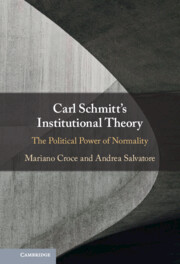
In 1922, Carl Schmitt penned Political Theology, the celebrated essay in which he elaborated on the notorious theory that the heart of politics lies in the sovereign power to issue emergency measures that suspend the legal order. Ever since, Schmitt's thinking has largely been identified with this concept, despite him renouncing it over time. Offering a comprehensive analysis of Schmitt's writings, Carl Schmitt's Institutional Theory provides an ambitious, novel perspective on Carl Schmitt and his legal and political thinking. By delving into Schmitt's output over his decades-long career, Mariano Croce and Andrea Salvatore explore Schmitt's varied and developing thoughts on exceptionalism, societal pluralism and the law as the progenitor and enforcer of normality. Challenging dominant interpretations, Croce and Salvatore dethrone the false centrality of certain key texts, and instead provide a more unified, coherent account of his institutional theory from across his long and controversial career.
Aristotle said that the only way to establish first principles is by dialectical argument. This book has presented an extended dialectical argument. We have seen how modern philosophers have tried to justify liberal institutions. Some did so by attaching a normative value to pleasure or preference satisfaction. Yet it is hard to believe that all pleasures or preferences are worthwhile. Some embraced what we have called a principle of universal concern: one must apply the same standard to others as to oneself. They had trouble explaining what that standard should be. Some attached a normative value to self-expression but then they had to explain why, in itself, self-expression is of value.
Chinese and Western classical thought began with the challenge of Confucius and Socrates to the way most people live their lives. They neglect what is “worthy.” They “undervalue the greater, and overvalue the rest.”
When asked why any life was worthy or of value, philosophers in both traditions said that normative standards are grounded in human nature. Yet if it is so, why do people neglect what is worthy and undervalue what is good? Why should human beings have any difficulty living the life that is natural to them? All human beings have desires and fears that are obstacles to living a good life. If these desires and fears also arise from human nature, they would seem to be part of that nature as much as inclinations toward good. Why would an evil life be any less human?
Rationalism flourished in the seventeenth and eighteenth centuries. As John Finnis and Germain Grisez noted,1 its metaphysics can be traced to the theologian Francisco Suárez (1548–1617). He was one of the last of the late scholastics.
Suárez, unlike Aristotle and Aquinas, believed that that the concepts of all things that are or could be are timeless and invariable. Consequently, so are the precepts of natural law. Moral knowledge is knowledge of these precepts. Moral action is conformity to them. In reaching those conclusions, he broke with the way human nature had been understood in the Aristotelian tradition. In these respects, he was followed by two of the most influential rationalist philosophers, Gottfried Wilhelm Leibniz (1646–1716) and Christian Wolff (1679–1754).
In both classical traditions, human nature is a source of normative standards. Human nature is universal. Normative standards may not be the same for different individuals, in different times and places, or under different circumstances. Normative standards must be as invariable as human nature and yet they must vary. How is that possible?
The classical traditions that we will study began in China with Confucius, and, in the West, with Socrates, who was born less than thirty years after Confucius died.
Both had a sense of divine mission although neither said a great deal about the divine. Both regarded political life as one of the noblest of vocations yet neither of them held political office. They were teachers. The task they set for themselves was to help others acquire the moral qualities they needed to live a worthwhile life. Both believed that there was no better qualification for political life than the possession of these qualities.