To save content items to your account,
please confirm that you agree to abide by our usage policies.
If this is the first time you use this feature, you will be asked to authorise Cambridge Core to connect with your account.
Find out more about saving content to .
To save content items to your Kindle, first ensure no-reply@cambridge.org
is added to your Approved Personal Document E-mail List under your Personal Document Settings
on the Manage Your Content and Devices page of your Amazon account. Then enter the ‘name’ part
of your Kindle email address below.
Find out more about saving to your Kindle.
Note you can select to save to either the @free.kindle.com or @kindle.com variations.
‘@free.kindle.com’ emails are free but can only be saved to your device when it is connected to wi-fi.
‘@kindle.com’ emails can be delivered even when you are not connected to wi-fi, but note that service fees apply.
There are three pillars of jurisprudence: moral theorizing (reflected in natural law, but not exclusive to it); analytic theorizing (reflected in positivism); and sociolegal theorizing (reflected in legal realism). Legal realism exemplifies this third approach to international law theory beyond natural law and positive law covered in Chapters 2 and 3, and it provides a foundation for many theoretical approaches in the chapters that follow. For legal realists, jurisprudence should be conceived not just in terms of what law “is” or “ought” to be, but also in terms of how law obtains meaning, operates, and changes through practice.
In the United States (US), legal realism grew out of and continues to have parallels with European sociolegal thought (sometimes referred to as European legal realism), as well as sociolegal thought around the world. It built from sociological jurisprudence that developed in Europe and the United States in the early twentieth century.
Designing Indicators for a Plural Legal World engages with the role of quantification in law, and its impact on law and development and judicial reform. It seeks to examine how different institutions shape and influence the making and use of legal indicators globally. This book sheds light on the limitations of existing quantification tools, which measure rule of law due to their lack of engagement with contexts and countries in the Global South. It offers an alternative framework for measurement, which moves away from an institutional look at rule of law, to a bottom up, user centered approach that places importance on the lives that people lead, and the challenges that they face. In doing so, it offers a way of thinking about access to justice in terms of human capabilities.
The emerging society of networks is no longer tied to territorial differentiation. The network form causes a rupture with established models of liability (individual or organisational liability), undermines the public/private liability divide, and also their regulation, now beyond the state. This third rupture in the knowledge base of society creates profound challenges for tort law. So far, the response in tort law has largely been deferential to definitions of acceptable risk that emerge from governance networks beyond territorial borders. This is explained by the uneven de-territorialisation of functional systems (economy vs law, and politics), and in particular by the failure of tort law to develop a convincing model of ascription for network failures. The chapter has two main tasks; first, it locates these problems within EU law because it is considered an avant-garde experiment in governing a society of networks. It is claimed that its product liability law offers novel solutions to problems of risk-responsibility under conditions of uncertainty. It also deepens our understanding of tort law as a venue for providing contestory, discursive spaces when systems discourses collide.
In this book, it has been argued that tort law in the nation-state context has evolved two primary normative models of liability, namely individual responsibility and organisational liability. Whereas the former rests on subjective fault, albeit objectively defined (community standard of conduct) the latter rests on liability for typical and, therefore, foreseeable risks. Both forms of liability developed within the nation-state and apply with modifications to both private parties and the state. Both forms of liability additionally are second-order normative models of liability in an acentric society. A ‘top-down’ public law understanding of the law overestimates this significantly. By contrast, private law with its emphasis on private ordering and how the law tracks rather than determines ‘the reasonable expectations of honest men’ better reflects the relationship between legal system and society as a plurality of normative orders. In the society of individuals, will and fault reflect this acentricity and constitute its legal buttress. They are tied to the knowledge base of society via bridging concepts such as reasonableness. However, when the knowledge base of the society of individuals ruptured, caused by the rise of organisations, the law was reshaped in light of these organisational forms taking advantage of their capacity for planning and collective action. Reconciling groups, as placeholders for different functional discourses, was in the heyday of the nation-state the role of the state. In systems theory terminology, the state’s role is that of mediator between different functional systems or different normative orders. The law was an important means of ensuring the positive integration society by mediating these different normative orders.
If Chapter 3 situated the problems facing contemporary tort law within EU law, it did not provide a comprehensive or novel model of liability. In Chapter 4, the key argument is that network liability in its incipient form can be detected in the law on 'private' gatekeepers of product liability, and this model can and should be applied equally to the state through reimagining Francovich liability. This move will also assist in developing the liability criteria, and the concept of a sufficient serious breach of EU law offers a coherent and normatively principled standard for the liability of secondary actors in public/private governance networks. It is then underlined that different existing models of liability should be understood as different means of recovery in networks. The central point is that these three models of liability – individual, organisational and network – should be placed within a more encompassing normative concept of network responsibility. This model of responsibility can, and should, be applied beyond the context of product liability as a template for solving problems of attribution and imputation in governance networks. The idea is tested in the context of value chain liability.
This chapter deepens the insight that tort law fulfils a societal role. It locates the classical model of tort liability, namely individual responsibility, within a wider privatist societal constitution. Both contract and tort, however, are understood as second order observations of the knowledge base of society, which has broken free of tradition and centralized authority in modernity. Therefore, private law models its dynamic knowledge base, and provide a constitution of civil society that unleashes experimentation and enables a 'relational rationality' to unfold. The gradual emergence classical tort law is documented, and its constitutional role underscored through examples from of private and public liability in English, French and German law. The society of individuals on which the law of torts is modelled, however, begins to rupture by the end of the 19th century, and it becomes increasingly difficult to frame all legal problems as issues of corrective justice. Nonetheless, the legacy of classical tort law, is a model of individual responsibility, which continues to shape scholarly engagement with tort law, and continues to impact on how legal problems are perceived in law.
The second phase in tort law develop relates to its reception of the society of organisations, which represents an evolution in the law's knowledge base by which large public and private organisations become central to knowledge generation and management. This is accompanied by the rise of expertise and insurance, and a break between expert knowledge and distributed experience as the knowledge base of society. This is patterned onto the law by the rise in 'vertical vicarious liability' or organisational liability, whatsoever its doctrinal nomenclature at the turn of the twentieth century. Calculable risk replaces fault as a key legal concept in the attribution of acts and omissions, and tort law is increasingly conceptualised as concerned with risk management against a background of the providential state. However, the model of organisational liability that develops remains a model of responsibility and should be characterised as a form of weak corrective justice or organisational moral responsibility. These changes have a profound impact on the law, which is documented by reference public and private liability in French, UK and German law, but reach their limits with the rise of network governance.
The Introduction situates the book in a broader context of tort theory. The key argument advanced is that with the rise of transnational regulation and law-making, the settled academic debates in tort theory, whether corrective justice theory or law and economics, are inadequate explanations of the social role and function of tort law today. The Introduction, then, develops an alternative theoretical framework for tort law rooted in Ladeurian systems theory, which focues on the societal role of private (tort) law. The basic argument is that it is not feasible or convincing to present tort law apart from its societal knowledge base from which it draws its models of liability. It is then argued that when tort law is understood in its societal role at a transnational and European level, new theoretical insights and models of liability can be perceived. The new model that emerges at a European level in products’ liability case law is a form of network responsibility, which focuses on the role of peripheral parties to torts, which fulfil normatively secondary roles in the society of networks. This can become a wider template for tort liability in governance networks, and this argument will be deepened in Chapter 4 using examples from value chain liability.
For centuries, the starting points for serious thought about ethics, justice, and government were traditions founded, in China by Confucius, and in the West by his near contemporary Socrates. In both classical traditions, norms were based on human nature; to contravene these norms was to deny part of one's humanity. The Chinese and Western philosophical traditions have often been regarded as mutually unintelligible. This book shows that the differences can only be understood by examining where they converge. It describes the role of these traditions in two political achievements: the formation of the constitutions of Song dynasty China and the American Republic. Both traditions went into eclipse for similar reasons but with quite different consequences: in China, the growth of absolutism, and in the West, the inability of modern political and ethical thought to defend the most fundamental values.
A vast literature has developed probing the law's aversion to statistical/probability evidence in general and its rejection of naked statistical evidence in particular. This literature rests on false premises. At least so far as US law is concerned, there is no general aversion to statistical forms of proof and even naked statistics are admissible and sufficient for a verdict when the evidentiary proffer meets the normal standards of admissibility, the most important of which is reliability. The belief to the contrary rests upon a series of mistakes: most importantly, mismodeling of the structure of legal systems and the nature of common law decision making. Contributing to these mistakes is the common methodology in this literature of relying on weird hypotheticals that mismodel the underlying legal relations and contain impossible epistemological demands. Collectively, these phenomena have distracted attention from issues that actually affect real legal systems.
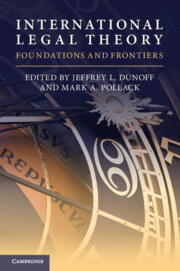
Over the past decades international affairs have been increasingly legalized. International law has dramatically expanded into new fields and taken on new challenges. Despite this development, there has been little in-depth scholarship on what impact these changes have had on the field of international legal theory, how it is taught, and where it is going. This volume investigates the major developments in the field and explores the core assumptions and concepts, analytical tools, and key challenges associated with different approaches. An outstanding team of legal academics provides an accessible overview of competing theoretical movements, and a more in-depth understanding of the strengths, preoccupations, insights, and limits of those schools of thought. The contributions provide an authoritative account of current thinking about the theoretical foundations of contemporary international law and will serve as an indispensable resource for students, scholars, and practitioners.
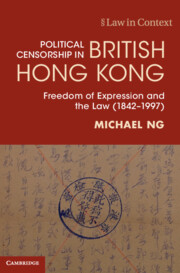
Drawing on archival materials, Michael Ng challenges the widely accepted narrative that freedom of expression in Hong Kong is a legacy of British rule of law. Demonstrating that the media and schools were pervasively censored for much of the colonial period and only liberated at a very late stage of British rule, this book complicates our understanding of how Hong Kong came to be a city that championed free speech by the late 1990s. With extensive use of primary sources, the free press, freedom of speech and judicial independence are all revealed to be products of Britain's China strategy. Ng shows that, from the nineteenth to the twentieth century, Hong Kong's legal history was deeply affected by China's relations with world powers. Demonstrating that Hong Kong's freedoms drifted along waves of change in global politics, this book offers a new perspective on the British legal regime in Hong Kong.