To save content items to your account,
please confirm that you agree to abide by our usage policies.
If this is the first time you use this feature, you will be asked to authorise Cambridge Core to connect with your account.
Find out more about saving content to .
To save content items to your Kindle, first ensure no-reply@cambridge.org
is added to your Approved Personal Document E-mail List under your Personal Document Settings
on the Manage Your Content and Devices page of your Amazon account. Then enter the ‘name’ part
of your Kindle email address below.
Find out more about saving to your Kindle.
Note you can select to save to either the @free.kindle.com or @kindle.com variations.
‘@free.kindle.com’ emails are free but can only be saved to your device when it is connected to wi-fi.
‘@kindle.com’ emails can be delivered even when you are not connected to wi-fi, but note that service fees apply.
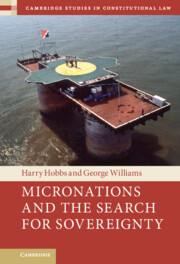
Political disagreement is a fact of life. It can prompt people to stand for public office and agitate for political change. Others take a different route; they start their own nation. Micronations and the Search for Sovereignty is the first comprehensive examination of the phenomenon of people purporting to secede and create their own country. It analyses why micronations are not states for the purposes of international law, considers the factors that motivate individuals to separate and found their own nation, examines the legal justifications that they offer and explores the responses of recognised sovereign states. In doing so, this book develops a rich body of material through which to reflect on conventional understandings of statehood, sovereignty and legitimate authority. Authored in a lively and accessible style, Micronations and the Search for Sovereignty will be valuable reading for scholars and general audiences.
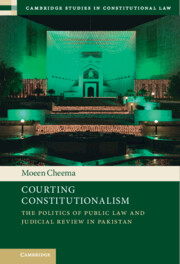
Over the last decade, the Supreme Court of Pakistan has emerged as a powerful and overtly political institution. While the strong form of judicial review adopted by the Supreme Court has fostered the perception of a sudden and ahistorical judicialisation of politics, the judiciary's prominent role in adjudicating issues of governance and statecraft was long in the making. This book presents a deeply contextualised account of law in Pakistan and situates the judicial review jurisprudence of the superior courts in the context of historical developments in constitutional politics, evolution of state structures and broader social transformations. This book highlights that the bedrock of judicial review has remained in administrative law; it is through the consistent development of the 'Writ jurisdiction' and the judicial review of administrative action that Pakistan's superior courts have progressively carved an expansive institutional role and aggrandised themselves to the status of the regulator of the state.
Moeen Cheema, Australian National University, Canberra,David Dyzenhaus, University of Toronto,Thomas Poole, London School of Economics and Political Science
As Pakistan emerged from the shadows of military rule, dismembered and disenchanted, democratic governance and progressive politics promised a better future for the masses. The adoption of Pakistan’s first constitution by an elected assembly in 1973 added to the optimism for constitutionalism and rule of law. This optimism was quickly dispelled as the elected government of Zulfiqar Ali Bhutto (1970–76) proved itself to be as authoritarian as its predecessors and very much within the mould of postcolonial governance. The courts, which attempted to rely on the new constitution to protect fundamental liberties and provide a voice to the opposition, were soon undermined by constitutional amendments designed to curtail judicial review. Chapter 4 describes this failure of formal democratic constitutionalism in the face of an elective dictatorship. It also charts how, nonetheless, the superior courts insisted on minimal procedural safeguards against the enforcement of state security and public order laws and pushed the envelope of the judicial review of executive action.
Moeen Cheema, Australian National University, Canberra,David Dyzenhaus, University of Toronto,Thomas Poole, London School of Economics and Political Science
This paper offers a novel substantive justification for mandatory electoral quotas—e.g., gender or racial quotas—and a new methodological approach to their justification. Substantively, I argue for a political egalitarian account of electoral quotas. Methodologically, based on this account and a political egalitarian grounding of political participatory rights, I offer an alternative to the External Restriction Approach to the justification of electoral quotas. The External Restriction Approach sees electoral quotas as at best justified restrictions on political participatory rights. I argue for the Internal Restriction Approach instead, which can justify electoral quotas by specifying the pro tanto scope of political participatory rights rather than by justifying restrictions on the pro tanto scope of these rights. On this approach, adequately set electoral quotas do not even conflict with and are not balanced against political participatory rights, while electoral quotas—when justified—are pro tanto required rather than merely permitted.
Moeen Cheema, Australian National University, Canberra,David Dyzenhaus, University of Toronto,Thomas Poole, London School of Economics and Political Science
As Pakistan emerged from military rule upon the death of General Zia in a plane crash in 1988, it underwent a new governmental experience marked by tussles between unsettled elected governments, a constitutionally empowered civilian presidency and a military establishment that covertly exercised considerable power. Chapter 6 unveils how the superior courts utilised the available political space to engineer a dramatic expansion of public law and carved a role for themselves as an important institution of the state. As the civil state’s machinery became the turf of power struggles, safeguarding its independence and ensuring its rule-boundedness emerged as a key pillar of the superior courts’ Writ jurisdiction. The superior courts also began to develop a more robust jurisprudence of rule of law and fundamental rights, while the Supreme Court utilised its Original jurisdiction for the first time to institute Public Interest Litigation. Nonetheless, recurrent involvement in matters of pure politics and governmental change resulted in direct confrontations between the judiciary and elected governments, and ultimately the politicisation of judicial review.
Moeen Cheema, Australian National University, Canberra,David Dyzenhaus, University of Toronto,Thomas Poole, London School of Economics and Political Science
Chapter 5 highlights the emergence of a distinctly praetorian governmentality in the next cycle of military rule in the 1980s. Having displaced an elected government, the military regime of General Zia ul Haq (1977–88) set about the task of refining the blueprint for military rule. What was distinctive, however, about this form of praetorian governmentality as compared to the earlier period of military rule was the hegemonic ideation of political legitimacy predicated on religion. The military regime visibly embarked on the agenda of 'Islamising' the constitution and the laws. New Shariat courts were given unprecedented powers of judicial review of legislation for conformity with Islamic law at the same time that the fundamental rights provisions of the Constitution remained under suspension, and the superior courts’ Writ jurisdiction was incapacitated. Nonetheless, Islamisation also enabled the superior courts to re-orient their public law jurisprudence and to bolster their legitimacy. Pakistan’s appellate courts learnt to capitalise on this new rhetoric and restructured a more assertive form of judicial review grounded in the normative bedrock of Islamic legality.
Moeen Cheema, Australian National University, Canberra,David Dyzenhaus, University of Toronto,Thomas Poole, London School of Economics and Political Science
Chapter 2 provides an account of the emergence of an inchoate ‘Writ’ jurisdiction in the late colonial period in British India. It is the limited availability and partial success of a procedural form of rule of law in moderating the authoritarianism of the colonial state, despite its larger failures, that account for its lasting resonance amongst segments of the colonised elites. In the first decade of postcolonial existence, as the Constituent Assembly of Pakistan failed to draft a constitution until 1956, The Government of India Act 1935 remained the interim framework. The role of the newly empowered superior courts will be particularly scrutinised with regard to their alleged complicity in the uprooting of constitutionalism and democracy in the first decade of the republic’s existence. However, despite their seeming subservience to the executive the courts continued to push the political elites that came to dominate the new state towards framing a republican constitution. Most notably, the dislocations in the state structure caused by the partition of British India also gave the courts the space to extend their administrative law jurisdiction through the newly-established ‘Writ jurisdiction’ over a bureaucracy that was in the process of reconstruction.
Moeen Cheema, Australian National University, Canberra,David Dyzenhaus, University of Toronto,Thomas Poole, London School of Economics and Political Science
Chapter 7 dissects the subtle shifts in state structure and power relations during the third cycle of military rule in Pakistan which for the first time was characterised by a successful hybridity of a military–civil composite. When General Pervez Musharraf overthrew an elected government in October 1999 the familiar architecture of military rule was resurrected. However, unlike previous military regimes General Musharraf was successful in holding elections and managing a symbiotic relationship with a civilian government whereby a semblance of democratic governance could be upheld. The Supreme Court once again validated the military takeover and the continuity of judicial review of executive action initially aligned with the regime’s proclaimed agenda of the structural reform of the state and anti-corruption drive. However, when Chief Justice Iftikhar Chaudhry assumed office in 2005 this accommodation between the military-dominated regime and the courts began to fracture. With impending elections in 2007, the regime dismissed the Chief Justice sparking the protest movement by the lawyers that would ultimately pave the way for another transition to civil democratic rule, as well as for the restoration of an assertive ‘Chaudhry Court’.
Moeen Cheema, Australian National University, Canberra,David Dyzenhaus, University of Toronto,Thomas Poole, London School of Economics and Political Science
Chapter 3 charts the consolidation of judicial review during the first period of direct and indirect martial rule under the Ayub regime (1958–1968). Despite the military–bureaucratic authoritarianism of the Ayub era and the judicial validation of Martial Law, the courts managed to preserve the judicial review of bureaucratic action. The exercise of the Writ jurisdiction aligned with the priorities of a Martial Law regime that was attempting to subdue and co-opt a hitherto powerful bureaucracy. In the post-Martial Law phase, the promulgation of the 1962 Constitution provided the courts with the basis to consolidate the foundations of the Writ jurisdiction along three axes – formal constitutionalism, administrative law and procedural safeguards against the abuse of public order and state security laws – which have remained at the core of the superior courts’ definition of rule of law in the decades since.
Moeen Cheema, Australian National University, Canberra,David Dyzenhaus, University of Toronto,Thomas Poole, London School of Economics and Political Science
In addition to providing an overview of the book and its methodological orientation, the introductory chapter highlights three key facets of constitutionalism in Pakistan. Firstly, it is through the consistent development of the judicial review of administrative action, even under military rule, that Pakistan’s superior courts have acquired the power to mediate inter-state tensions. Secondly, the courts’ increasing capacity to mediate state–society dialectics – arising out of the demands of various groups and classes on the periphery of the state – also had much of its basis in the judicial review of executive action. Thirdly, Pakistan’s courts strategically re-situated themselves from time to time and re-fashioned their role in accordance with fundamental shifts in constitutional politics, state structure and state-society dialectics charted in this book.
Moeen Cheema, Australian National University, Canberra,David Dyzenhaus, University of Toronto,Thomas Poole, London School of Economics and Political Science
While the ambitions of this book are by and large localised – to explain the historical evolution of public law and judicial review in Pakistan – it is hoped that such a grounded description will also provide an insight into the theorisation of the judicialisation of politics worldwide. The concluding chapter situates the history of judicial review in Pakistan within three broad frameworks that are generally employed within comparative public law literature for describing and analysing the judicialisation of politics in a given polity. Ultimately, however, this book argues that a deeply descriptive account of the non-linear expansion of judicial power in Pakistan may help highlight how fluid and dynamic the process of judicialisation can be. Furthermore, at any given time a range of factors and players may contribute to the expansion of and/or resistance to a more assertive judicial role. Therefore, this book represents a call to eschew over-reliance on global frameworks to explain and evaluate the increasing significance of courts anywhere and everywhere, but instead to situate the politics of particular courts in specific historical and political contexts.
Moeen Cheema, Australian National University, Canberra,David Dyzenhaus, University of Toronto,Thomas Poole, London School of Economics and Political Science