To save content items to your account,
please confirm that you agree to abide by our usage policies.
If this is the first time you use this feature, you will be asked to authorise Cambridge Core to connect with your account.
Find out more about saving content to .
To save content items to your Kindle, first ensure no-reply@cambridge.org
is added to your Approved Personal Document E-mail List under your Personal Document Settings
on the Manage Your Content and Devices page of your Amazon account. Then enter the ‘name’ part
of your Kindle email address below.
Find out more about saving to your Kindle.
Note you can select to save to either the @free.kindle.com or @kindle.com variations.
‘@free.kindle.com’ emails are free but can only be saved to your device when it is connected to wi-fi.
‘@kindle.com’ emails can be delivered even when you are not connected to wi-fi, but note that service fees apply.
We want to describe how judges play by, and with, legal rules. It appears that, on the one hand, even in cases in which the legal basis is thin or absent, judges seek rules on which to base their decisions. In that sense, judges are positivist legal practitioners who need legal rules to perform their professional duties. On the other hand, however, moral considerations seem to deeply influence the same judges’ legal cognition. We aim to show how this unfolds in the concrete settings of four countries – Indonesia, Lebanon, Egypt, and Senegal – in cases relating to male homosexuality. First, we outline the legal and judicial frameworks of the four countries being studied. Second, we concentrate on cases in these countries related to homosexuality. On the basis of these court cases, third, we analyze the reference to rules as the core of the life of law, although in a qualified manner. Finally, we draw together the main lines of the debate regarding rules, their indeterminacy and their interpretation, stressing the usefulness of a praxeological treatment centered on reasoning, justification, and decision-making practices to better understand the ways in which law lives through rules.
Joseph Capizzi lays out Catholic just war theory and its tie to the Church’s teaching on conscience. The scriptural context for just war teaching is Jesus’ discourse in John 14, in which he promises to give peace, but not as world gives. The world’s peace is often tainted with the temptation to sacrifice neighbors and innocents. War can be an expression of conscience, but only if ordered toward peace, guided by morality, and open always to the conversion of self and neighbor. The just war approach excludes objectives such as vengeance. It prohibits direct harm to noncombatants. Both sides in a conflict are potential members of the community for whom peace is a goal. As against any duty of military service, US law currently protects the conscience of conscientious objectors (COs) who oppose all wars on the basis of religion or nonreligious morals. It does not, however, protect “selective conscientious objectors” (SCOs), those who oppose only unjust wars. Finally, consistent application of conscience protection instructs that soldiers with moral agency as rational beings with a conscience, should refuse to follow orders against their conscience and the moral law.
Jeffrey Hammond outlines a biblical theology of conscience. A Christian conscience is an ever-growing, recalibrating capacity of the regenerated (converted) person. Then, through the sanctifying work of the Holy Spirit, the Christian can seek to fulfill the great commands of the New Testament: to love God and love the neighbor. Working out these commands involves judgment of what to do in any given situation. However, in making any difficult judgment, the Christian is always aided by the “still, small” voice of the Holy Spirit, counselors, prayer, and the certain knowledge that the conscientious decision will always line up with the will of God as revealed in the Word of God. The redeemed conscience is one that is both bound and freed. The Christian is bound to follow the moral instruction in the New Testament, but at the same time, she is also freed to do it. The redeemed conscience is one that judges and will be judged by the God who perceives the deliberations of all consciences. The Christian, however, sensitive to the Spirit in both deciding and acting, can rest upon her decisions with a sense of equanimity and peace, knowing that she has faithfully exercised her conscience.
Christian Brugger treats a question of Catholic theology: the sensus fidei (the sense of the faith) in relation to conscience. Some theologians have claimed that when a significant number of the faithful conclude about a matter of faith or morals, they are expressing the sensus fidei, which merits recognition. Thus, such a conclusion can unfailingly inform the conscience. The sensus fidei has a long history but was noticeably used in Lumen Gentium from the Second Vatican Council. There it concerned the capacity of the baptized to know the truths of the faith, by the Holy Spirit. It is an intellectual power, however many false ideas about it followed the Council. Properly understood, the sensus fidei is inclusive of the teachings of Jesus and the Church about right and wrong. It is about the Church as a whole and is witnessed by consent of the whole Church – lay, hierarchy and religious. It can be blunted by poor liturgy and formation. It is limited to matters of faith and morals, and attendant to building up the Church. When properly exercised, it is one of the ways the Church can speak infallibly about what is to be believed.
Three periods of constitutionalism can be identified: long-nineteenth-century reformist constitutionalism; independence-consolidating constitutionalism; and post-1990s liberalizing constitutionalism. All three periods correspond to dynamics that unfolded all over the world, but they also manifest specific characteristics that cannot be explained without paying close attention to events in, and the peculiarities of, Moroccan political, social, and economic life. Moroccan constitutionalism can thus be properly described in terms of a combination of global determinism and local contingencies. To make such a description, we mainly concentrate on the ways in which the drafters identify the different powers, their separation, and their balance. Only in this framework of constitutional checks and balances can we eventually address the place of Islam in these different texts. Indeed, it is our contention that the issue of Islam in constitutions cannot be dissociated from the general concept and organization of the state, from close attention to the state’s constitutive powers and their position in relation to each other or from the degree of religious legitimacy of the head of state.
Mark Rienzi observes the tension in the United States' pluralistic democracy between religious diversity and majority rule. He notes that the Supreme Court has forged a path of religious accommodation, versus forced conformity, and this has not led to anarchy. In the past, the Court and legislatures have sometimes pushed limited religious toleration or even forced conformity. Today, the accommodationist path is illustrated in the Court’s second Jehovah’s Witness-pledge case, and in legislative and Supreme Court treatment of conscientious objectors to military service. Conscience protections for those opposed to abortion have been strong Roe v. Wade in 1973. They have been extended to institutions and individuals, and often protect religious and non-religious objections. Even following the Court’s 1990 case curtailing mandatory Free Exercise accommodations, Congress and many states adopted statutory religious conscience protections. Many states interpreted their state constitutions to provide protections for religious freedom. This has not resulted in anarchy but has preserved the ability of many medical professionals and religious social service institutions to continue their services.
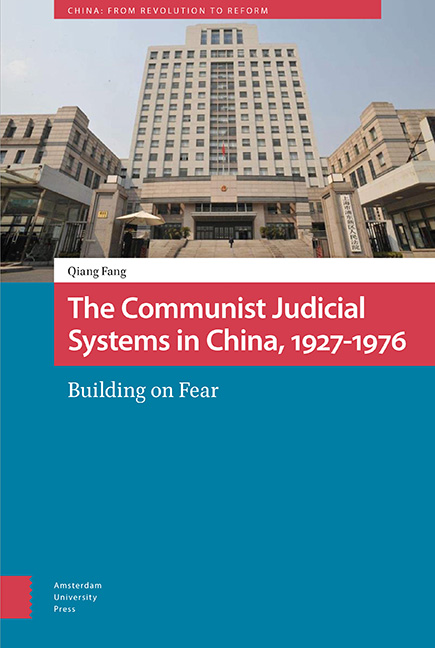
Drawing on hundreds of newly released judicial archives and court cases, this book analyzes the communist judicial system in China from its founding period to the death of Mao Zedong. It argues that the communist judicial system was built when the CCP was engaged in a life-or-death struggle with the GMD, meaning that the overriding aim of the judicial system was, from the outset, to safeguard the Party against both internal and external adversaries. This fundamental insecurity and perennial fear of loss of power obsessed the Party throughout the era of Mao and beyond, prompting it to launch numerous political campaigns, which forced communist judicial cadres to choose between upholding basic legal norms and maintaining Party order. In doing all of this, The Communist Judicial System in China, 1927–1976: Building on Fear fills a major lacuna in our understanding of communist-era China.
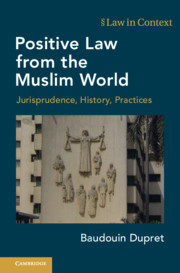
Can the concept of law be indiscriminately extended to times and places in which it did simply not exist? Such an extension is at best useless and at worst misleading. Producing an intelligible jurisprudence of the concept of law means keeping it within the reasonable boundaries of its contemporary common-sense understanding: positive law. Parallel to Western societies in which it firstly emerged, the concept of positive law developed in many places, including countries characterized as Muslim. There, it faced other existing normativities, like customs and the Sharia. This book aims, from the Muslim world's perspective, to clarify the uses of the concept of law and the ways of studying it, to describe some of its historical developments, including the ideas of constitutional law, customary law and forensic evidence, and to describe present-day practices, including reference to law sources, rules and interpretation.
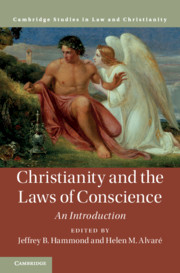
Conscience has long been a foundational theme in Christian ethics, but it is a notoriously slippery and contested term. This volume works to define conscience and reveal the similarities and differences between different Christian traditions' thinking on the subject. In a thorough and scholarly manner, the authors explore Christian theological, legal, constitutional, historical, and philosophical meanings of conscience. Covering a range of historical periods, major figures in the development of conscience, and contemporary applications, this book is a vital source for scholars from a wide variety of disciplines seeking to understand conscience from a range of perspectives.
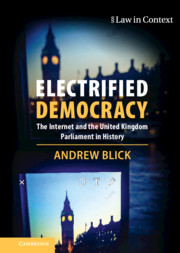
The story of how the UK Parliament came to use the Internet from the 1960s onwards has never been told. Electrified Democracy places the impact of technology on parliamentary workings in its longer term historical context. The author identifies repeating patterns of perception and analysis, and cultural tendencies in the perception of inventions dating back over centuries that have reasserted themselves in connection with the parliamentary response to networked computers. He uncovers evidence and makes new connections, while situating all this within the wider global debates on connections between communication and democracy in the age of the Internet, constitutional law and history, and 'law and technology'. This book will be of interest to a wide readership including policy makers, researchers, and all those interested in contemporary controversies about the role of the Internet in modern societies.
This chapter analyses the standards of review in Irish constitutional property law and their relationship to the text of the constitutional property clauses. It has a particular focus on the proportionality principle, which is an important point of convergence between many jurisdictions with constitutional property rights guarantees. It focuses on the distinctive questions that arise where it is deployed by judges in constitutional property rights adjudication. It futher considers the impact of the progressively framed text of the Irish Constitution's property rights clauses on the formulation and application of standards of review. It demonstrates that the form of constitutional property clauses may have limited impact in shaping the application of general standards of review, and argues for a greater judicial focus on the core question of fairness posed by constitutional property law.
This chapter synthesises the broad picture that emerges from Irish constitutional proeprty law about the mediation of property rights and social justice, and about the impact of progressively framed constitutional property guarantees on that mediation. It highlights the rewards for progressive property theory of doctrinal analysis and a wider comparative lens. Most fundamentally, it emphasises the political nature of constitutional property law in two ways. FIrst, judges gravitate away from innovative interpretation and application of ideas like social justice towards deference to the determinations of the elected branches of government. Second, constitutional property law can have political, and wider cultural effects, that do not reflect the strict legal effect of constitutional property rights as reflected in doctrine. It concludes that Irish constitutional property law demonstrates the challenges of implementing progressive property ideas in legal doctrine, but at the same time provides an illuminating example of a broadly coherent and effective attempt to implement a progressive constitutional structure for achieving partial resolutions of the tension betwene property rights and social justice.