To save content items to your account,
please confirm that you agree to abide by our usage policies.
If this is the first time you use this feature, you will be asked to authorise Cambridge Core to connect with your account.
Find out more about saving content to .
To save content items to your Kindle, first ensure no-reply@cambridge.org
is added to your Approved Personal Document E-mail List under your Personal Document Settings
on the Manage Your Content and Devices page of your Amazon account. Then enter the ‘name’ part
of your Kindle email address below.
Find out more about saving to your Kindle.
Note you can select to save to either the @free.kindle.com or @kindle.com variations.
‘@free.kindle.com’ emails are free but can only be saved to your device when it is connected to wi-fi.
‘@kindle.com’ emails can be delivered even when you are not connected to wi-fi, but note that service fees apply.
The call for ethical leadership in international organizations is intuitively persuasive. We need – or at least, we want – leaders to ‘model’ ethical values: to profess them and, ideally, to be guided by them. This is not simply an issue of public perception about international organizations. In numerous conversations over many years with individuals who worked professionally in the vast system of organizations that comprise ‘international Geneva’ – including senior civil servants in the United Nations (UN) and International Labour Organisation (ILO) systems, civil society activists, members of diplomatic delegations and young interns to all of these positions – I found that many were emphatic that good leaders made an enormous difference. This may be particularly important for the staff of international organizations: many of them come to these organizations with a deep sense of idealism and a desire to ‘make the world a better place’ and they believe that such leaders need to set an example.
The Greek Pavilion in the 57 Venice Biennale of Art, hosted an exhibition titled Laboratory of Dilemmas. As the informative note explained at the entrance of the site: ‘Laboratory of dilemmas is a narrative video installation based on Aeschylus’ theatre play Iketides (Suppliant women) and the dilemmas it poses between saving the Foreigner or maintaining the safety of the Native, which attempts to expose the anguish, puzzlement and confusion of individuals and social groups when called upon to address similar dilemmas’. According to the note: Iketides ‘is the first literary text in history that raises the issue of a persecuted group of people seeking asylum …. . The King is faced with a major dilemma … If he doesn’t help them he will be breaking the sacred laws of hospitality and violating the principles of Law and Humanism, leaving the Suppliants to the mercy of their pursuers who might well destroy them.’
In the burgeoning realm of global governance, ethics has occupied an increasingly prominent place in recent years. One of the buzzwords of the last two decades or so has been ‘accountability’, a term which carries overtones of proper behaviour, control and responsibility. Persons in a position of leadership emphasize their concern for such things as full financial disclosure and transparency. The humanitarian intervention over Kosovo may have been illegal but was nonetheless, many have claimed, ethically justifiable. Codes of ethics have been devised both for the international bar and, somewhat lukewarm, for the international judiciary. The infamous ‘torture memos’ have thrown into perspective the need for legal advisors to behave ethically; writings have appeared on the ethical aspects of humanitarian missions, and several studies have been published focusing on the ethics of the international legal order as such, the ethics of international commercial arbitration, or the ethics of the international bar.
Two central transformations occurred in the second decade of twenty-first century. The first is a whole new level of access to information about peoples’ habits. This is the ‘big data’ revolution: never before had it been possible to gather so much information about so many people, with such accuracy – specially gathered by huge online service providers such as Facebook, Google or Amazon, which record each of the action of their users. Thus, while marketing strategists or political campaigns have always sought to know the preferences of particular segments of the population, big data makes possible a truly high-resolution profiling of behaviours, which reflects the habits of specific individuals, and not only of demographic groups or certain geographical areas.
The most compelling one would probably be to keep in mind that international sporting institutions are formally private institutions. There is one important exception, however, that is the World Anti-Doping Agency (WADA), an interesting case of global hybrid public and private body, which adopts the World Anti-Doping Code (WADC). Beside WADA, international sporting bodies, such as the International Olympic Committee (IOC), the Court of Arbitration for Sport (CAS), and the decades of International Sports Federations are genuinely private entities and, in most cases, it is Swiss civil law that regulates them.
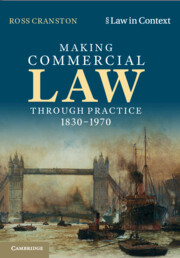
Making Commercial Law Through Practice 1830–1970 adds a new dimension to the history of Britain's commerce, trade manufacturing and financial services, by showing how they have operated in law over the last one hundred and forty years. In the main law and lawyers were not the driving force; regulation was largely absent; and judges tended to accommodate commercial needs, so that market actors were able to shape the law through their practices. Using legal and historical scholarship, the author draws on archival sources previously unexploited for the study of commercial practice and the law's role in it. This book will stimulate parallel research in other subject areas of law. Modern commercial lawyers will learn a great deal about the current law from the story of its evolution, and economic and business historians will see how the world of commerce and trade operated in a legal context.
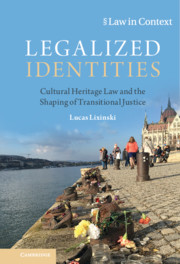
Cultural heritage is a feature of transitioning societies, from museums commemorating the end of a dictatorship to adding places like the Auschwitz-Birkenau concentration camp to the World Heritage List. These processes are governed by specific laws, and yet transitional justice discourses tend to ignore law's role, assuming that memory in transition emerges organically. This book debunks this assumption, showing how cultural heritage law is integral to what memory and cultural identity is possible in transition. Lixinski attempts to reengage with the original promise of transitional justice: to pragmatically advance societies towards a future where atrocities will no longer happen. The promise in the UNESCO Constitution of lasting peace through cultural understanding is possible through focusing on the intersection of cultural heritage law and transitional justice, as Lixinski shows in this ground-breaking book.
Two rival approaches to property rights dominate contemporary political philosophy: Lockean natural rights and egalitarian theories of distributive justice. This article defends a third approach, which can be traced to the work of David Hume. Unlike Lockean rights, Humean property rights are not grounded in pre-institutional moral entitlements. In contrast to the egalitarian approach, which begins with highly abstract principles of distributive justice, Humean theory starts with simple property conventions and shows how more complex institutions can be justified against a background of settled property rights. Property rights allow people to coordinate their use of scarce resources. For property rules to serve this function effectively, certain questions must be considered settled. Treating existing property entitlements as having prima facie validity facilitates cooperation between people who disagree about distributive justice. Lockean and egalitarian theories endorse moral claims that threaten to unsettle property conventions and undermine social cooperation.
This article develops and advances a liberal ideal of equality for evaluating the lawful scope of employer control over employees. It argues that, in addition to attending to discrimination and bargaining power asymmetries, we should ensure that our laws treat workers as the moral equals of their bosses more broadly—as people with equally weighty claims to exercising agency over their own values and lives. To illustrate, the article explains that employer control over workplace expression can preclude colleagues from communicating with each other as moral equals and can compromise employees’ abilities to exercise agency over their own characters. It then discusses how our agential interests in workplace expression can guide legal reform.
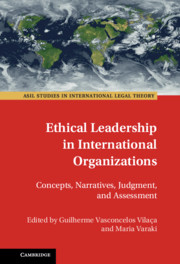
This book offers an innovative interdisciplinary approach that elucidates the importance of virtue ethics to help better understand the role of leadership in international organisations. The authors use a combination of theoretical and conceptual narratives as well as case studies to highlight both the advantages and weaknesses that the angle of virtue ethics offers. A particularly important step in times of uncertainty or crisis when the demand for leadership becomes more urgent yet more daunting. In this sense, this volume oscillates between critique and hope, since it provides a plausible, rather than a purely abstract, approach to the conceptualization and concretization of ethical leadership.
Can a doctrinal scholarship which is based on the normativist-positivist framework espoused in this book do any better than mainstream legal scholarship? Starting from a critique of certain hyper-systematising approaches, the chapter introduces Kelsen’s idea of legal scholarship properly so called, one devoid of external influences because these make it impossible to correctly cognise the law. Reconstructed in this manner, doctrinal scholarship can provide a structural analysis of the law, both on the macro-level of system-coherence and on the micro-level as frame-determination. It can also give practical information on how awards have exercised their freedom within the frame of possible meanings.