To save content items to your account,
please confirm that you agree to abide by our usage policies.
If this is the first time you use this feature, you will be asked to authorise Cambridge Core to connect with your account.
Find out more about saving content to .
To save content items to your Kindle, first ensure no-reply@cambridge.org
is added to your Approved Personal Document E-mail List under your Personal Document Settings
on the Manage Your Content and Devices page of your Amazon account. Then enter the ‘name’ part
of your Kindle email address below.
Find out more about saving to your Kindle.
Note you can select to save to either the @free.kindle.com or @kindle.com variations.
‘@free.kindle.com’ emails are free but can only be saved to your device when it is connected to wi-fi.
‘@kindle.com’ emails can be delivered even when you are not connected to wi-fi, but note that service fees apply.
Carl Schmitt, the well-known German theorist of international law, constitutional law and politics, is a unique figure in the history of international criminal law and worthy of study. Schmitt was associated with the National Socialist regime from 1933 until his ousting in 1936. Schmitt’s reputation as ‘Crown Jurist’ or Kronjurist of the Third Reich dogs his legacy to this day. Discerning the precise nature of Carl Schmitt’s relationship to National Socialism and National Socialist crimes in his life and work is an open question and by no means a simple one. It is, however, definitely worth the effort – if not almost mandatory – to answer in order to engage with his work. Most of the extant scholarship on Schmitt does not address why he escaped prosecution at Nuremberg. Some authors think his National Socialist associations taint his work, while others see his work as having an intrinsic value separate and apart from the activities of the man himself. The leading works thus tend to discuss Schmitt and his legacy in a more or less binary fashion by separating the two groups of authors and then broadly taking two separate views. Both these opposed poles can then cite examples to bolster their respective positions. Some authors claim that Schmitt was more committed to his ambition than to National Socialism; other scholars maintain that Schmitt’s anti-liberal jurisprudence, coupled with his anti-Semitism, made it ethically logical for him to be in favour of the National Socialist regime. What is not in dispute is that Schmitt did not hold any official position in the National Socialist regime. This fact, although neglected, explains why he was not prosecuted. Irrespective of who is (factually) right or wrong, it was the particular interpretation of ‘holding an office’ that prevailed – to Schmitt’s advantage.
The UN was not created to take mankind to heaven, but to save humanity from hell.
Dag Hammerskjöld (quoted in Weiss 2011, 2)
Crises – a medical term that has made its way into the heart of law and theology – abound in international criminal law. The ravages of World War II brought forth the International Military Tribunal at Nuremberg (IMT) and the International Military Tribunal for the Far East at Tokyo (IMTFE). The break-up of the former Yugoslavia necessitated the creation of the International Criminal Tribunal for the former Yugoslavia (ICTY). Civil war in Rwanda brought the International Criminal Tribunal for Rwanda (ICTR) in its wake. Suffice to say that each of these crises, among others, was exemplary in providing the basis for creating and extending (once novel and temporary but now commonplace and permanent) international criminal jurisdiction.
Why the Faustian pact? Why international law? Why now? Inquiring into whether international law is quintessentially Faustian and how to deal with that – as this book seeks to do – does not necessarily explain and justify itself. To start with, Johann Wolfgang von Goethe’s Faust dangles the tantalising possibility of frustrating Faustian pacts, and two lines from it sparked and have spurred and sustained this project on. The first was Mephistopheles’ description of himself as:
A part of that force
Which, always willing evil, always produces good.
where he represented himself – and indeed was presented – as somehow a servant of God or at the very least as doing God’s work for Him. The second, and related to this, was Mephistopheles’ sly and ironic observation to God that Faust ‘serves You in a curious way’, which may well have been simultaneously description and self-description. Whether taken together or separately, these lines say a good deal about the Mephistophelean character and role, which claims to bring good and evil together in some sort of productive and somehow mutually reliant relationship, all the while couched in a consciously bottomless ironic register.
The medieval distinction between the official and the personal bodies of the state sovereign played out before the International Criminal Court in fairly dramatic action. This scenario involved the President of the Republic of Kenya willingly submitting to the jurisdiction of the International Criminal Court, but only in his personal capacity and not as president. Essentially this argument is based on the medieval doctrine of the ‘King’s two bodies’. The distinction of describing two bodies united in one inits origins sits at the crossroads of legal theory and political theology. As such, it draws from a rich heritage of these traditions that are of necessity developed through reconciling practical imperatives with theoretical niceties. Seeing the ancient doctrine of the King’s two bodies manifested in a contemporary context thus provides the opportunity to observe a longstanding (if dormant and obscure) legal theory applied to a novel factual situation. It demonstrates that this legal fiction remains stubbornly useful and effective in navigating between political imperatives and legal strictures. Moreover, that unusual irruption of an arcane legal and political practice into a modern-day international courtroom shows thatthe practice still bears the unmistakeable signature of its mystical foundation.
On 8 October 2014, Uhuru Kenyatta the President of the Republic of Kenya became the first sitting Head of State in history to appear voluntarily in response to a summons before any international criminal court or tribunal. Or not.This chapter examines whether, and if so how far, his claims of attending in a personal capacity were sustainable as well as what its implications would be for sovereigns elsewhere. The charges against Kenyatta stem from the post-electoral violence that swept Kenya between the years 2007 to 2008 following the national elections. An International Criminal Court (ICC) Pre- Trial Chamber found that ‘crimes against humanity had been committed on Kenyan territory’.
War is the father of all things, the king of all things.
Some he proves to be gods, others men;
some he makes slaves, others free.
Heraclitus’s Fragmentum 53
Whereas both law and music have provided justification for war as a necessary evil, the two are seldom considered together in that regard. Although they have both provided an explaining away of the evil of war (a lay theodicy), this remains unexplored and under-theorised. Furthermore, ironically it is more present for music and musicians than it is for law and lawyers. Parker notes that, ‘As a community of jurists, we have become deaf to law and to the problem of the acoustic.’ Lyrics link law to text, to poetry and sometimes, as we shall see, to violence. That confluence is the point of inquiry for this chapter. Is it really too simplistic, as Manderson critiques Derrida in Songs Without Music: Aesthetic Dimensions of Law and Justice, to understand ‘law as a species of mandated force, of state-sanctioned violence’? After all, Manderson agrees that ‘War, like law, is not merely an exercise in brute force but rather a series of symbolic acts.’ Sykes observes the ambiguity or ambivalence in that ‘music is a cultural force that may contest or enhance political and legal power’. Consequently, the chapter asks and attempts to answer several questions: What utility could there possibly be in war? What does the law have to say about it? And why is music relevant? The argument pursued is that the combination of music, law and violence aggregates and disaggregates the body politic. This chapter examines and stages encounters between war, law and music spanning from the ‘Laudes Regiae’ medieval acclamatory hymn and George Frideric Handel’s ‘The Lord is a Man of War’ to Bob Marley’s speech set to Reggae ‘War’ and Edwin Starr’s ‘War’ in relation to the international This case is extraordinary in that the court essentially ruled that it was unable to answer a question before it, even after accepting jurisdiction.
My first draft was quite good, I thought. I’d based it on the UN Charter itself. The Foreign Office sent me over a copy, with a note attached explaining that the preamble to the Charter was known as the Unconditional Surrender of the English Language.
The Complete Yes Prime Minister, p. 459
If what humans speak is a language, and if there is not only one language but many, then the plurality of languages corresponds to the plurality of people and political communities.
Giorgio Agamben, What is Philosophy?, p. 6
According to the former President of the International Criminal Court (ICC), Judge Silvia Ferna´ndez de Gurmendi, populism – along with bigotry and xenophobia – has the potential to undermine ‘international criminal justice and more broadly a rules-based order’. John Dugard concurs, stating, ‘At present the rule based international order is under threat from forces of nationalism and populism.’ In his speech, Dugard identifies the UN Human Rights Council and the ICC as two principal targets of these nationalist and populist forces. At least one witness in The Prosecutor v. William Samoei Ruto and Joshua Arap Sang identified ‘a certain degree of anti-Kikuyu populism’ in the run-up to the 2017 elections in Kenya. According to the former President of the International Criminal Court (ICC), Judge Silvia Ferna´ndez de Gurmendi, populism – along with bigotry and xenophobia – has the potential to undermine ‘international criminal justice and more broadly a rules-based order’. John Dugard concurs, stating, ‘At present the rule based international order is under threat from forces of nationalism and populism.’ In his speech, Dugard identifies the UN Human Rights Council and the ICC as two principal targets of these nationalist and populist forces.
World history is a history of land powers against sea powers.
Schmitt, Land and Sea
Precisely what is at stake in the contemporary South China Sea? The content, effect and application of legal rules? The basis for those rules? The order within which those rules exist? Or order in another sense, that of an implied hierarchy with only room for the United States right at the very top? This chapter invokes Johann Wolfgang von Goethe’s version of the Faust myth with an eye on, and in the context of, the South China Sea but from the removed if not quite neutral perspective of the East African Coast. Specifically, how would the struggle look to a Somali pirate? This follows the example of Niccolò Machiavelli’s famous dedication of The Prince to the Magnificent Lorenzo di Piero de’ Medici that one needs to be down in the plains to study mountains and in the mountains to study plains.
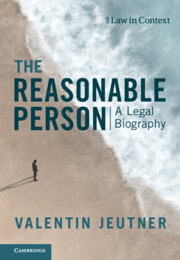
Jeutner argues that the reasonable person is, at heart, an empathetic perspective-taking device, by tracing the standard of the reasonable person across time, legal fields and countries. Beginning with a review of imaginary legal figures in the legal systems of ancient Egypt, Greece, and Rome, the book explains why the common law's reasonable person emerged amidst the British industrialisation under the influence of Scottish Enlightenment thinking. Following the figure into colonial courts, onto battlefields and into self-driving cars, the book contends that the reasonable person invites judges, jury-members, and lawyers to take another person's perspective when assessing their own or another person's conduct. The perspective of another is taken by means of empathy, by feeling what others might feel in a particular situation. Thus construed, the figure of the reasonable person can help us make more accurate judgments in a diverse world.
A social history of West Germany's Bundesgrenzschutz (BGS, Federal Border Police) that complicates the telling of the country's history as a straightforward success story.
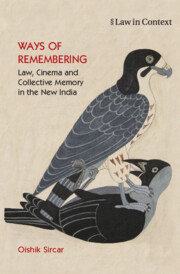
Ways of Remembering tells a story about the relationship between secular law and religious violence by studying the memorialisation of the 2002 Gujarat pogrom—postcolonial India's most litigated and mediatized event of anti-Muslim mass violence. By reading judgments and films on the pogrom through a novel interpretive framework, the book argues that the shared narrative of law and cinema engenders ways of remembering the pogrom in which the rationality of secular law offers a resolution to the irrationality of religious violence. In the public's collective memory, the force of this rationality simultaneously condemns and normalises violence against Muslims while exonerating secular law from its role in enabling the pogrom, thus keeping the violent (legal) order against India's Muslim citizens intact. The book contends that in foregrounding law's aesthetic dimensions we see the discursive ways in which secular law organizes violence and presents itself as the panacea for that very violence.
The figure of the bogus asylum seeker has become a catalyst for another powerful figure dominating migration law discourses, namely the figure of the ‘illegal’. As shown earlier, illegality as a legal category has been proliferating and fear of the illegal underpins regulation of migration across the globe. In this chapter I will illustrate that the illegal is such a vague and ephemeral figure that its appearance in a isual field is often conveyed in the form of the invisibility of an actual migrant.The preference for invisibility is dictated by the uncertainties related to who the illegal is, how they cross borders, and what qualities the illegal represents. But more importantly, as a form of ghostly figure that threatens the viewer with the unknown but powerful illegality of arrival (Gozdecka 2020), their invisibility can result in a more powerful affective and legal response from the viewer.
I will use the Australian ‘NO WAY’ campaign and the British ‘Go Home’ campaign to show how those implicitly 'depicted' without a physical appearance become ‘ghostly’ and threatening entities that can be disciplined, detained and deported with the help of the law. In addition, I will focus on the image from the gallery of US Customs and Border Protection. The visual campaigns and resources analysed below have been used by authorities to directly target migrants and refugees in order to deter them from crossing the border, staying in the territory or claiming asylum and to warn them of harsh treatment on the other side of the border.They have used invisibility as a tool to convey ‘fraudulence’ on the part of a migrant or asylum seeker rather than seeking to depict them as a specific person. This chapter examines how invisibility reinforces the local population’s anxiety about the imagined arrival of ‘illegals’. I will also show that visual invisibility often translates into invisibility within the legal system and leads to long-term or permanent inability to access the justice system.