Refine search
Actions for selected content:
16154 results in Animal behaviour
Two new species of Metachromadora (Nematoda: Desmodoridae) from Guanabara Bay, Rio de Janeiro, Brazil, and a revised dichotomous key to the genus
-
- Journal:
- Journal of the Marine Biological Association of the United Kingdom / Volume 94 / Issue 1 / February 2014
- Published online by Cambridge University Press:
- 05 September 2013, pp. 105-114
-
- Article
- Export citation
14 - Social minds and social selves
- from Part III - Toward respectful coexistence
-
-
- Book:
- The Politics of Species
- Published online:
- 05 September 2013
- Print publication:
- 05 September 2013, pp 179-188
-
- Chapter
- Export citation
Part III - Toward respectful coexistence
-
- Book:
- The Politics of Species
- Published online:
- 05 September 2013
- Print publication:
- 05 September 2013, pp 177-245
-
- Chapter
- Export citation
The Politics of Species - Title page
-
-
- Book:
- The Politics of Species
- Published online:
- 05 September 2013
- Print publication:
- 05 September 2013, pp iii-iii
-
- Chapter
- Export citation
15 - The human–macaque interface in the Sulawesi Highlands
- from Part III - Toward respectful coexistence
-
-
- Book:
- The Politics of Species
- Published online:
- 05 September 2013
- Print publication:
- 05 September 2013, pp 189-196
-
- Chapter
- Export citation
5 - “Race” andspecies in the post-World War II United Nations discourse on human rights
- from Part I - Moving beyond speciesism
-
-
- Book:
- The Politics of Species
- Published online:
- 05 September 2013
- Print publication:
- 05 September 2013, pp 67-76
-
- Chapter
- Export citation
17 - Home flocks
- from Part III - Toward respectful coexistence
-
-
- Book:
- The Politics of Species
- Published online:
- 05 September 2013
- Print publication:
- 05 September 2013, pp 206-222
-
- Chapter
- Export citation
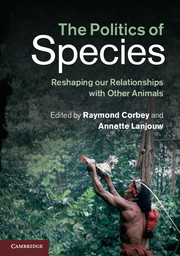
The Politics of Species
- Reshaping our Relationships with Other Animals
-
- Published online:
- 05 September 2013
- Print publication:
- 05 September 2013
20 - The capacity of non-human animals for legal personhood and legal rights
- from Part III - Toward respectful coexistence
-
-
- Book:
- The Politics of Species
- Published online:
- 05 September 2013
- Print publication:
- 05 September 2013, pp 241-245
-
- Chapter
- Export citation
Copyright page
-
- Book:
- The Politics of Species
- Published online:
- 05 September 2013
- Print publication:
- 05 September 2013, pp iv-iv
-
- Chapter
- Export citation
12 - Animals as persons in Sumatra
- from Part II - Sentience and agency
-
-
- Book:
- The Politics of Species
- Published online:
- 05 September 2013
- Print publication:
- 05 September 2013, pp 156-163
-
- Chapter
- Export citation
The Politics of Species - Half title page
-
- Book:
- The Politics of Species
- Published online:
- 05 September 2013
- Print publication:
- 05 September 2013, pp i-ii
-
- Chapter
- Export citation
4 - Apeism and racism
- from Part I - Moving beyond speciesism
-
-
- Book:
- The Politics of Species
- Published online:
- 05 September 2013
- Print publication:
- 05 September 2013, pp 53-66
-
- Chapter
- Export citation
10 - Intersubjective engagements without theory of mind
- from Part II - Sentience and agency
-
-
- Book:
- The Politics of Species
- Published online:
- 05 September 2013
- Print publication:
- 05 September 2013, pp 126-140
-
- Chapter
- Export citation
Preface
-
- Book:
- The Politics of Species
- Published online:
- 05 September 2013
- Print publication:
- 05 September 2013, pp xiii-xiv
-
- Chapter
- Export citation
8 - The expression of grief in monkeys, apes, and other animals
- from Part II - Sentience and agency
-
-
- Book:
- The Politics of Species
- Published online:
- 05 September 2013
- Print publication:
- 05 September 2013, pp 106-114
-
- Chapter
- Export citation
16 - The fabric of life
- from Part III - Toward respectful coexistence
-
-
- Book:
- The Politics of Species
- Published online:
- 05 September 2013
- Print publication:
- 05 September 2013, pp 197-205
-
- Chapter
- Export citation
Index
-
- Book:
- The Politics of Species
- Published online:
- 05 September 2013
- Print publication:
- 05 September 2013, pp 284-295
-
- Chapter
- Export citation
Part I - Moving beyond speciesism
-
- Book:
- The Politics of Species
- Published online:
- 05 September 2013
- Print publication:
- 05 September 2013, pp 13-92
-
- Chapter
- Export citation
Trophic importance of meiofauna to polychaetes in a seagrass (Zostera marina) bed as traced by stable isotopes
-
- Journal:
- Journal of the Marine Biological Association of the United Kingdom / Volume 94 / Issue 1 / February 2014
- Published online by Cambridge University Press:
- 05 September 2013, pp. 121-127
-
- Article
- Export citation
