To save content items to your account,
please confirm that you agree to abide by our usage policies.
If this is the first time you use this feature, you will be asked to authorise Cambridge Core to connect with your account.
Find out more about saving content to .
To save content items to your Kindle, first ensure no-reply@cambridge.org
is added to your Approved Personal Document E-mail List under your Personal Document Settings
on the Manage Your Content and Devices page of your Amazon account. Then enter the ‘name’ part
of your Kindle email address below.
Find out more about saving to your Kindle.
Note you can select to save to either the @free.kindle.com or @kindle.com variations.
‘@free.kindle.com’ emails are free but can only be saved to your device when it is connected to wi-fi.
‘@kindle.com’ emails can be delivered even when you are not connected to wi-fi, but note that service fees apply.
The B mutation is associated with a tandem duplication of 16A1–16A7. It is unstable, mutating to wild type and to a more extreme form at a frequency of one in 1000 to 3000. The reversion to wild type is associated with the loss of one copy of the duplication, whereas the mutation to extreme B is associated with a triplication of the region. The instability of B has been attributed to unequal crossing-over between the two copies of the duplication. Recent molecular data show that there is a transposable element, B104, between the two copies of the duplication and support the hypothesis that this element generated the duplication via a recombination event. These data suggest that unequal crossing-over within the duplication may not be the cause of the instability of B. Instead, the instability may be caused by a recombination event involving the B104 element. This issue was addressed using probes for the DNA on either side of the B104 element at the B breakpoint. All of the data indicate that the B104 element is not involved in the instability of B and support the original unequal crossing-over model.
The inheritance of self-incompatibility proteins was studied in three homozygous self-incompatible genotypes of Brassica oleracea var. capitata and their F1 and F2 progenies. The presence or absence in the stigma of incompatibility proteins was determined by immunodiffusion and independently by disk electrophoresis. Certain proteins (antigens) were present in F1 and F2 plants in exact correlation with segregation of the S alleles as determined by phenotypic expression of incompatibility. An S allele–protein–phenotype relationship was thus verified.
Mutants of [psi] a cytoplasmically inherited factor in the yeast Saccharomyces cerevisiae were isolated after treatment with a variety of agents including conventional mutagens and a number of compounds which cause loss of [psi] at high frequencies, namely methanol, KCl, dimethyl sulphoxide and guanidine hydrochloride. In [psi−] mutants the suppressor SUQ5 does not suppress ochre mutations such as ade.2.1.
Reversion analysis of the [psi−] mutants revealed three classes: (1) a class of agents producing [psi−] mutations which could readily revert to [psi+] (methanol, KCl and dimethyl sulphoxide belong to this class), (2) those which could not be shown to revert (GuHCl) and (3) the conventional mutagens which produced both revertible and apparently non-revertible [psi−] mutations. We conclude that GuHCl causes a deletion or loss of the [psi] factor. Methanol may cause an alteration of ‘state’ for example, of a promoter, and KCl may be selecting or inducing low copy number variants of [psi+] strains. It is possible that DMSO may be involved in regulation of [psi].
Gene amplification involving a particular haplotype has been found at the esterase B locus of mosquitoes from various countries. This similarity has been explained by a unique amplification event followed by migration and selection by organophosphate (OP) insecticides. This assumes that the polymorphism of non-amplified esterase haplotypes is so large that the chance of independent amplification in two distinct populations is negligible. In order to test this assumption, three susceptible populations from northern Europe were sampled and analysed for esterase and haplotype polymorphism. At the protein level, 18 and 16 alleles were found for esterase A and B respectively in one French population (n = 74), and 16 and 14 in an English one(n = 50). At the DNA level, 24 alleles at the esterase B locus were detected in a sample of 72 mosquitoes from one population, with the use of only one restrictionenzyme (EcoR V). Restriction maps of two nonamplified haplotypes randomly sampled from a single breeding site in Belgium were built with six restriction enzymes. 60% of all restriction sites were different among the two maps. The huge polymorphism found in northern Europe requires specific explanations for its stability, but it considerably strengthens the hypothesis of migration of amplified haplotypes.
Relationships between mating type genes and mating-inducing factors (gamones) were investigated in the ciliate Euplotes patella syngen 2. Ten mating types were distinguished, and genetic data indicated that the ten mating types were determined by four codominant alleles in possible combinations of two of them. There were six heterozygous types (mt1/mt2, mt3/mt4, etc.) and four homozygous types (mt1/mt1, mt2/mt2, etc.). Conjugation-conditioned fluid (CCF) obtained from a mixture of cells of homozygous types could induce homotypic pair formation in cells of all mating types except for a particular type. Genetic data of cell-CCF combination experiments suggest that each mating type allele controls the production of a specific gamone which induces pair formation in cells which do not produce the same gamone. Gamones and their hypothetical receptors are discussed.
In(IL; IR)O Y348 is a pericentric inversion of linkage group I in N. crassa, with a breakpoint between fr and un-5 in the left arm and a breakpoint between ad-9 and nit-1 in the right arm. Approximate breakpoint location was found by tabulating crossovers between the rearrangement and markers in normal chromosome sequence. Inversion structure was verified by marked In O Y348 × In O Y348 crosses. Precise mapping of breakpoints was by duplication coverage. Inversions like O Y348 do not produce progeny with segmental chromosome duplications when crossed to normal sequence, but duplications were produced by crossing it to In(IL; IR)O Y323 (Barry & Leslie, 1982), another standard pericentric inversion, and to T(I → VI)NM103 (Turner, 1977), a translocation to a tip. Each of these rearrangements has a breakpoint within the inverted region of In O Y348. Two duplications from In O Y348 × In O Y323 were converted to normal chromosome sequence by double mitotic recombination. Besides expediting mapping, the technique of intercrossing rearrangements increasingly enables us to make segmental duplications exactly tailored for studying specific included genes.
The zymogram phenotypes of 11 enzymes were determined for 22 Triticum aestivum cv. Chinese Spring-Elytrigia elongata disomic and ditelosomic chromosome addition lines. Eleven isozyme structural genes were located in specific arms of six E. elongata chromosomes, as follows: Gpi-E1 in 1ES, Est-E1 in 3ES, Got-E3 in 3EL, Adh-E1 and Lpx-E1 in 4ES, Adh-E2 and Lpx-E2 in 5EL, Amp-E1 in 6Eα, Adh-E3 and Got-E2 in 6Eβ, and Ep-E1 in 7EL. The E. elongata chromosomes present in five disomic addition lines have previously been designated 1E, 2E, 4E, 6E, and 7E to indicate their homoeology with Chinese Spring chromosomes. The results of this study support these designations. The development of disomic putative 3E and 5E addition lines is reported. The added chromosomes designated IV, V, and VI that are present in three of the seven original disomic T. aestivum-E. elongata addition lines are translocated. Evidence that VL and VIL are opposite arms of 2E and that IV is partially homoeologous to 3E has been published. The results reported in this paper indicate that IVS = 3ES, IVL = 7EL, VS = 3ES, and VIS = 5ES and are consistent with VL and VIL being opposite arms of 2E. The synteny relationships of the 11 E. elongata isozyme genes identified in this study are fully consistent with those of homoeologous T. aestivum cv. Chinese Spring genes and thus provide evidence that the gene synteny groups which these two species inherited from their common ancestor are conserved. This study further documents the valuable role that studies of isozyme genes can play in the isolation, characterization, and maintenance of alien chromosomes, telosomes, and chromosomal segments in wheat strains.
We investigated the interaction of recombination and selection on the process of fixation of two linked loci with epistatic interactions in fitness. We consider both the probability of fixation of newly arising mutants (the static model) and the time to fixation under continued mutation (the dynamic model). Our results show that the fixation of a new advantageous combination is facilitated by higher fitness of the advantageous genotype and by weaker selection against the intermediate deleterious genotypes. Fixation occurs more rapidly when the recombination rates are small, except when selection against intermediate genotypes is weak and selection in favour of the double mutant is very strong. In these cases fixation is more rapid when the recombinant rate is large. Mutations of strong effects, deleterious when alone but beneficial when coupled, are fixed more easily than mutations of intermediate effects, at least for large recombination rates. Among the possible pathways the process of fixation might follow, independent substitutions lead to the fixation of the double mutant only when selection is weak. The relative importance of the other pathways depends on the interaction between recombination and selection. The coupled-gamete pathway (i.e. when the population waits until the double mutant appears and then drives it to fixation) is more important as selection intensity increases and the recombination rate is reduced. For all recombination rates, asymmetries in fitness of the intermediate genotypes increase the rate at which fixations occur. Finally, throughout the fixation process, the population will be monomorphic at least at one of the two loci for most of the time, which implies that there would be little opportunity to detect the presence of negative epistasis even if it were important for occasional evolutionary transitions.
X-linked modification of the heterozygous phenotypes of X-linked genes has been detected in the X chromosomes of several inbred strains of mice. The effect is similar to that of the alternative ‘states’ or alleles, of the X chromosome controlling element, Xce, identified in T(1; X)Ct X chromosomes. Tests on two such differing X chromosomes have indicated that the phenotypic modification results either from non-random inactivation of the two X chromosomes or from selection operating on the two cell populations differentiated by X-inactivation. The data provide evidence of non-random X chromosome activity in the somatic cells of the female mouse.
The paper on the analysis of data from transduction experiments with Salmonella typhimurium, which was published in Genetical Research (Dawson, 1963), unfortunately contained an error on p. 419. In calculating the limiting values X/Y, the formulae for d and d′ are correctly stated, but their solutions are transposed. The last and third last lines on p. 419 should therefore be interchanged. In the arithmetic example on pp. 420 and 421, a similar interchange of the calculations of d and d′ is necessary. The maximum value of a/b is then:
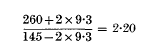
and the calculation of the minimum value should be:
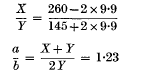
These values of 2·20 and 1·23 are to be compared with the values of 2·23 and 1·24 in the published paper.
The behaviour of linkage disequilibrium between two segregating loci in finite populations has been studied as a continuous stochastic process for different intensity of linkage, assuming no selection. By the method of the Kolmogorov backward equation, the expected values of the square of linkage disequilibrium z2, and other two quantities, xy(1 − x) (1 − y) and z(1 − 2x) (1 − 2y), were obtained in terms of T, the time measured in Ne as unit, and R, the product of recombination fraction (c) and effective population number (Ne). The rate of decrease of the simultaneous heterozygosity at two loci and also the asymptotic rate of decrease of the probability for the coexistence of four gamete types within a population were determined. The eigenvalues λ1, λ2 and λ3 related to the stochastic process are tabulated for various values of R = Nec.
Transcription in 9A–11A aneuploid mosaic female larvae of Drosophila melanogaster has been assessed autoradiographically. Eleven larvae were found to exhibit mosaicism out of sixty-six larvae scanned and the percentage of XO and XX nuclei varied from approximately 9 to 100. Irrespective of the number of XX nuclei present the XO nuclei (duplicated for 9A–11A) invariably showed hyperactivity for both the segments. The XX nucleus exhibited a dosage effect for all the three segments of 9A–11A. Results support the transcriptional constancy of the entire X chromosome, as proposed by Maroni and Lucchesi. Cellular autonomy of hyperactivity of the single X chromosome even at the level of segments of the X is thus evident from the present results.
