To save content items to your account,
please confirm that you agree to abide by our usage policies.
If this is the first time you use this feature, you will be asked to authorise Cambridge Core to connect with your account.
Find out more about saving content to .
To save content items to your Kindle, first ensure no-reply@cambridge.org
is added to your Approved Personal Document E-mail List under your Personal Document Settings
on the Manage Your Content and Devices page of your Amazon account. Then enter the ‘name’ part
of your Kindle email address below.
Find out more about saving to your Kindle.
Note you can select to save to either the @free.kindle.com or @kindle.com variations.
‘@free.kindle.com’ emails are free but can only be saved to your device when it is connected to wi-fi.
‘@kindle.com’ emails can be delivered even when you are not connected to wi-fi, but note that service fees apply.
The rubber tree of commerce (Hevea brasiliensis Muell. Arg.) is indigenous to the Amazon rainforest, within 5° N and 5° S latitude of the equator. Its properties were well known to the Indians of South and Central America long before the arrival of the Europeans in the sixteenth century. It is cultivated for its latex, which is used in the production of natural rubber, 60% of which is utilised in the manufacture of tyres (Figure 7.1). Latex is a cellular fluid consisting of a suspension of rubber hydrocarbon particles, represented by the formula (C5H8)n, in an aqueous medium. The nineteenth century saw the vulcanisation of rubber (heating with sulphur allows rubber to retain its physical properties unchanged over the temperature range 0–100 °C), the development of specialist machinery and techniques for manufacturing rubber goods, the rise of commercial trade in rubber, and the first efforts to cultivate rubber when the demand for raw rubber began to exceed the supply from wild trees in Brazil (Varghese and Abraham, 2005). In 1876 seeds were gathered from the rainforest and taken to Kew Gardens in London. Subsequently, seedlings were sent from London to Sri Lanka and afterwards onward to Singapore where they formed the basis of the rubber-producing industry that developed throughout the twentieth century, particularly in South-east Asia (Purseglove, 1968).
The total annual production of natural rubber in 2008 was about 10.6 million t from 8.9 million ha. The principal producers are Thailand (3.0 million t, 1.8 million ha), Indonesia (2.8 million t, 2.9 million ha), Malaysia (1.2 million t, 1.25 million ha), India (0.82 million t, 0.45 million ha) and Vietnam (0.61 million t, 0.63 million ha). The largest producer in West Africa is the Côte d'Ivoire (0.18 million t), and in South America it is Brazil (0.11 million t). In 2008, South-east Asia produced 94% of the world's crop (FAO, 2010b; IRSG, 2010).
The centre of origin of the oil palm (Elaeis guineensis Jacq.) is the tropical rainforest of West Africa where its natural habitat is believed to be in swamps and along river banks. The main economic product is palm oil obtained from the mesocarp in the fruit. Palm kernel oil, which has a different fatty acid composition, is produced in smaller quantities. Kernel cake, produced after the kernel oil has been extracted, is used in animal feeds. Oil palm is the highest yielding oil crop (t ha−1) in the world. Traditionally, palm oil was used in soap, margarine and cooking fat, but is now largely used in food products. It has also become the source of more diverse materials (Corley and Tinker, 2003). When grown as a smallholder crop, the oil palm contributes much more than oil to the communities living in the areas where it is cultivated. For, example, the sap can provide raw material for sugar and alcoholic beverages. The palms are also a source of building materials, and some of the tissues are important sources of fibre.
The oil palm has long been important to village economies throughout its area of distribution in the forests of West Africa, where semi-wild palm groves became established around homesteads (Nouy et al., 1999). The export of palm oil and kernels from Africa grew rapidly in the late nineteenth century, while the first large-scale plantations in Malaysia and Indonesia were established in the early years of the twentieth century. These were followed in the 1920s by plantations in the Congo and later in other parts of West Africa (Corley, 1976a). It is now grown between latitudes 19° N (Dominican Republic) and 15° S (Brazil). In 2009, the two largest palm oil producers by far were Indonesia (85 million t fresh fruit bunches from 5 million ha) and Malaysia (83 million t from 3.9 million ha). This represents a substantial proportion of the estimated total global area of 14.7 million ha. In terms of fruit production these two countries produce 81% of the world total with fruit bunch yields averaging 17–21 t ha−1 (containing 3.4–4.2 t ha−1 of mesocarp oil) (FAO, 2011a).
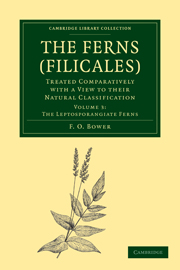
Frederick Orpen Bower (1855–1948) was a renowned botanist best known for his research on the origins and evolution of ferns. Appointed Regius Professor of Botany at the University of Glasgow in 1885, he became a leading figure in the development of modern botany and the emerging field of paleobotany, devising the interpolation theory of the life cycle in land plants. First published between 1923 and 1928 as part of the Cambridge Botanical Handbook series, The Ferns was the first systematic classification of ferns according to anatomical, morphological and developmental features. In this three-volume work Bower analyses the major areas of comparison between different species, describes primitive and fossil ferns and compares these species to present-day fern species, providing a comprehensive description of the order. Volume 3 describes, analyses and classifies extant species of ferns.
My first job was with the Tea Research Institute of East Africa. This institute served the tea industries in three neighbouring countries, Kenya, Tanzania and Uganda, each with diverse ecological conditions. The results of the research, which was largely funded by the industry, had to be interpreted and applied to areas distant from the location of the field experiments, and then communicated to smallholders as well as large estates in appropriate ways. There was little opportunity to undertake basic research as the industry wanted answers to immediate practical questions, but if the results were to have generic value answers to fundamental questions were also needed.
My second job was in the UK with Wye College (University of London) where the task was to support the introduction of maize, a ‘new crop’, into British agriculture. This might seem very different from the job in East Africa, but the challenge was the same. To undertake and report research of immediate value to enterprising farmers concerned about profitability, yet supported by good science. It also meant working with a multidisciplinary team of agronomists, engineers and economists.
There are few easily identifiable or accessible sources where the results of international irrigation research have been brought together and interpreted in coherent and useful ways for individual crops. This is in part due to the diversity of sources, and also to the difficulty of reconciling the results of research conducted in contrasting situations, often with insufficient supporting information, to allow the results to be extrapolated to new situations with confidence (Carr, 2000a).
A scientific understanding of the role that water plays in the growth and development of crops is essential, but this knowledge needs to be interpreted and presented as practical advice in a language that can assist planners, irrigation engineers, irrigation agronomists and producers to allocate and use water, whether rainfall or irrigation, effectively and profitably. Communication between the professions attempting to improve irrigation water management for the benefit of the commercial producer and the wider community can always be improved. Field experiments must be designed and managed to quantify with precision the (marketable) yield responses of crops to water. Adequate supporting measurements need to be taken to enable the results to be interpreted and applied with confidence to other locations, or at other times, where the climate, weather and/or soils may be different. Site specific, single discipline, empirical studies should normally be avoided. But, to minimise duplication of effort, existing information on the water relations and irrigation need of individual crops first needs to be collated and interpreted in practically useful ways. This is especially true for plantation crops having international commercial importance (Carr, 2000a).
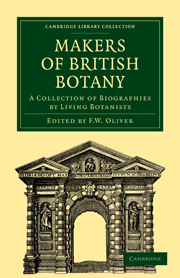
First published in 1913, this volume reproduces a series of lectures on influential botanists delivered in 1911 in the Botanical Department of University College, London. The subjects of these biographies include Sir William Hooker (1785–1865), the first Director of Kew, and John Ray (1627–1705), considered the founder of scientific botany in Britain. The biographies are written by distinguished botanists of the period, over half of them holding a university professorship and membership of the Royal Society. Edited by F. W. Oliver (1864–1951), Professor of Botany at University College, London, from 1890 to 1929, these essays provide information on the lives, and discuss the scientific contributions, of each botanist, each contributor specialising in the same area of botany as the subject. The wide range of subjects covered demonstrates the development of key botanical concepts and the growth of scientific botany in the eighteenth and nineteenth centuries.
Tea (Camellia sinensis L.) is believed to have originated within the fan-shaped area extending from the Assam/Burma border in the west to China in the east (c. 26° N), and south from this line through Burma and Thailand to Vietnam (c. 14° N) (Kingdom-Ward, 1950; Mair and Hoh, 2009). This is an area of monsoon climates with a warm, wet summer and a cool, dry (or less wet) winter. From the main centres of cultivation in South-east Asia tea has been introduced into many other areas of the world and is now grown in conditions that range from Mediterranean-type climates to the hot, humid tropics, from Georgia in the north (42° N) to Argentina (27° S) and New Zealand (37° S) in the south, and from sea level to 2700 m altitude (Carr, 1972). By far the largest producer of tea is China (estimated planted area by 2008 = 1.4 million ha; annual production of processed tea = 1.3 million t) followed by India (474 000 ha; 800 000 t) and then Kenya (158 000 ha; 345 000 t) and Sri Lanka (222 000 ha; 319 000 t) (FAO, 2010b).
In this chapter, the contribution of research into the water relations and irrigation requirements of tea over the last 40 years to commercial crop management, and to our understanding of the physiology of the crop, is summarised and reviewed. The focus is on work done in eastern Africa where the Tea Research Foundation of Kenya (TRFK; 0° 22c′ S; alt. 2200 m), the Tea Research Institute of Tanzania (TRIT, 8° 32′ S; alt. 1840 m), and the Tea Research Foundation of Central Africa (TRFCA, 16° 05′ S; alt. 630 m), based in Malawi, have all undertaken fundamental research on these topics. Prior to 1978, the Tea Research Institute of East Africa (TRIEA) served three countries – Kenya, Tanzania and Uganda. Some of the major private tea companies also undertake their own research.
The coconut (Cocos nucifera L.) contributes to the livelihoods of millions of people in the developing world, not only through its production but also through employment generated by the many associated industries. It is the most wide-spread, economically useful palm of the wet tropics, being found mainly in coastal areas between latitudes 20° N and 20° S of the equator.
Although there still remains some uncertainty about the coconut's centre of origin(it may be South America), it is generally accepted that the coconut originated in the south-west Pacific or the Indian Ocean and that it became domesticated in Malaysia and on the coasts and islands between South-east Asia and the western Pacific. It has been present in the Pacific islands (a centre of genetic diversity) for millions of years, long before their settlement by Polynesians, where it is an indigenous species. It is believed that coconut was distributed widely by nuts floating in ocean currents and germinating after they were washed ashore in new locations. In this way it probably reached southern India and Sri Lanka, where the coconut has a recorded history of 2000–3000 years, and possibly Madagascar and eastern Africa. The nuts were probably also carried by humans as a source of food and drink on long sea voyages, reaching West Africa and the Americas about 500 years ago when the coconut became pantropical (Purseglove, 1972; Harries, 1978, 1995; Persley, 1992).
C. E. Raven (1885–1964) was an academic theologian elected Regius Professor of Divinity at the University of Cambridge in 1932, who developed an interest in natural history and the history of scientific thought. First published in 1947, this volume demonstrates how changing attitudes to the natural world reflected and influenced the transformations in scientific thought between the medieval period and the eighteenth century. Raven's focus on the field of 'natural history' reveals how the scientific ideas behind modern biological studies developed from the richly illustrated and often fantastical bestiaries of the medieval world. The subjects of this volume are grouped chronologically into Pioneers, Explorers and Popularisers, with biographical details woven together with discussions of their academic work. The book provided a wealth of new information concerning the founders of natural history and remains a valuable contribution to this subject.
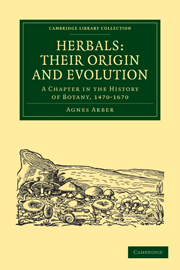
Agnes Arber (1879–1960) was a prominent British botanist specialising in plant morphology and the history of botany. In 1946 she became the first female botanist to be elected a Fellow of the Royal Society. First published in 1912 and issued in an expanded second edition in 1938, this volume traces the history and development of printed herbals between 1470 and 1670. This two-hundred-year period was the most prolific for the publication of herbals, and significantly saw the emergence of botany as a scientific discipline within the study of natural history. Although Arber mentions the medical aspects of the herbal, her analysis remains focused on investigating herbals from a botanical view, with chapters devoted to the evolution of plant descriptions, classifications and illustrations. Her book remains the standard work on this subject. The text of this volume is taken from a 1953 reissue of the 1938 second edition.
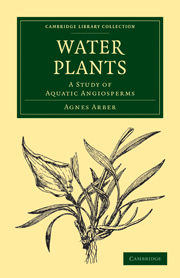
Agnes Arber (1879–1960) was a prominent British botanist specialising in plant morphology and comparative anatomy. In 1946, she became the first female botanist to be elected a Fellow of the Royal Society. First published in 1920, this volume provides a detailed anatomical study of aquatic flowering plants, with a discussion of their evolutionary history. Arber describes the general anatomical and reproductive organs, life histories and physiological adaptations of aquatic plants in detail, with interpretations informed from her previous experimental work. The final section of this volume discusses the evolutionary history of aquatic plants in the light of affinities to terrestrial flowering plants. Arber's account of aquatic plants was the first general description of these plants published, and provides a classic example of the comparative anatomy studies which were central to botanical investigation during the early twentieth century. An extensive bibliography and over 170 illustrations are included in this volume.
Sugar cane (Saccharum officinarum L., the so-called Noble Cane because of its fine thick stem) is believed to have originated in the islands of the South Pacific, probably New Guinea (2–10° S) having evolved through human selection from strains of two wild species S. robustum and S. spontaneum and hybridisation with S. sinense (Purseglove, 1972; Bull and Glasziou, 1976; Julien et al., 1989; Jones et al., 1990; Simmonds, 1998). Because of its natural sweetness, it has been grown for chewing since ancient times in the Pacific and South-east Asia. The production of sugar from sugar cane began in India, followed by China, Persia (Iran), Egypt and Spain and elsewhere around the Mediterranean. In the seventeenth century the first plantations were established in the West Indies, and the resultant need for labour, particularly for harvesting, led to sugar cane's links with the slave trade.
Most of the commerce between Europe and the sugar regions of the west that followed was subsequently based on the outward shipment of slaves and the homeward carriage of sugar, molasses and rum (Purseglove, 1972; Hobhouse, 1985). Molasses, the dark brown viscous liquid residue left behind after the centrifugal process has ended and no more sucrose can be extracted, is one of the most important by-products (contains 50% fermentable sugars) from the manufacture of cane sugar. It is used as a raw material in industry. Rum is produced by the fermentation of molasses, followed by distillation. Other products include industrial ethyl alcohol (ethanol), which is manufactured from molasses, and bagasse, the fibrous residue left after the extraction of juice from the cane (used for fuel in the sugar factory, as well as in various manufacturing processes). The pith from the bagasse is used as a stockfeed. Not much of the plant is wasted.
Dame Helen Gwynne-Vaughan (1879–1967) was a prominent British mycologist, specialising in the sexual process of fungi. In 1909 she was appointed Head of the Department of Botany at Birkbeck College, becoming Professor of Botany when Birkbeck College joined the University of London in 1920. This volume was first published in 1922 as part of the Cambridge Botanical Handbooks series. The introduction provides a detailed description of the structure, sexual reproduction, parasitism and symbiosis of all fungi, with subsequent chapters describing fully the morphology and reproduction of genera within the phylum ascomycetes and the orders ustilaginales and uredinales on which Gwynne-Vaughan based her research. Illustrations and a bibliography accompany each chapter. This volume provides an insight into the study of mycology in the early twentieth century, before technological advances in the field of cytology revolutionized the discipline.