To save content items to your account,
please confirm that you agree to abide by our usage policies.
If this is the first time you use this feature, you will be asked to authorise Cambridge Core to connect with your account.
Find out more about saving content to .
To save content items to your Kindle, first ensure no-reply@cambridge.org
is added to your Approved Personal Document E-mail List under your Personal Document Settings
on the Manage Your Content and Devices page of your Amazon account. Then enter the ‘name’ part
of your Kindle email address below.
Find out more about saving to your Kindle.
Note you can select to save to either the @free.kindle.com or @kindle.com variations.
‘@free.kindle.com’ emails are free but can only be saved to your device when it is connected to wi-fi.
‘@kindle.com’ emails can be delivered even when you are not connected to wi-fi, but note that service fees apply.
Thomas Andrew Knight (1759–1838) was a distinguished British naturalist and botanist who is often regarded as the father of nineteenth-century horticultural science. From 1811 to 1838 Knight was the president of the Royal Horticultural Society and his interest in structural biology, plant physiology and plant breeding is evident in this collection of papers, published in 1841. On his country estate in Herefordshire, Knight devoted his time to research and writing, and carried out experiments on plants and trees. He published papers on his theories about such physiological problems as the ascent and descent of sap and how buds are produced. The main focus, however, is on Knight's own practical work: building greenhouses and experimenting with plant nutrition, fertilisation and the improvement of fruit trees by selective breeding (work later appreciated by Darwin). In an interesting chapter on animals, Knight relates his observations on the behaviour of bees and dogs.
Originally published in 1832, this two-volume account of the life of Sir James Edward Smith (1759–1828) was posthumously compiled by his wife, Pleasance (1773–1877). Smith trained originally as a doctor, but his independent wealth enabled him to pursue botany. Hugely influenced by the work of Linnaeus, he benefited greatly from the purchase of the latter's library and herbarium in 1783, upon the advice of his friend, Sir Joseph Banks. He was highly regarded throughout Europe as a botanist, and in 1788 founded the Linnean Society. He published various botanical works, of which the most important was The English Flora (1824–8), and assisted in the publication of many more. His wife recounts his character as well as his achievements, using both narrative and 'various familiar and domestic letters' to do so. Volume 1 includes letters from Banks and Samuel Goodenough, bishop of Carlisle and Smith's close botanical friend.
Sir Charles James Fox Bunbury (1809–86), the distinguished botanist and geologist, corresponded regularly with Lyell, Horner, Darwin and Hooker among others, and helped them in identifying botanical fossils. He was active in the scientific societies of his time, becoming a Fellow of the Royal Society in 1851. This nine-volume edition of his letters and diaries was published privately by his wife Frances Horner and her sister Katherine Lyell between 1890 and 1893. His copious journal and letters give an unparalleled view of the scientific and cultural society of Victorian England, and of the impact of Darwin's theories on his contemporaries. Volume 8 covers the years 1878–83. Family and social matters, and comments on the disturbed political state of Europe, and British military engagements in Africa and Afghanistan, predominate, although Bunbury also comments on plants he has seen and books he has read.
The Irish-born gardener and writer William Robinson (1838–1935) travelled widely to study gardens and gardening in Europe and America. In 1871 he founded a weekly illustrated periodical, The Garden, which he owned until 1919, and he published numerous books on different aspects of horticulture. Topics included annuals, hardy perennials, alpines and subtropical plants, as well as accounts of his travels. High Victorian garden fashion involved formal beds of exotic and hothouse flowers. Robinson was influential in introducing less formal garden designs, using plants more suited to the English climate. This work was published in 1871, and showed how impressive outdoor displays could be achieved from hardier species, rather than relying on expensive greenhouses for short-lived plants. Robinson's most famous books, The Wild Garden (1870) and The English Flower Garden (1883) are also reissues in this series.
James Shirley Hibberd (1825–90) was a journalist and writer on gardening, whose popular works had great influence on middle-class taste. Although not a trained horticulturalist, his many books were based on practical experience. He developed a succession of gardens in North London, concentrating on particular types of plants, and his books reflected this work, with this book of 1864 and The Fern Garden (1869) being particularly successful. He also wrote on garden design, flower arrangement, garden furniture and architecture, and his Rustic Adornments of 1856 (reissued in this series, together with The Fern Garden), is an interesting document of social history. He edited the magazine Floral World until 1875 and later The Gardener's Magazine, and was even consulted by the government about potato blight. His engaging and very personal style made him a popular forerunner of modern celebrity gardeners, and set a fashion for highly decorative and ornamental gardens.
George Bentham (1800–84) was one of Britain's most influential botanists, whose own collection of plant specimens numbered more than 100,000. Although he donated his herbarium to the Royal Botanic Gardens, Kew in 1854, he continued to make significant contributions to the field, including this exhaustive, seven-volume work detailing the plant life of Australia, which was published from 1863 to 1878. It was part of a series of works commissioned by the British government to document the flora in its colonies. Using the extensive numbers of specimens at Kew - and with the help of Ferdinand Mueller (1825–96), a German botanist in Australia - Bentham was able to compile descriptions of more than 8,000 species of Australian plants, making these volumes the first completed compendium of the flora of any large continental area. Volume 6, published in 1873, describes 20 orders of flora in the classes dicotyledon and monocotyledon.
Alexander von Humboldt (1769–1859) was an intellectual giant: an explorer who helped lay the foundations of biogeography, a naturalist who influenced Charles Darwin, and a botanist who developed a model of the Earth's climate zones. He travelled extensively in Europe, carried out scientific explorations across the Russian Empire and in Latin America, and devoted much energy to seeking a unified view of the different branches of scientific knowledge. Ansichten der Natur, published in 1808 with a second edition in 1826, aimed to 'engage the imagination' as well as to communicate new ideas, and was translated into many European languages. This authorised translation of the third and final 1849 edition, dating from Humboldt's eightieth year, was published in 1850, though another English translation (by Mrs Sabine) had appeared the previous year. The wide coverage, including geology, geography and biology, is typical of Humboldt, as is the precise and engaging style.
Sir Charles James Fox Bunbury (1809–86), the distinguished botanist and geologist, corresponded regularly with Lyell, Horner, Darwin and Hooker among others, and helped them in identifying botanical fossils. He was active in the scientific societies of his time, becoming a Fellow of the Royal Society in 1851. This nine-volume edition of his letters and diaries was published privately by his wife Frances Horner and her sister Katherine Lyell between 1890 and 1893. His copious journal and letters give an unparalleled view of the scientific and cultural society of Victorian England, and of the impact of Darwin's theories on his contemporaries. Volume 6 covers the years 1869–72. Bunbury was less active in scientific matters than before, but still reading copiously, carrying on a busy social life, and developing the gardens of his home in Suffolk. There are many comments on current affairs and politics.
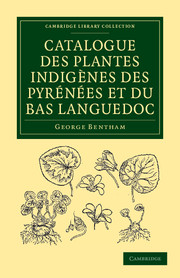
English botanist George Bentham (1800–84) is most famous as the author of the popular Handbook of the British Flora (1858), which ran into many editions. A distinguished scientist, Bentham was elected a Fellow of the Royal Society in 1862, and served as President of the Linnean Society of London for thirteen years (1861–74). Originally published in 1826, this catalogue of plants from the Pyrénées region of France is Bentham's second work. Inspired by French botanist de Candolle (1778–1841) as well as by the analytical methods of his uncle, the famous philosopher Jeremy Bentham, this book is a systematic overview of the plants found between Figueras, in the north of Spain, and Bordeaux, Narbonne and Montpellier in France. The book opens with the story of Bentham's 1825 three-month trip through the Pyrenees region, with botanist G. A. Walker Arnott (1799–1868), on which the Catalogue is based.
John Lindley (1799–1865) was an English botanist and a leading authority on orchids. He attended Norwich Grammar School but was unable to afford university. Lindley's passion for botany helped him into the position of assistant in the herbarium of the naturalist and explorer Sir Joseph Banks. He soon established himself as a botanist of considerable talent, and was elected to the Linnean Society of London at the age of twenty-one. In 1822 he became assistant secretary to the Horticultural Society, and was elected Fellow of the Royal Society in 1828. He was Professor of Botany at University College, London, from 1829 to 1860. Published in 1838, Flora Medica is a systematic reference work written to help medical students understand the botanical characteristics and therapeutic properties of important medicinal plants from around the world. The book includes an appendix of indigenous names of Asiatic species, and a full index.
John D. Sedding (1838–91) was an English church architect and an influential figure in the Arts and Crafts movement. Having worked in Penzance and Bristol, he was elected a Fellow of the Royal Institute of British Architects in 1874 and set up a practice in London, eventually becoming a neighbour of William Morris. His designs included new churches such as Holy Trinity in Sloane Street (1888–90), Holy Redeemer in Clerkenwell (1887–95), and All Saints, Falmouth (1887–90), as well as restoration projects and decorative work. In 1888 he moved to Kent, and developed his interests in gardening and garden design. This book, completed in 1890 and published posthumously in 1891, sets out Sedding's vision for the landscaped garden. It helped to revive garden features such as terraces, covered walkways and topiary, and inspired generations of garden designers, particularly in the Arts and Crafts movement.
This biography of Swedish botanist Carl Linnaeus (1707–78) was originally published in 1903 by another Swedish botanist, Theodor Magnus Fries (1832–1913). This English version, published in 1923, was translated and edited by British botanist Benjamin Daydon Jackson (1846–1927). Jackson is best known for founding (with J. D. Hooker) the Index Kewensis, the register of all botanical names of seed plants; he also acted as Secretary of the Linnean Society for twenty-two years, becoming its General Secretary in 1902. This biography covers the early life of Linnaeus (including some family history), his student years at Uppsala, his travels, his years as a teacher, notes on his personality and his relationship with the wider scientific community. Jackson provides further information in the appendices, enhancing Fries' work with Linnaeus' genealogy, a list of his pupils, his private notes on 'Divine Punishment' and a brief history of Sweden during Linnaeus' lifetime.
Sir Charles James Fox Bunbury (1809–86), the distinguished botanist and geologist, corresponded regularly with Lyell, Horner, Darwin and Hooker among others, and helped them in identifying botanical fossils. He was active in the scientific societies of his time, becoming a Fellow of the Royal Society in 1851. This nine-volume edition of his letters and diaries was published privately by his wife Frances Horner and her sister Katherine Lyell between 1890 and 1893. His copious journal and letters give an unparalleled view of the scientific and cultural society of Victorian England, and of the impact of Darwin's theories on his contemporaries. Volume 3 covers the years from 1848 to 1856. In 1848 Bunbury published a well-received account of South Africa, and particularly its natural history: he had accompanied Sir George Napier, his step-mother's father, then governor general. Another notable event was a meeting in Berlin with Alexander von Humboldt.
Sir Charles James Fox Bunbury (1809–86), the distinguished botanist and geologist, corresponded regularly with Lyell, Horner, Darwin and Hooker among others, and helped them in identifying botanical fossils. He was active in the scientific societies of his time, becoming a Fellow of the Royal Society in 1851. This nine-volume edition of his letters and diaries was published privately by his wife Frances Horner and her sister Katherine Lyell between 1890 and 1893. His copious journal and letters give an unparalleled view of the scientific and cultural society of Victorian England, and of the impact of Darwin's theories on his contemporaries. The final volume covers the years 1884–6. Bunbury's health was declining, but he kept up his journal- and letter-writing (although many of his contemporaries had predeceased him), and had many visitors. The volume ends with tributes written by his many friends.
John Stevens Henslow (1796–1861), professor of botany at Cambridge University and Anglican clergyman, is best remembered for his role as a mentor to Charles Darwin. First published in 1862, this biography by Henslow's colleague and brother-in-law, Leonard Jenyns, pays tribute to a man he describes as one of the most remarkable of his time. Through vivid accounts of times spent with Henslow both in the university and on travels around Britain, he paints a portrait of a modest and conscientious man, whose pursuits were intended solely for the benefit of others. Recounting Henslow's scientific work and religious endeavours, Jenyns also explores his pioneering contribution to botany and geology, his assistance to the farmers and the poor of his parish, and the role of his faith in his work. Compiled with help from Darwin and other colleagues, Jenyns' memoir provides a unique insight into an important figure in scientific history.
Originally published in 1832, this two-volume account of the life of Sir James Edward Smith (1759–1828) was posthumously compiled by his wife, Pleasance (1773–1877). Smith trained originally as a doctor, but his independent wealth enabled him to pursue botany. Hugely influenced by the work of Linnaeus, he benefited greatly from the purchase of the latter's library and herbarium in 1783, upon the advice of his friend, Sir Joseph Banks. He was highly regarded throughout Europe as a botanist, and in 1788 founded the Linnean Society. He published various botanical works, of which the most important was The English Flora (1824–8), and assisted in the publication of many more. His wife recounts his 'religious, social and scientific character' as well as his achievements, and Volume 2 includes correspondence from Alexander von Humboldt, and concludes with an appendix in which short papers by Smith present a variety of topics.
Irrigation has been used for thousands of years to maximize the performance, efficiency and profitability of crops and it is a science that is constantly evolving. This potential for improved crop yields has never been more important as population levels and demand for food continue to grow. Recognising the need for a coherent and accessible review of international irrigation research, this book examines the factors influencing water productivity in individual crops. It focuses on nine key plantation/industrial crops on which millions of people in the tropics and subtropics depend for their livelihoods (banana, cocoa, coconut, coffee, oil palm, rubber, sisal, sugar cane and tea). Linking crop physiology, agronomy and irrigation practices, this is a valuable resource for planners, irrigation engineers, agronomists and producers concerned with the international need to improve water productivity in agriculture in the face of increased pressure on water resources.
This world-famous work was begun by Sir William Jackson Hooker (1785–1865) in 1837, and the ten volumes reissued here were produced under his authorship until 1854, at which point his son, Joseph Dalton Hooker (1817–1911) continued the work of publication. Hooker's own herbarium, or collection of preserved plant specimens, was so extensive that at one point he stored it in one house and lived in another; it was left to the nation on his death. Each volume contains 100 line drawings of plants, and each is accompanied by a full Latin description, with notes in English on habitat and significant features. The order of the plants in each volume is not systematic, but two 'indexes' at the beginning provide plant lists, in alphabetical order and 'arranged according to the natural orders'.
Sir Charles James Fox Bunbury (1809–86), the distinguished botanist and geologist, corresponded regularly with Lyell, Horner, Darwin and Hooker among others, and helped them in identifying botanical fossils. He was active in the scientific societies of his time, becoming a Fellow of the Royal Society in 1851. This nine-volume edition of his letters and diaries was published privately by his wife Frances Horner and her sister Katherine Lyell between 1890 and 1893. His copious journal and letters give an unparalleled view of the scientific and cultural society of Victorian England, and of the impact of Darwin's theories on his contemporaries. Volume 5 covers the years 1865–8, and shows Bunbury's wide reading, from Latin poetry and military history to new books such as the latest edition of Lyell's Elements of Geology, as well as an interesting correspondence between Bunbury, Lyell, Hooker and Darwin about Agassiz's theories on glaciation.
John Lindley (1799–1865) was an English horticulturalist who worked for Sir Joseph Banks and was later instrumental in saving the Royal Horticultural Society from financial disaster. His earlier books on British plants were well received and he was influential in the realm of botanical nomenclature, especially in orchidology. He was a prolific author and many of his books were aimed at a non-specialist readership. His aim in this work, published in 1840, was to provide 'the intelligent gardener, and the scientific amateur … with the rationalia of the more important operations of horticulture'. Beginning with a chapter on seeds, the first part of the book describes the life and structure of a plant - the root, the stem, the leaves, the flowers and the fruit. The second part moves on to practical topics, such as ventilation and seed-saving, as well as pruning and potting, explaining many basic concepts of plant cultivation.