To save content items to your account,
please confirm that you agree to abide by our usage policies.
If this is the first time you use this feature, you will be asked to authorise Cambridge Core to connect with your account.
Find out more about saving content to .
To save content items to your Kindle, first ensure no-reply@cambridge.org
is added to your Approved Personal Document E-mail List under your Personal Document Settings
on the Manage Your Content and Devices page of your Amazon account. Then enter the ‘name’ part
of your Kindle email address below.
Find out more about saving to your Kindle.
Note you can select to save to either the @free.kindle.com or @kindle.com variations.
‘@free.kindle.com’ emails are free but can only be saved to your device when it is connected to wi-fi.
‘@kindle.com’ emails can be delivered even when you are not connected to wi-fi, but note that service fees apply.
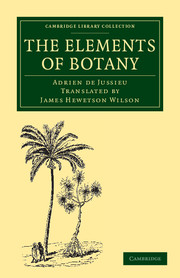
The author of pioneering works on the plant families Euphorbiaceae and Malpighiaceae, French botanist Adrien de Jussieu (1797–1853), from a famous family of scientists, became professor of botany at the Paris Museum National d'Histoire Naturelle in 1826. The author of several specialised monographs, he is best known for his Botanique: Cours élémentaire d'histoire naturelle (1842), an exhaustive introduction to botany originally intended for use in French schools. This much acclaimed book went through twelve editions between 1842 and 1884, and was translated into many languages. This English translation, completed while he was still an Oxford student by the young British botanist James Hewetson Wilson (1826–50), was first published in 1849. It contains additional descriptions of the different systems and structures that clarify de Jussieu's terminology, as well as an appendix on geology.
Sir Charles James Fox Bunbury (1809–86), the distinguished botanist and geologist, corresponded regularly with Lyell, Horner, Darwin and Hooker among others, and helped them in identifying botanical fossils. He was active in the scientific societies of his time, becoming a Fellow of the Royal Society in 1851. This nine-volume edition of his letters and diaries was published privately by his wife Frances Horner and her sister Katherine Lyell between 1890 and 1893. His copious journal and letters give an unparalleled view of the scientific and cultural society of Victorian England, and of the impact of Darwin's theories on his contemporaries. Volume 4 covers the years 1857–64. Bunbury correctly foresaw in October 1859 that 'Darwin's forthcoming book on Species ... is likely to cause no little combustion in the scientific world'. He provides a valuable commentary on its reception over the following months.
Containing the Descriptions and Synonymes of the Fruits and Fruit Trees Commonly Met with in the Gardens and Orchards of Great Britain, with Selected Lists of Those Most Worthy of Cultivation
Robert Hogg (1818–97) was a British nurseryman and an early secretary of the Royal Horticultural Society: a prize medal is named in his honour. Born in Berwickshire, Hogg trained in medicine at Edinburgh before following his father into fruit tree cultivation, and became joint editor of the Cottage Gardener, later the Journal of Horticulture. In 1851, he published The British Pomology (also reissued in this series): this work, on apples, was apparently intended as a study of British fruit trees, but no further volumes followed. Instead, in 1860, Hogg published this comprehensive catalogue of British fruit, which ran to five, increasingly extended, editions over the next twenty-five years. It became the standard reference work, and was even plagiarised in Scott's Orchardist: however Hogg sued and obtained an injunction preventing further sales. Hogg promoted systematic work in the Royal Horticultural Society and was instrumental in setting up its fruit committee.
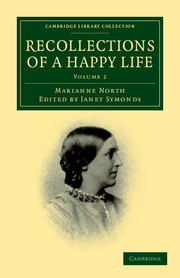
Marianne North (1830–90), the Victorian amateur botanist and painter, travelled to distant countries of the world to paint exotic flora in their natural surroundings. This two-volume collection of her memoirs, edited by her sister and published in 1892, records North's remarkable travels. Laden with her palettes and easels, the independent North travelled alone and fended for herself. Her journals describe how she endured swarms of insects, scaled cliffs, trudged through wilderness and crossed swamps in order to reach the plants she wanted to paint. Volume 2 covers North's travels to Australia and New Zealand, which she undertook at the suggestion of Charles Darwin. The work concludes with the last journey she made, to Chile in 1884–5, to paint the monkey-puzzle tree in its natural habitat. This autobiography reveals the stories behind North's art, which can still be appreciated today since her vivid paintings are displayed at Kew Gardens.
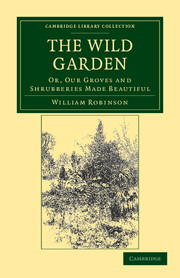
An Irish-born gardener and writer, William Robinson (1838–1935) travelled widely to study gardens and gardening in Europe and America. He founded a weekly illustrated periodical, The Garden, in 1871, which he owned until 1919, and published numerous books on different aspects of horticulture. His most famous book, The English Flower Garden (also reprinted in this series), was published in 1883, and fifteen editions were issued in his lifetime. The Wild Garden, published in 1870, attacks contemporary fashions in public parks and private gardens, which involved showy masses of colour in labour-intensive summer bedding, using mostly subtropical and exotic species. He calls for a return to native species, found in traditional English gardens, pointing out that these are more economical than short-lived annuals, and that there is much greater variety available to the garden designer. He suggests plants more suitable for the English climate, and exotics more capable of naturalisation.
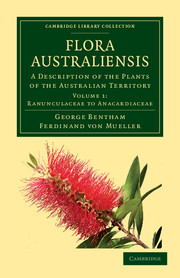
George Bentham (1800–84) was one of Britain's most influential botanists, whose own collection of plant specimens numbered more than 100,000. Although he donated his herbarium to the Royal Botanic Gardens, Kew in 1854, he continued to make significant contributions to the field, including this exhaustive, seven-volume work detailing the plant life of Australia, which was published from 1863 to 1878. It was part of a series of works commissioned by the British government to document the flora in its colonies. Using the extensive numbers of specimens at Kew - and with the help of Ferdinand Mueller (1825–96), a German botanist in Australia - Bentham was able to compile descriptions of more than 8,000 species of Australian plants, making these volumes the first completed compendium of the flora of any large continental area. Volume 1, published in 1863, introduces the project and describes 39 orders of the dicotyledon class of flora.
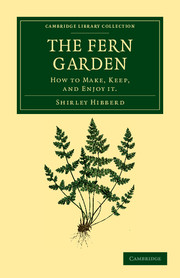
James Shirley Hibberd (1825–90) was a journalist and writer on gardening, whose popular works had great influence on middle-class taste. Although not a trained horticulturalist, his many books were based on practical experience. He developed a succession of gardens in north London concentrating on particular types of plants, and his books reflected this work, with the Rose Book (1864) and the Fern Garden (1869) being particularly successful. He also wrote on garden design, flower arrangement, garden furniture and architecture, and his Rustic Adornments of 1856, also published in this series, is an important work of social and fashion history. He edited the magazine Floral World until 1875 and later the Gardener's Magazine, and was even consulted by the government about potato blight. His engaging and very personal style made him a popular forerunner of modern celebrity gardeners, and set a fashion for highly decorative and ornamental gardens.
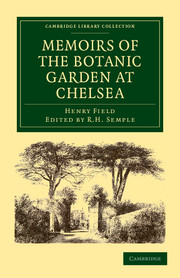
Henry Field (1755–1837) was a British apothecary and member of the Society of Apothecaries of London. Besides serving in various administrative capacities for the Society, as well as for the London Annuity Society (founded by his father), he was nominated in 1831 as one of the medical officers for the City of London board of health, charged with taking precautions against an outbreak of cholera in the city. A lecturer and regular contributor to medical journals, Field is also the author of this history of the Chelsea Physic Garden, first published in 1820. The present reissue, published in 1878, was revised and extended by Robert Hunter Semple (1815–91). The garden was originally created by the Society as a professional resource in 1673 and the book covers its development up to 1878, and also includes a ground plan of the garden in that year.
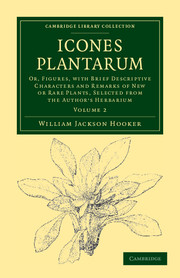
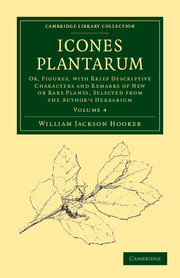
This world-famous work was begun by Sir William Jackson Hooker (1785–1865) in 1837, and the ten volumes reissued here were produced under his authorship until 1854, at which point his son, Joseph Dalton Hooker (1817–1911) continued the work of publication. Hooker's own herbarium, or collection of preserved plant specimens, was so extensive that at one point he stored it in one house and lived in another; it was left to the nation on his death. Each volume contains 100 line drawings of plants, and each is accompanied by a full Latin description, with notes in English on habitat and significant features. The order of the plants in each volume is not systematic, but two 'indexes' at the beginning provide plant lists, in alphabetical order and 'arranged according to the natural orders'.
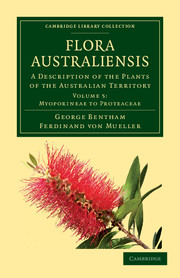
George Bentham (1800–84) was one of Britain's most influential botanists, whose own collection of plant specimens numbered more than 100,000. Although he donated his herbarium to the Royal Botanic Gardens, Kew in 1854, he continued to make significant contributions to the field, including this exhaustive, seven-volume work detailing the plant life of Australia, which was published from 1863 to 1878. It was part of a series of works commissioned by the British government to document the flora in its colonies. Using the extensive numbers of specimens at Kew - and with the help of Ferdinand Mueller (1825–96), a German botanist in Australia - Bentham was able to compile descriptions of more than 8,000 species of Australian plants, making these volumes the first completed compendium of the flora of any large continental area. Volume 5, published in 1870, gives the details of 14 orders of monopetalae and monochlamydeae dicotyledon flora.
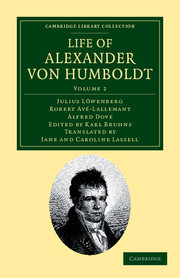
Alexander von Humboldt (1769–1859) was a naturalist, explorer and philanthropist now well known for his multidisciplinary approach to science. First published in English in 1873, this two-volume biography was translated from the German edition of 1872, edited by Karl Bruhns, which had been compiled in commemoration of the centenary of Humboldt's birth. Incorporating numerous extracts of Humboldt's own warmly written letters and anecdotes from his many acquaintances, it charts his travels in South America, Asia and Europe. Volume 2 covers his later life, exploring his impecunious period in Paris at the École Polytechnique, where he shared rooms with the famous French chemist Gay-Lussac, and later, his close association with King Frederick William IV of Prussia. Ideal for students and researchers in the history of science, this is a minutely detailed and compelling insight into the life of the man behind the scientist.
Sir Charles James Fox Bunbury (1809–86), the distinguished botanist and geologist, corresponded regularly with Lyell, Horner, Darwin and Hooker among others, and helped them in identifying botanical fossils. He was active in the scientific societies of his time, becoming a Fellow of the Royal Society in 1851. This nine-volume edition of his letters and diaries was published privately by his wife Frances Horner and her sister Katherine Lyell between 1890 and 1893. His copious journal and letters give an unparalleled view of the scientific and cultural society of Victorian England, and of the impact of Darwin's theories on his contemporaries. Volume 2 covers the years 1844–8, and shows how Bunbury's marriage brought him into close contact with the geologist Charles Lyell, whom he greatly admired, and who became his brother-in-law. His diaries mention attending lectures by Sedgwick and Owen, and socialising with Babbage and Henslow among others.
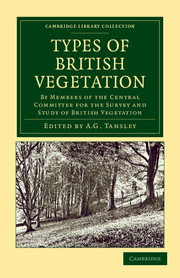
Distinguished plant ecologist A. G. Tansley (1871–1955) is widely considered to be the father of British ecology. He was one of the founding members of the British Ecological Society and during his career he edited two important journals on the subject: The New Phytologist and the Journal of Ecology. He was also part of a committee formed in 1904 to survey systematically the vegetation of the British Isles. This book, edited by Tansley and first published in 1911, is the result of that survey. It contains contributions by leading botanists of the early twentieth century, and contains detailed maps, photographs and figures. The physical characteristics and climate of Britain are outlined early in the book and later the plant communities of particular areas such as moors, fens and the coast are discussed. This is a significant work that will appeal to both plant ecologists and natural historians.
To Which is Annexed the Diary of Linnaeus, Written by Himself, and Now Translated into English, from the Swedish Manuscript in the Possession of the Editor
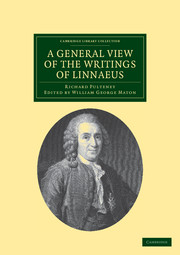
Carl Linnaeus (1707–88), father of modern taxonomy, was one of the most important scientists of the eighteenth century. This biography was written by Richard Pulteney (1730–1801), a physician and botanist who greatly admired Linnaeus' methods and aimed to promote them in England. The first edition was published in 1781 and contains a thorough account of the major works of Linnaeus and his unpublished papers. As well as details of his academic career, the work also gives insights into Linnaeus' character and personal life. The second edition, reissued here, was edited by William George Maton (1774–1835), a physician and member of the Linnean Society, and published in 1805. It contains in addition a memoir of Pulteney and a translation of a Swedish life of Linnaeus based on his own notes. The book is a rich source of information on a central figure in the history of botany.
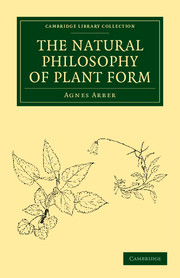
When she was elected a Fellow of the Royal Society in 1946, Agnes Arber (1879–1960) was one of only three women to have been admitted into the institution. Arber conducted research that focused mainly on the morphology of flowering plants, but her work is characterised by its explorations of historical botany and evolution. First published in 1950, this book widens the scope of morphology into a study of all aspects of form across the whole chronology of botany. Arber begins with Aristotle and investigates the work of early modern botanists like Bacon and Goethe, before examining the effects of this wider approach on subjects like evolution and taxonomy. Arguing that post-Darwinian doctrine often causes botanists to twist their observations to suit a hypothetical history of phylogenesis, rather than changing the hypothesis to suit observational facts, this bold and fascinating text will interest students of biology and philosophy alike.
This world-famous work was begun by Sir William Jackson Hooker (1785–1865) in 1837, and the ten volumes reissued here were produced under his authorship until 1854, at which point his son, Joseph Dalton Hooker (1817–1911) continued the work of publication. Hooker's own herbarium, or collection of preserved plant specimens, was so extensive that at one point he stored it in one house and lived in another; it was left to the nation on his death. Each volume contains 100 line drawings of plants, and each is accompanied by a full Latin description, with notes in English on habitat and significant features. The order of the plants in each volume is not systematic, but two 'indexes' at the beginning provide plant lists, in alphabetical order and 'arranged according to the natural orders'.
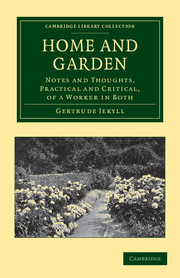
Gertrude Jekyll (1843–1932), the distinguished and influential garden designer of the late nineteenth and early twentieth centuries, originally trained as an artist but later turned her hand to craftwork, gardening, and plant collecting and breeding. During her career she collaborated with distinguished architects such as Sir Edwin Lutyens and reached a popular audience through the publication of articles in newspapers and magazines such as William Robinson's The Garden. Jekyll's second book, first published in 1890, is a collection of her advice and reflections on a range of topics, particularly those relating to her own home, Munstead Wood. It contains chapters on particular plants, and gives guidance on projects such as building rock gardens, as well as more idiosyncratic pieces on her cats, or the importance of one's own tools. Jekyll's informal tone and the range of topics discussed make this a fascinating work of social and gardening history.
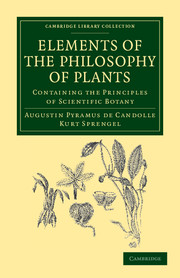
Containing the Principles of Scientific Botany; Nomenclature, Theory of Classification, Phythography; Anatomy, Chemistry, Physiology, Geography, and Diseases of Plants
This treatise on scientific botany brings together the works of two leading European scientists from the beginning of the nineteenth century, the Swiss botanist Augustin Pyramus de Candolle (1778–1841) and the German botanist and physicist Kurt Polycarp Joachim Sprengel (1766–1833). First published in German in 1820, it was almost immediately translated (anonymously) into English and published in Edinburgh by Blackwood in 1821. This collaborative volume includes three chapters from de Candolle's Théorie élémentaire de la botanique published in Paris in 1819, while the remaining texts and the preface were written by Sprengel; at the time, it provided significant advances on previous botanical theories such as the work of German botanist Carl Ludwig Willdenow (1765–1812). A fascinating document on the evolution of botanical science, the book contains a practical section detailing the characteristics of over forty plants, as well as eight illustrations.
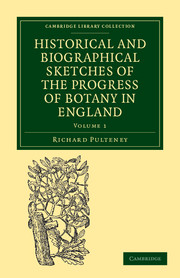
Richard Pulteney (1730–1801) was a Leicestershire physician whose medical career suffered both from a lack of aristocratic patronage and from his dissenting religious background. However, his lifelong interest in botany and natural history, and particularly his work on the new Linnaean system of botanical classification, led to publications in the Gentleman's Magazine and the Philosophical Transactions of the Royal Society. He was elected a Fellow of the Royal Society in 1762. His book on Linnaeus (also reissued in this series), first published in 1782, was later considered to be of great significance for the acceptance in England of the Linnaean system, and this two-volume work, published in 1790, is still relevant to the study of the history of botany. Volume 1 begins in 'primaeval' and 'druidical' times and continues to the seventeenth century, including the first printed herbals and the work of the great botanist John Ray.
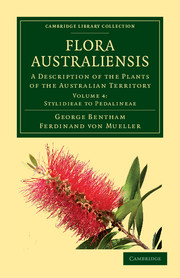
George Bentham (1800–84) was one of Britain's most influential botanists, whose own collection of plant specimens numbered more than 100,000. Although he donated his herbarium to the Royal Botanic Gardens, Kew in 1854, he continued to make significant contributions to the field, including this exhaustive, seven-volume work detailing the plant life of Australia, which was published from 1863 to 1878. It was part of a series of works commissioned by the British government to document the flora in its colonies. Using the extensive numbers of specimens at Kew - and with the help of Ferdinand Mueller (1825–96), a German botanist in Australia - Bentham was able to compile descriptions of more than 8,000 species of Australian plants, making these volumes the first completed compendium of the flora of any large continental area. Volume 4, published in 1869, describes 26 orders of dicotyledon flora in the subclass monopetalae.