To save content items to your account,
please confirm that you agree to abide by our usage policies.
If this is the first time you use this feature, you will be asked to authorise Cambridge Core to connect with your account.
Find out more about saving content to .
To save content items to your Kindle, first ensure no-reply@cambridge.org
is added to your Approved Personal Document E-mail List under your Personal Document Settings
on the Manage Your Content and Devices page of your Amazon account. Then enter the ‘name’ part
of your Kindle email address below.
Find out more about saving to your Kindle.
Note you can select to save to either the @free.kindle.com or @kindle.com variations.
‘@free.kindle.com’ emails are free but can only be saved to your device when it is connected to wi-fi.
‘@kindle.com’ emails can be delivered even when you are not connected to wi-fi, but note that service fees apply.
Gertrude Jekyll (1843–1932) was one of the most influential garden designers of the late nineteenth and early twentieth centuries. Skilled as a painter and in many forms of handicrafts, she found her metier in the combination of her artistic skills with considerable botanical knowledge. Having been collecting and breeding plants, including Mediterranean natives, since the 1860s, she began writing for William Robinson's magazine, The Garden, in 1881, and together they are regarded as transforming English horticultural method and design: Jekyll herself received over 400 design commissions in Britain, and her few surviving gardens are treasured today. Like Robinson's, her designs were informal and more natural in style than earlier Victorian fashions. In this, the first of fourteen books, published in 1899, she stresses the importance of being inspired by nature, and sums up her philosophy of gardening: 'planting ground is painting a landscape with living things'.
Julius Sachs (1832–97) was an important and influential German botanist. He attended Charles University in Prague, gaining his doctorate in 1856. After appointments in Dresden, Chemnitz and Bonn, he took a professorship at the University of Freiburg in 1867. A year later he accepted a chair at Würzburg, where he stayed for the rest of his career. Sachs made important contributions across botanical science, notably in cytology and photosynthesis. He was also largely responsible for the leap in understanding of plant physiology that took place in the second half of the nineteenth century. His famous Textbook of Botany, published here in the 1875 English translation of the final German edition (1874), takes the physiological approach that he pioneered and features hundreds of instructive illustrations and a full index. It was the most influential botanical text of its day, and the standard textbook on the subject for many years.
Leonard Jenyns (1800–93; he changed his name late in life to benefit from a legacy), was a clergyman, and a respected naturalist and zoologist. A distinguished member of a dozen scientific societies, he was educated at Eton, and then at St John's College, Cambridge, where he graduated in 1822. During his tenure as vicar in Swaffham Bulbeck, he made important contributions to zoology, becoming one of the original members of the Zoological Society of London. In 1831, unwilling to spend years away from his parish responsibilities, he turned down the chance to travel as the naturalist on-board H.M.S. Beagle. Published in 1889, this is the second edition of Jenyns' autobiography, which he had first had privately printed. It starts with the major events of his life, then shares a series of scientific anecdotes, including his decision to recommend Darwin instead of himself as the naturalist for the Beagle voyage.
Sir Charles James Fox Bunbury (1809–86), the distinguished botanist and geologist, corresponded regularly with Lyell, Horner, Darwin and Hooker among others, and helped them in identifying botanical fossils. He was active in the scientific societies of his time, becoming a Fellow of the Royal Society in 1851. This nine-volume edition of his letters and diaries was published privately by his wife Frances Horner and her sister Katherine Lyell between 1890 and 1893. His copious journal and letters give an unparalleled view of the scientific and cultural society of Victorian England, and of the impact of Darwin's theories on his contemporaries. Volume 1 begins with a short autobiographical memoir written by Bunbury towards the end of his life, and ends with his marriage to Frances Horner in 1844. It demonstrates his interest in science, encouraged by his parents and continued at Cambridge and during travels in Europe and South America.
This world-famous work was begun by Sir William Jackson Hooker (1785–1865) in 1837, and the ten volumes reissued here were produced under his authorship until 1854, at which point his son, Joseph Dalton Hooker (1817–1911) continued the work of publication. Hooker's own herbarium, or collection of preserved plant specimens, was so extensive that at one point he stored it in one house and lived in another; it was left to the nation on his death. Each volume contains 100 line drawings of plants, and each is accompanied by a full Latin description, with notes in English on habitat and significant features. The order of the plants in each volume is not systematic, but two 'indexes' at the beginning provide plant lists, in alphabetical order and 'arranged according to the natural orders'.
Alphonse de Candolle (1806–93) was a French-Swiss botanist who was an important figure in the study of the origins of plants and the reasons for their geographic distribution. He also created the first Code of Botanical Nomenclature. Despite initially studying law, he took over both the chair of botany at the University of Geneva, and the directorship of Geneva's botanical gardens from his father Augustin de Candolle (1778–1841). He published numerous botanical books, and edited ten volumes of the Prodromus, a seventeen-volume reference text intended to cover the key properties of all known seed plants. This work, reissued in the second edition of the English translation of 1886, is his most famous and influential book, tracing the geographic origins of plants known to have been cultivated by humans. It is one of the earliest studies of the history of crop domestication, and an important contribution to phytogeography.
This world-famous work was begun by Sir William Jackson Hooker (1785–1865) in 1837, and the ten volumes reissued here were produced under his authorship until 1854, at which point his son, Joseph Dalton Hooker (1817–1911) continued the work of publication. Hooker's own herbarium, or collection of preserved plant specimens, was so extensive that at one point he stored it in one house and lived in another; it was left to the nation on his death. Each volume contains 100 line drawings of plants, and each is accompanied by a full Latin description, with notes in English on habitat and significant features. The order of the plants in each volume is not systematic, but two 'indexes' at the beginning provide plant lists, in alphabetical order and 'arranged according to the natural orders'.
Best remembered today for his technically innovative design for the Crystal Palace of 1851, Joseph Paxton (1803–65) was head gardener to the Duke of Devonshire at Chatsworth by the age of twenty-three, and remained involved in gardening throughout his life. Tapping in to the burgeoning interest in gardening amongst the Victorians, in 1841 he founded the periodical The Gardener's Chronicle with the botanist John Lindley (1799–1865), with whom he had worked on a Government report on Kew Gardens. Paxton's Flower Garden appeared between 1850 and 1853, following a series of plant-collecting expeditions. Only three of the planned ten volumes were published, but with hand-coloured plates (which can be viewed online alongside this reissue) and over 500 woodcuts, the work is lavish. Further colour plates of orchids are to be found in Volume 2, clearly a reflection of Lindley's interest, but also of the wider fascination for these flowers.
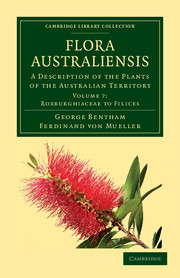
George Bentham (1800–84) was one of Britain's most influential botanists, whose own collection of plant specimens numbered more than 100,000. Although he donated his herbarium to the Royal Botanic Gardens, Kew in 1854, he continued to make significant contributions to the field, including this exhaustive, seven-volume work detailing the plant life of Australia, which was published from 1863 to 1878. It was part of a series of works commissioned by the British government to document the flora in its colonies. Using the extensive numbers of specimens at Kew - and with the help of Ferdinand Mueller (1825–96), a German botanist in Australia - Bentham was able to compile descriptions of more than 8,000 species of Australian plants, making these volumes the first completed compendium of the flora of any large continental area. Volume 7, published in 1878, concludes with descriptions of flora in the classes of monocotyledon and cryptogamae.
Richard Pulteney (1730–1801) was a Leicestershire physician whose medical career suffered both from a lack of aristocratic patronage and from his dissenting religious background. However, his lifelong interest in botany and natural history, and particularly his work on the new Linnaean system of botanical classification, led to publications in the Gentleman's Magazine and the Philosophical Transactions of the Royal Society. He was elected a Fellow of the Royal Society in 1762. His book on Linnaeus (also reissued in this series), first published in 1782, was later considered to be of great significance for the acceptance in England of the Linnaean system, and this two-volume work, published in 1790, is still relevant to the study of the history of botany. Volume 2 includes the development of botanical gardens, famous figures such as Dillenius and Sherard, and the study of botany in Scotland and Ireland.
Thoroughly revised and updated to reflect current and emerging practices, this book explores modern methods of disease control in field and glasshouse crops. It outlines the major crop diseases, with a particular emphasis on those features of symptomology and life cycle that are most relevant to the development of control measures. Modern diagnostic techniques are considered, focusing on developments in nucleic acid and immunological based procedures and their use in plant quarantine and certification schemes. The potential impact of these advances in molecular technology on plant breeding and disease resistance is also covered. Fungicides are a central part of disease control in the EU and, as such, a comprehensive account of their use forms an important part of the text, along with strategies to minimise the incidence of fungicide resistance in pathogen populations. Looking to the future, the book also addresses legislative, environmental and food safety concerns.
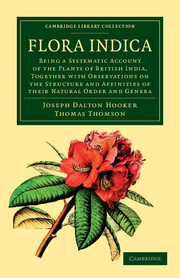
Being a Systematic Account of the Plants of British India, Together with Observations on the Structure and Affinities of their Natural Order and Genera
Sir Joseph Hooker (1817–1911) was one of the greatest British botanists and explorers of the nineteenth century. He succeeded his father, Sir William Jackson Hooker, as Director of the Royal Botanic Gardens, Kew, and was a close friend and supporter of Charles Darwin. His journey to the Himalayas and India, during which he collected some 7,000 species, was undertaken between 1847 and 1851 to increase the Kew collections; his account of the expedition (also reissued in this series) was dedicated to Darwin. In 1855 he published Flora Indica with his fellow-traveller Thomas Thomson, who became Superintendent of the East India Company's Botanic Garden at Calcutta. Lack of support from the Company meant that only the first volume of a projected series was published. However, the introductory essay on the geographical relations of India's flora is considered to be one of Hooker's most important statements on biogeographical issues.
Robert Hogg (1817–97), son of a Scots nurseryman, was destined for a career in medicine, but abandoned his studies to pursue horticulture. Employed by a famous London tree nursery, he travelled widely in Britain and Europe to study gardening practice. This work, first published in 1851, was intended to encourage a taste for the 'most important, most instructive, and intellectual branch of horticultural science' - the cultivation of fruit. (The book is subtitled 'The Apple', as though further volumes on other fruit were intended, but none appeared, though Hogg did publish The Fruit Manual (also reissued in this series) in 1860.) It lists and gives detailed descriptions, including drawings, of 401 apples in cultivation in Great Britain, and a further 541 of which Hogg had no direct knowledge. He provides classification lists by fruit colour, shape, seasonality and region - a fascinating resource for the history of horticulture and of food.
George Bentham (1800–84) was one of Britain's most influential botanists, whose own collection of plant specimens numbered more than 100,000. Although he donated his herbarium to the Royal Botanic Gardens, Kew in 1854, he continued to make significant contributions to the field, including this exhaustive, seven-volume work detailing the plant life of Australia, which was published from 1863 to 1878. It was part of a series of works commissioned by the British government to document the flora in its colonies. Using the extensive numbers of specimens at Kew - and with the help of Ferdinand Mueller (1825–96), a German botanist in Australia - Bentham was able to compile descriptions of more than 8,000 species of Australian plants, making these volumes the first completed compendium of the flora of any large continental area. Volume 2, published in 1864, gives descriptions of seven orders of the dicotyledon class of flowering plant.
For twenty years, the herbalist John Gerard (1545–1612) served as superintendent of the gardens of Elizabeth I's minister, Lord Burghley. The 1596 edition of Gerard's Catalogus is probably the first complete catalogue of any one garden, public or private, ever published. Describing his own garden, the list includes frankincense, saffron, an almond tree and even tulips, then exotic and notoriously costly. Probably intended originally only for the interest of Gerard's friends, and containing numerous errors, it progressed in 1599 into a new, improved edition for a much wider readership. In this book, first published privately in 1876, the botanist Benjamin Daydon Jackson (1846–1927) reproduces both editions, preserving the original errors and adding a memoir of the author that demonstrates the depth of his own research. With the modern names of the plants printed beside their earlier counterparts, Jackson's text is a fascinating resource for historical botanists and taxonomists.
This world-famous work was begun by Sir William Jackson Hooker (1785–1865) in 1837, and the ten volumes reissued here were produced under his authorship until 1854, at which point his son, Joseph Dalton Hooker (1817–1911) continued the work of publication. Hooker's own herbarium, or collection of preserved plant specimens, was so extensive that at one point he stored it in one house and lived in another; it was left to the nation on his death. Each volume contains 100 line drawings of plants, and each is accompanied by a full Latin description, with notes in English on habitat and significant features. The order of the plants in each volume is not systematic, but two 'indexes' at the beginning provide plant lists, in alphabetical order and 'arranged according to the natural orders'.
Sir Charles James Fox Bunbury (1809–86), the distinguished botanist and geologist, corresponded regularly with Lyell, Horner, Darwin and Hooker among others, and helped them in identifying botanical fossils. He was active in the scientific societies of his time, becoming a Fellow of the Royal Society in 1851. This nine-volume edition of his letters and diaries was published privately by his wife Frances Horner and her sister Katherine Lyell between 1890 and 1893. His copious journal and letters give an unparalleled view of the scientific and cultural society of Victorian England, and of the impact of Darwin's theories on his contemporaries. Volume 7 covers the years 1873–7. With advancing age there are many notices of deaths or illnesses of friends or colleagues, such as Sedgwick, Agassiz and Lyell, but Bunbury was still enthusiastically discussing his reading with correspondents.
Marianne North (1830–90), the Victorian amateur botanist and painter, travelled to distant countries of the world to paint exotic flora in their natural surroundings. This two-volume collection of her memoirs, edited by her sister and published in 1892, records North's remarkable travels. Laden with her palettes and easels, the independent North travelled alone and fended for herself. Her journals describe how she endured swarms of insects, scaled cliffs, trudged through wilderness and crossed swamps in order to reach the plants she wanted to paint. Volume 1 covers North's early upbringing and the origins of her enthusiasm for nature, and traces her travels through Canada and the United States, Jamaica, Brazil, Japan, Borneo, India and Sri Lanka. This fascinating autobiography reveals the stories behind North's art, which can still be appreciated today since she bequeathed her vivid paintings to Kew Gardens, where they are on display.
The Veitch dynasty, originally from Scotland, owned plant nurseries in Devon and London throughout the nineteenth century. By commissioning several expeditions to search for new and exotic flora for British gardens, they were instrumental in bringing many previously unknown plants into cultivation in Britain. James Herbert Veitch (1868–1907), who became managing director of the firm, spent time in Germany and France studying the techniques of horticulture, and later travelled the world himself collecting plants for the nursery in Chelsea. This work, published in 1906, gives a detailed account of the family business and of the men that the firm sent to South America, Japan, China and India during the period 1840–1906, including distinguished plant finders such as William Lobb, his brother Thomas, who first introduced various types of orchids from India to Britain for cultivation, and Richard Pearce, who brought back tuberous begonias from South America.
Alexander von Humboldt (1769–1859) was a naturalist, explorer and philanthropist now well known for his multidisciplinary approach to science. First published in English in 1873, this two-volume biography was translated from the German edition of 1872, edited by Karl Bruhns, which had been compiled in commemoration of the centenary of Humboldt's birth. Incorporating numerous extracts of Humboldt's own warmly written letters and anecdotes from his many acquaintances, it charts his travels in South America, Asia and Europe. Volume 1 covers his early exploratory trips and some of his lesser-known exploits, including becoming Superintendent of Mines in Northern Bavaria, his research on the sixteenth-century eruption of Nevado del Altar in Ecuador and his friendship with the young Prince William of Prussia. Of interest to students and researchers in the history of science, this is a minutely detailed and compelling insight into the life of the man behind the scientist.