To save content items to your account,
please confirm that you agree to abide by our usage policies.
If this is the first time you use this feature, you will be asked to authorise Cambridge Core to connect with your account.
Find out more about saving content to .
To save content items to your Kindle, first ensure no-reply@cambridge.org
is added to your Approved Personal Document E-mail List under your Personal Document Settings
on the Manage Your Content and Devices page of your Amazon account. Then enter the ‘name’ part
of your Kindle email address below.
Find out more about saving to your Kindle.
Note you can select to save to either the @free.kindle.com or @kindle.com variations.
‘@free.kindle.com’ emails are free but can only be saved to your device when it is connected to wi-fi.
‘@kindle.com’ emails can be delivered even when you are not connected to wi-fi, but note that service fees apply.
We are now entering a new era of socio-economic disruption arising from the fourth industrial revolution (4IR) – which is characterized by the amalgamation of the digital, biological and physical realms (Ndung’u and Signé 2020). A key question on the African agenda is how Africa can leverage 4IR for its benefit and not miss out this time around. This chapter deals with this question and explores some of the crucial cross-cutting issues surrounding the topic of 4IR in the African context. This work is intended to serve as a high-level African perspective of the fourth industrial revolution that will assist scholars, policy-makers, researchers, governments, business and other stakeholders in their respective roles in taking Africa forward.
Technologies of the 4IR are perhaps not a far-off vision for Africa (AfDB 2019), and are already playing a pivotal role as Africa transitions into the mainstream global economy. There are ongoing developments across the continent with recent expansions by tech giants such as Netflix, Facebook, Google and so on into Africa, and the rapid growth of tech start-ups and other such exciting developments in Africa's emerging technology landscape (Bright 2016). It has become clear that industries and governments must invest in and leverage 4IR technologies to make gains in the modern-day global economy (Marwala 2019). Although there has been some positive movement on the continent, with improved human development indices, and better regional interactions and economic progress, there are very deep concerns about the continent potentially missing out on reaping the growth benefits of 4IR due to the lack of human capacity development, adequate infrastructure and coherent leadership (Mead 2017; Radu 2020). These major thematic areas, that is, infrastructure, human capacity development and policy are explored in this chapter in the context of Africa's preparedness for 4IR. Taking into account that Africa is a vast and diverse continent, a high-level analysis of these issues is carried out with emphasis placed on the critical commonalities surrounding these issues as they pertain to Africa's 54 countries. This reveals some of the major challenges and opportunities relating to the aforementioned transition.
The COVID-19 health crisis triggered changes in the workplace. This paper explores the insights from scholarly work published in the Journal of Management and Organization (JMO) and systematizes this body of knowledge to build a scientific overview that looks at how the COVID-19 health crisis and its repercussions may be managed by organizations. We conducted a bibliometric investigation of JMO's most influential papers published from 1995 to June 2020 that offers insights into the management of the COVID-19 crisis. Our bibliometric investigation reveals six clusters: (1) conservation of resources theory, entrepreneurs, gender and work–family conflict; (2) corporate governance, corporate social responsibility and stakeholder salience; (3) family firms, innovation and research methods; (4) creativity, leadership and organizational change; (5) job satisfaction and psychological empowerment; and (6) team performance. We discuss the theoretical and practical implications of our findings.
This article develops a micro-level theoretical perspective of business influence in international negotiations. By drawing on organizational institutional theory, the article proposes that site-specific institutionalized norms can structure the nature and extent of business power. The article illustrates the value of this perspective through an illustrative case study of the International Maritime Organization (IMO) through interviews and participant observation of on-site dynamics during negotiations on environmental shipping regulation. The article shows how, in the case of the IMO, specific institutionalized norms and beliefs structure private actors’ possible influence and their claims to authority. In particular, strongly held beliefs about the nature of political deliberation in the IMO both constrain and enable business interests, sometimes overriding the general structural power of the shipping industry. This research implies that future scholarship of business power and lobbying should be attentive to specific institutionalized ideas structuring business actors’ range of legitimate activities, in particular in international institutions where individual negotiation sites can develop idiosyncratic norms and beliefs about the legitimacy of private actor participation.
Contemporary scholars debate the factors driving despotic labour conditions across the world economy. Some emphasize the dominance of global market imperatives and others highlight the market's reliance upon extra-economic coercion and state violence. At the Margins of the Global Market engages in this debate through a comparative and world-historical analysis of the labour regimes of three global commodity-producing subregions of rural Colombia: the coffee region of Viejo Caldas, the banana region of Urabá, and the coca/cocaine region of the Caguán. By drawing upon insights from labour regimes, global commodity chains, and world historical sociology, this book offers a novel understanding of the broad range of factors - local, national, global, and interregional - that shape labour conditions on the ground in Colombia. In doing so, it offers a critical new framework for analysing labour and development dynamics that exist at the margins of the global market.
Middle-managers' innovative behaviours are considered an essential determinant of firm-level innovativeness. While prior research has traditionally focused on the contextual determinants of middle-managers' innovative work behaviour (IWB), research regarding individual-level determinants continues to remain scant. Particularly lacking is research which explores how middle-managers' ownership feelings influence their IWB. This study investigates whether middle-managers' affective commitment mediates the relationship between their psychological ownership and their IWB. Data are collected from 110 middle-managers – supervisor dyads in a large Malaysian IT organisation. Findings from this study contribute to enhancing our understanding of the individual-level determinants of middle-managers' IWB.
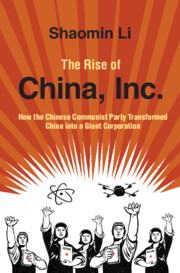
Leveraging its absolute power, low human rights advantage, and tolerance by other countries, the Chinese Communist Party has transformed China into a giant corporation. Living and working is not a right, but a privilege granted by the party. State-owned firms are business units or subsidiaries, private firms are joint ventures, and foreign firms are franchisees of the party. 'China, Inc.' enjoys the agility of a firm and the vast resources of a state. Meanwhile, foreign firms competing with Chinese firms can find themselves matched against the mighty Chinese state. The Rise of China, Inc. will interest many readers: it will compel business scholars to rethink state-firm relationships; assist multinational business practitioners in formulating effective strategies; aid policy-makers in countering China's expansion; and inform the public of the massive corporate organisation China has become, and how democracies can effectively deal with it.
Blockchain technology, originally the basis of the Bitcoin cryptocurrency, has received great attention from both academics and practitioners in the last decade. The consequent rise of interest in blockchain applications by different industries as well as public sector organizations has been complemented by questions and research on the impact of blockchain on organizations’ business models. Blockchain is also considered a source of innovation opportunities and challenges for entrepreneurs. Therefore, this chapter explores its potential for digital entrepreneurs, by first introducing the main elements making up the technology and then discussing eight companies that apply blockchain in different sectors, thus providing insights for new ventures. The chapter aims to give an essential understanding of blockchain’s advantages for digital entrepreneurs as well as insights that could inspire potential future applications of this technology for value creation and innovation in different sectors.
The role of this chapter is to introduce the reader to the digital entrepreneurial world where businesses exploit modern technologies in order to gain a strategic advantage over their competitors when entering the market. By distinguishing among the different types of online business – SMEs, start-ups or spin-offs – this chapter introduces the concept of open innovation that lies at the heart of every digital entrepreneur. Furthermore, this chapter delineates the series of steps that an entrepreneur should understand and follow to successfully establish an online business and outlines the risks and challenges to be aware of along the entrepreneurial journey. The last section of this chapter features two digital start-up success stories that leveraged the dynamics of digital technologies and achieved great growth rates as well as high revenues.
Digital entrepreneurs create digital businesses through digital media funnels such as web applications, social media, mobile SMS and emails, providing digital products and services. Nowadays, it is relatively seamless for digital entrepreneurs to adopt the diverse digital tools and techniques in developing their products and services. Moreover, the avalanche that is the current digital era is changing the processes for many existing business models, in the financial sector, the health sector and many more. As a result of these changes, digital entrepreneurs are faced with new challenges and exposed to unprecedented risks. This chapter discusses the challenges faced by digital entrepreneurs and start-ups within business sectors such as fintech, insurtech, retailtech, biotech, healthtech and fashiontech. In addition, two case studies that demonstrate the existing challenges are highlighted with their corresponding focus points. The chapter concludes with a summary of the key points addressed and a few recommendations for digital entrepreneurs.
The present chapter offers an analysis of the role that digital marketing plays today in helping digital businesses reach their goals. It delineates the types of digital media that a company can harness in order to promote its products and services, and distinguishes among paid, owned and earned media. Furthermore, the chapter emphasizes the critical role of the digital marketing strategy and highlights the benefits and challenges associated with the various digital marketing tools and tactics available today, explaining the importance of selecting and implementing the most effective as well as the most prominent. Moreover, the chapter discusses how the performance and results of the different elements of a digital strategy can be tracked and measured in order to provide valuable data and insight into profitability and revenues. The last section of the chapter presents a case study of a start-up in the educational sector, depicting how strategic marketing decisions can affect the overall success of a company. This section aims to offer valuable advice and recommendations to entrepreneurs, start-ups and investors of every industry.
Human rights due diligence (HRDD) has become the buzzword of much of the advocacy and work today around business and human rights.1 It is almost commonplace that companies have the responsibility to identify, prevent, mitigate and account for how they address these adverse human rights impacts as part of their ongoing HRDD processes, in line with the UNGPs.2 The assessment of human rights impacts (HRIA) is a critical step in this process.3
This chapter discusses the role of digital entrepreneurship in building start-ups and businesses that consider innovation to be a key success factor for thriving in today’s competitive market. After highlighting the difference between innovation and open innovation as well as its importance, this chapter explains how the right business model can help in establishing innovative digital entrepreneurship. It also discusses how information and communication technologies (ICTs) enable open innovation and differentiates between businesses that acquire other innovative start-ups and those that create innovation hubs in order to sustain their competitive advantage. Further, it describes the challenges that hinder innovation within digital entrepreneurship, before listing actions that need to be considered in order to meet the expectations set by the collaborators in digital innovation ecosystems. Finally, this chapter elaborates on a case study that discusses how innovation facilitated the introduction of innovative products to consumers and how this helped the business to make huge profits.
Digital entrepreneurship refers to the means or methods of creating fresh and innovative businesses, products or commodities as well as services that are enabled, permitted and provided via the Internet. Social media also refers to the mode by which people interact through the exchange of ideas and information in virtual networks. There are plenty of social media platforms in existence today; amongst the most popular are Facebook, Twitter, YouTube, Instagram and WhatsApp. The use of social media platforms for digital entrepreneurship can create opportunities like working remotely, on-the-go and at any time in the world. This chapter offers an insight into social media, its advantages on digital entrepreneurship as well as the potential future of social media for digital entrepreneurship.