Refine search
Actions for selected content:
46841 results in Management
The Evangelicals: The Struggle to Shape America. By Frances FitzGerald . New York: Simon and Schuster, 2017. 740 pp. Photographs, glossary, notes, index. Cloth, $35.00. ISBN: 978-1-4391-3133-6.
-
- Journal:
- Business History Review / Volume 91 / Issue 3 / Autumn 2017
- Published online by Cambridge University Press:
- 10 October 2017, pp. 625-627
- Print publication:
- Autumn 2017
-
- Article
- Export citation
Hedge Fund Return Dependence: Model Misspecification or Liquidity Spirals?
-
- Journal:
- Journal of Financial and Quantitative Analysis / Volume 52 / Issue 5 / October 2017
- Published online by Cambridge University Press:
- 02 October 2017, pp. 2157-2181
- Print publication:
- October 2017
-
- Article
- Export citation
BHR volume 91 issue 3 Cover and Front matter
-
- Journal:
- Business History Review / Volume 91 / Issue 3 / Autumn 2017
- Published online by Cambridge University Press:
- 10 October 2017, pp. f1-f7
- Print publication:
- Autumn 2017
-
- Article
-
- You have access
- Export citation
Oil Shock: The 1973 Crisis and Its Economic Legacy. Edited by Elisabetta Bini , Giuliano Garavini , and Federico Romero . London: I. B. Tauris, 2016. 336 pp. Illustrations, notes. Cloth, $110.00. ISBN: 978-1-78453-556-8.
-
- Journal:
- Business History Review / Volume 91 / Issue 3 / Autumn 2017
- Published online by Cambridge University Press:
- 10 October 2017, pp. 595-598
- Print publication:
- Autumn 2017
-
- Article
- Export citation
Worldly Philosopher: The Odyssey of Albert O. Hirschman, by Jeremy Adelman. Princeton: Princeton University Press, 2013. 740 pp. ISBN: 978-0691155678
-
- Journal:
- Business Ethics Quarterly / Volume 27 / Issue 4 / October 2017
- Published online by Cambridge University Press:
- 03 October 2017, pp. 633-636
- Print publication:
- October 2017
-
- Article
- Export citation
The Code Economy: A Forty-Thousand Year History. By Philip E. Auerswald . Oxford: Oxford University Press, 2017. vi + 298 pp. Figures, references, notes, index. Cloth, $29.95. ISBN: 978-0-19-022676-3.
-
- Journal:
- Business History Review / Volume 91 / Issue 3 / Autumn 2017
- Published online by Cambridge University Press:
- 10 October 2017, pp. 601-603
- Print publication:
- Autumn 2017
-
- Article
- Export citation
Entrepreneurial Litigation and Venture Capital Finance
-
- Journal:
- Journal of Financial and Quantitative Analysis / Volume 52 / Issue 5 / October 2017
- Published online by Cambridge University Press:
- 31 October 2017, pp. 2217-2250
- Print publication:
- October 2017
-
- Article
- Export citation
Long-Term versus Short-Term Contingencies in Asset Allocation
-
- Journal:
- Journal of Financial and Quantitative Analysis / Volume 52 / Issue 5 / October 2017
- Published online by Cambridge University Press:
- 31 October 2017, pp. 2277-2303
- Print publication:
- October 2017
-
- Article
- Export citation
A Time of Scandal: Charles R. Forbes, Warren G. Harding, and the Making of the Veterans Bureau. By Rosemary Stevens . Baltimore: Johns Hopkins University Press, 2016. xviii + 376 pp. Photographs, notes, index. Cloth, $34.95. ISBN: 978-1-4214-2130-8.
-
- Journal:
- Business History Review / Volume 91 / Issue 3 / Autumn 2017
- Published online by Cambridge University Press:
- 10 October 2017, pp. 620-622
- Print publication:
- Autumn 2017
-
- Article
- Export citation
Equilibrium-Informed Trading with Relative Performance Measurement
-
- Journal:
- Journal of Financial and Quantitative Analysis / Volume 52 / Issue 5 / October 2017
- Published online by Cambridge University Press:
- 31 October 2017, pp. 2083-2118
- Print publication:
- October 2017
-
- Article
- Export citation

Patents and Innovation in Mainland China and Hong Kong
- Two Systems in One Country Compared
-
- Published online:
- 29 September 2017
- Print publication:
- 12 October 2017
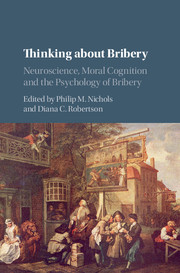
Thinking about Bribery
- Neuroscience, Moral Cognition and the Psychology of Bribery
-
- Published online:
- 28 September 2017
- Print publication:
- 07 September 2017
Part II - China (Mainland)
-
- Book:
- Enforcement of Corporate and Securities Law
- Published online:
- 30 August 2017
- Print publication:
- 28 September 2017, pp 101-218
-
- Chapter
- Export citation
9 - Improving Investor-Friendly Legal Environments in the Chinese Capital Market
- from Part II - China (Mainland)
-
-
- Book:
- Enforcement of Corporate and Securities Law
- Published online:
- 30 August 2017
- Print publication:
- 28 September 2017, pp 162-184
-
- Chapter
- Export citation
Notes on Contributors
-
- Book:
- Enforcement of Corporate and Securities Law
- Published online:
- 30 August 2017
- Print publication:
- 28 September 2017, pp x-xviii
-
- Chapter
- Export citation
11 - China’s Free Trade Zone and Latest Development of the Resolution Mechanism for Financial Disputes
- from Part II - China (Mainland)
-
-
- Book:
- Enforcement of Corporate and Securities Law
- Published online:
- 30 August 2017
- Print publication:
- 28 September 2017, pp 207-218
-
- Chapter
- Export citation
19 - Liability for Misstatements to the Market
- from Part IV - Civil Law Jurisdictions
-
-
- Book:
- Enforcement of Corporate and Securities Law
- Published online:
- 30 August 2017
- Print publication:
- 28 September 2017, pp 400-415
-
- Chapter
- Export citation
Figures
-
- Book:
- Enforcement of Corporate and Securities Law
- Published online:
- 30 August 2017
- Print publication:
- 28 September 2017, pp viii-viii
-
- Chapter
- Export citation
Preface
-
- Book:
- Enforcement of Corporate and Securities Law
- Published online:
- 30 August 2017
- Print publication:
- 28 September 2017, pp xix-xxvi
-
- Chapter
- Export citation
Copyright page
-
- Book:
- Enforcement of Corporate and Securities Law
- Published online:
- 30 August 2017
- Print publication:
- 28 September 2017, pp iv-iv
-
- Chapter
- Export citation
