Refine search
Actions for selected content:
26076 results in Abstract analysis
The spectral theory of multiplication operators and the recurrence properties for nondifferentiable functions in the Zygmund class Λ*a
- Part of
-
- Journal:
- Mathematika / Volume 39 / Issue 1 / June 1992
- Published online by Cambridge University Press:
- 26 February 2010, pp. 136-151
- Print publication:
- June 1992
-
- Article
- Export citation
Index to Volume 122
-
- Journal:
- Proceedings of the Royal Society of Edinburgh. Section A: Mathematics / Volume 122 / Issue 3-4 / 1992
- Published online by Cambridge University Press:
- 14 November 2011, pp. 379-380
- Print publication:
- 1992
-
- Article
- Export citation
Global stability in models of population dynamics with diffusion. I. Patchy environments
-
- Journal:
- Proceedings of the Royal Society of Edinburgh. Section A: Mathematics / Volume 122 / Issue 1-2 / 1992
- Published online by Cambridge University Press:
- 14 November 2011, pp. 69-84
- Print publication:
- 1992
-
- Article
- Export citation
Periodic homogenisation of certain fully nonlinear partial differential equations
-
- Journal:
- Proceedings of the Royal Society of Edinburgh. Section A: Mathematics / Volume 120 / Issue 3-4 / 1992
- Published online by Cambridge University Press:
- 14 November 2011, pp. 245-265
- Print publication:
- 1992
-
- Article
- Export citation
The resolvent problem for the Stokes system in exterior domains: uniqueness and non-regularity in Hölder spaces
-
- Journal:
- Proceedings of the Royal Society of Edinburgh. Section A: Mathematics / Volume 122 / Issue 1-2 / 1992
- Published online by Cambridge University Press:
- 14 November 2011, pp. 1-10
- Print publication:
- 1992
-
- Article
- Export citation
-
We consider the resolvent problem for the Stokes system in exterior domains, under Dirichlet boundary conditions:

where Ω is a bounded domain in ℝ3. It will be shown that in general there is no constant C > 0 such that
 for
for  with
with  , div u = 0, and for
  with
with  . However, if a solution (u, π) of problem (*) exists, it is uniquely determined, provided that u(x) and ∇π(x) decay for large values of |x|. These assertions imply a non-existence result in Hölder spaces.
 for
for  with
with  , div u = 0, and for
  with
with  . However, if a solution (u, π) of problem (*) exists, it is uniquely determined, provided that u(x) and ∇π(x) decay for large values of |x|. These assertions imply a non-existence result in Hölder spaces.
Multiple bifurcation in a predator–prey system with nonmonotonic predator response
-
- Journal:
- Proceedings of the Royal Society of Edinburgh. Section A: Mathematics / Volume 120 / Issue 3-4 / 1992
- Published online by Cambridge University Press:
- 14 November 2011, pp. 313-347
- Print publication:
- 1992
-
- Article
- Export citation
A note on lower limit of series and potential theory
-
- Journal:
- Proceedings of the Royal Society of Edinburgh. Section A: Mathematics / Volume 121 / Issue 3-4 / 1992
- Published online by Cambridge University Press:
- 14 November 2011, pp. 273-277
- Print publication:
- 1992
-
- Article
- Export citation
-
We are looking for positive sequences (bn) which have the following property: If (an) is a positive sequence such that
 , then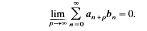
 , then
Existence of multiple positive solutions for a semilinear equation with critical exponent*
-
- Journal:
- Proceedings of the Royal Society of Edinburgh. Section A: Mathematics / Volume 122 / Issue 1-2 / 1992
- Published online by Cambridge University Press:
- 14 November 2011, pp. 161-175
- Print publication:
- 1992
-
- Article
- Export citation
-
In this paper we discuss the problem

We show that for c > 0 there exists a positive constant μ* such that (*)μ possesses at least one solution if μ ∈ (0, μ*) and no solutions if μ > μ*. Furthermore, there exists a positive constant μ**≦μ* such that (*)μ possesses at least two solutions if μ∈(0, μ**), 2<N<6. For N≧6, μ∈(0,μ**), we show that problem (*)μ possesses a unique solution if f(x) is radial with f′(r) < 0(r = |x|).
Uniform asymptotic expansions for oblate spheroidal functions I: positive separation parameter λ
-
- Journal:
- Proceedings of the Royal Society of Edinburgh. Section A: Mathematics / Volume 121 / Issue 3-4 / 1992
- Published online by Cambridge University Press:
- 14 November 2011, pp. 303-320
- Print publication:
- 1992
-
- Article
- Export citation
-
Uniform asymptotic expansions are derived for solutions of the spheroidal wave equation, in the oblate case where the parameter µ is real and nonnegative, the separation parameter λ is real and positive, and γ is purely imaginary (γ = iu). As u →∞, three types of expansions are derived for oblate spheroidal functions, which involve elementary, Airy and Bessel functions. Let δ be an arbitrary small positive constant. The expansions are uniformly valid for λ/u2 fixed and lying in the interval (0,2), and for λ / u2when 0<λ/u2 < 1, and
 when 1 = 1≦λ/u2 < 2. The union of the domains of validity of the various expansions cover the half- plane arg (z)≦ = π/2.
 when 1 = 1≦λ/u
The
 -radical in structural matrix near rings, II
-
- Journal:
- Proceedings of the Royal Society of Edinburgh. Section A: Mathematics / Volume 122 / Issue 1-2 / 1992
- Published online by Cambridge University Press:
- 14 November 2011, pp. 53-61
- Print publication:
- 1992
-
- Article
- Export citation
-
Whether the
-radical of a structural matrix near-ring  (B, R) is the sum of two non-trivial ideals, one of which is nilpotent, is an open problem. However, it is known that ((B, R)) contains two ideals
  and , which are respectively precisely the two ideals, the sum of which is the Jacobson radical, in the case where the underlying near-ring is a ring. We strengthen our conjecture that and are the sought-after ideals by showing that (B, R)/≅(C, R) in the near-ring case, where C is the largest symmetric Boolean matrix such that C≦B, and by showing that is nilpotent.
 -radical in structural matrix near rings, II
 (B, R) is the sum of two non-trivial ideals, one of which is nilpotent, is an open problem. However, it is known that
  and
and A global estimate for the gradient in a singular elliptic boundary value problem
-
- Journal:
- Proceedings of the Royal Society of Edinburgh. Section A: Mathematics / Volume 122 / Issue 3-4 / 1992
- Published online by Cambridge University Press:
- 14 November 2011, pp. 341-352
- Print publication:
- 1992
-
- Article
- Export citation
-
We investigate the singular problem
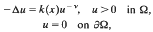
where Ω is a bounded smooth domain, k a bounded, nonnegative measurable function and v Ω 0. For the solution u to this problem, which is shown to exist if k(x) > 0 on some subset of Ω with positive measure, a uniform bound for |∇u| in Ω is derived when k(x) ≧ ψ (dist (x, ∂Ω)) with ψ (s)/sv ∈ Lp(0, a) for some a > 0, p > 1.
A note on primeness of semigroup rings
-
- Journal:
- Proceedings of the Royal Society of Edinburgh. Section A: Mathematics / Volume 120 / Issue 3-4 / 1992
- Published online by Cambridge University Press:
- 14 November 2011, pp. 191-197
- Print publication:
- 1992
-
- Article
- Export citation
Remark on the Dirichlet problem for harmonic maps from the disc into the 2-sphere
-
- Journal:
- Proceedings of the Royal Society of Edinburgh. Section A: Mathematics / Volume 122 / Issue 1-2 / 1992
- Published online by Cambridge University Press:
- 14 November 2011, pp. 63-67
- Print publication:
- 1992
-
- Article
- Export citation
On the growth of the relative volume of a tube with its radius*
-
- Journal:
- Proceedings of the Royal Society of Edinburgh. Section A: Mathematics / Volume 122 / Issue 3-4 / 1992
- Published online by Cambridge University Press:
- 14 November 2011, pp. 255-265
- Print publication:
- 1992
-
- Article
- Export citation
Robustness of a feedback control scheme for one-dimensional diffusion equations: perturbation to the Sturm-Liouville operator
-
- Journal:
- Proceedings of the Royal Society of Edinburgh. Section A: Mathematics / Volume 121 / Issue 3-4 / 1992
- Published online by Cambridge University Press:
- 14 November 2011, pp. 349-359
- Print publication:
- 1992
-
- Article
- Export citation
The exact coupled bounds for effective tensors of electrical and magnetic properties of two-component two-dimensional composites1
-
- Journal:
- Proceedings of the Royal Society of Edinburgh. Section A: Mathematics / Volume 122 / Issue 1-2 / 1992
- Published online by Cambridge University Press:
- 14 November 2011, pp. 93-125
- Print publication:
- 1992
-
- Article
- Export citation
On periodic solutions for singular perturbation problems
-
- Journal:
- Proceedings of the Royal Society of Edinburgh. Section A: Mathematics / Volume 120 / Issue 1-2 / 1992
- Published online by Cambridge University Press:
- 14 November 2011, pp. 143-152
- Print publication:
- 1992
-
- Article
- Export citation
Lower bounds for normal structure coefficients
-
- Journal:
- Proceedings of the Royal Society of Edinburgh. Section A: Mathematics / Volume 121 / Issue 3-4 / 1992
- Published online by Cambridge University Press:
- 14 November 2011, pp. 245-252
- Print publication:
- 1992
-
- Article
- Export citation
-
Using some new expressions for the weakly convergent sequences coefficient WCS(X) the lower boundedness
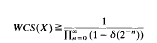
is proved, where δ(-) is the (Clarkson) modulus of convexity. We also define a modulus of noncompact convexity concerning nearly uniformly convex spaces which is used to obtain another lower bound for WCS(X). The computation of this modulus in Ip-spaces shows that our second lower bound is the best possible in these spaces.
Homogenisation of a class of fourth order equations with application to incompressible elasticity
-
- Journal:
- Proceedings of the Royal Society of Edinburgh. Section A: Mathematics / Volume 120 / Issue 1-2 / 1992
- Published online by Cambridge University Press:
- 14 November 2011, pp. 25-46
- Print publication:
- 1992
-
- Article
- Export citation
Classification of regularly solvable first-order differential operators
-
- Journal:
- Proceedings of the Royal Society of Edinburgh. Section A: Mathematics / Volume 120 / Issue 1-2 / 1992
- Published online by Cambridge University Press:
- 14 November 2011, pp. 165-178
- Print publication:
- 1992
-
- Article
- Export citation
-
In this article the expression τφ: = pφ + qφ with complex-valued coefficients is considered. We are particularly concerned with this expression when it is not formally symmetric, i.e., τ ≠ τ+, where τ+ is the formal adjoint of τ, and especially with the operators which are regularly solvable with respect to the minimal operators generated by τ and τ+ in the sense of W. D. Evans in [3]. This article is divided into five sections: Section 1 is an introduction, Section 2 is a brief study of the regular problem, in Section 3, some preliminary results in the singular case are displayed in Section 4, the joint field of regularity in the singular case is investigated and in Section 5, we discuss the case when
 .
.
 .
.