Refine search
Actions for selected content:
26070 results in Abstract analysis
Radial solutions of a semilinear elliptic problem*
-
- Journal:
- Proceedings of the Royal Society of Edinburgh. Section A: Mathematics / Volume 118 / Issue 3-4 / 1991
- Published online by Cambridge University Press:
- 14 November 2011, pp. 305-326
- Print publication:
- 1991
-
- Article
- Export citation
-
We analyse the set of nonnegative, global, and radial solutions (radial solutions, for short) of the equation

where 0 < p < 1, and
 is a radial and almost everywhere nonnegative function. We show that radial solutions of (E) exist if f(r) = o(r2p/1−1−p) or if f(r) ≈ cr2p/1−p as r → ∞, where
When f(r) = c*r2p/1−p + h(r) with h(r) = o(r2p/1−p) as r → ∞, radial solutions continue to exist if h(r) is sufficiently small at infinity. Existence, however, breaks down if h(r) > 0,

Whenever they exist, radial solutions are characterised in terms of their asymptotic behaviour as r → ∞.
 is a radial and almost everywhere nonnegative function. We show that radial solutions of (E) exist if f(r) = o(r
Some existence, uniqueness and nonuniqueness theorems for solutions of parabolic equations with discontinuous nonlinearities
-
- Journal:
- Proceedings of the Royal Society of Edinburgh. Section A: Mathematics / Volume 119 / Issue 1-2 / 1991
- Published online by Cambridge University Press:
- 14 November 2011, pp. 1-17
- Print publication:
- 1991
-
- Article
- Export citation
-
We consider the problem

where H stands for the maximal monotone graph associated with the Heaviside step function. It is shown that the problem possesses at least one (strong) solution belonging to an appropriate function space. Moreover, we prove:
(i) There is a smooth initial function u0, u0≧1, where the equality holds at exactly one point such that there are at least two different solutions corresponding to the initial data u0.
(ii) The comparison principle: The relation
 for any x ≠ 0, implies u1(t)>u2(t), t≧0 for any u1, u2 solving the problem with the initial data
  , respectively.
(iii) For a “reasonable” set of initial data the solution is uniquely determined. Moreover, the free boundary {(x, t)| u(x, t) = 1} is regular and on its complement the equation holds in a classical sense.
 for any x ≠ 0, implies u
 , respectively.
The nonwandering set of a special system of differential equations
-
- Journal:
- Proceedings of the Royal Society of Edinburgh. Section A: Mathematics / Volume 118 / Issue 1-2 / 1991
- Published online by Cambridge University Press:
- 14 November 2011, pp. 35-48
- Print publication:
- 1991
-
- Article
- Export citation
Genera of rationally equivalent integral binary quadratic forms
-
- Journal:
- Proceedings of the Royal Society of Edinburgh. Section A: Mathematics / Volume 119 / Issue 1-2 / 1991
- Published online by Cambridge University Press:
- 14 November 2011, pp. 27-30
- Print publication:
- 1991
-
- Article
- Export citation
Parameter ranges for the existence of solutions whose state components have specified nodal structure in coupled multiparameter systems of nonlinear Sturm–Liouville boundary value problems
-
- Journal:
- Proceedings of the Royal Society of Edinburgh. Section A: Mathematics / Volume 119 / Issue 3-4 / 1991
- Published online by Cambridge University Press:
- 14 November 2011, pp. 347-365
- Print publication:
- 1991
-
- Article
- Export citation
-
The set of solutions to the two-parameter system
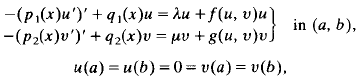
has been shown in a preceding paper of the author to exhibit a topological-functional analytic structure analogous to the structure of solution sets for nonlinear Sturm–Liouville boundary value problems. As the parameter λ and µ are varied, transitions in the solution set occur, first from trivial solutions to solutions (u, 0) with u having n nodes on (a, b) or solutions (0, v) with v having m nodes on (a, b), and then to solutions of the form (u, v), where u has n nodes on (a, b) and v has m nodes on (a, b), with n possibly different from m. Moreover, each transition is global in an appropriate bifurcation theoretic sense, with preservation of nodal structure. This paper explores these phenomena more closely, focusing on the range of parameters (λ, µ) for the existence of solutions (u, v) with u having n nodes on (a, b) and v having m nodes on (a, b) and its dependence on the assumptions placed on the coupling functions f and g. The principal tools of the analysis are the Alexander–Antman Bifurcation Theorem and a priori estimate techniques based on the maximum principle.
Index to Volume 117
-
- Journal:
- Proceedings of the Royal Society of Edinburgh. Section A: Mathematics / Volume 117 / Issue 3-4 / 1991
- Published online by Cambridge University Press:
- 14 November 2011, pp. i-ii
- Print publication:
- 1991
-
- Article
- Export citation
On dichotomic maps for a class of differential-difference equations
-
- Journal:
- Proceedings of the Royal Society of Edinburgh. Section A: Mathematics / Volume 117 / Issue 3-4 / 1991
- Published online by Cambridge University Press:
- 14 November 2011, pp. 317-328
- Print publication:
- 1991
-
- Article
- Export citation
Phenomena of critical exponent in ℝ2
-
- Journal:
- Proceedings of the Royal Society of Edinburgh. Section A: Mathematics / Volume 119 / Issue 1-2 / 1991
- Published online by Cambridge University Press:
- 14 November 2011, pp. 19-25
- Print publication:
- 1991
-
- Article
- Export citation
-
In this paper we make an attempt to explain the critical phenomena in ℝ2. We do this by exhibiting a class of functions having
 growth and for which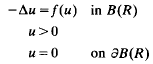
do not admit a solution when R is sufficiently small, where B(R) denotes the ball of radius R in ℝ2.
 growth and for which
Nontrivial full bounded solutions of time-periodic semilinear parabolic PDEs
-
- Journal:
- Proceedings of the Royal Society of Edinburgh. Section A: Mathematics / Volume 117 / Issue 3-4 / 1991
- Published online by Cambridge University Press:
- 14 November 2011, pp. 305-315
- Print publication:
- 1991
-
- Article
- Export citation
A problem in neural networks
-
- Journal:
- Proceedings of the Royal Society of Edinburgh. Section A: Mathematics / Volume 118 / Issue 3-4 / 1991
- Published online by Cambridge University Press:
- 14 November 2011, pp. 225-236
- Print publication:
- 1991
-
- Article
- Export citation
Schoenberg's exponential Euler spline curves*
-
- Journal:
- Proceedings of the Royal Society of Edinburgh. Section A: Mathematics / Volume 118 / Issue 1-2 / 1991
- Published online by Cambridge University Press:
- 14 November 2011, pp. 21-33
- Print publication:
- 1991
-
- Article
- Export citation
Asymptotic behaviour of solutions of elliptic equations with critical exponents and Neumann boundary conditions
-
- Journal:
- Proceedings of the Royal Society of Edinburgh. Section A: Mathematics / Volume 117 / Issue 3-4 / 1991
- Published online by Cambridge University Press:
- 14 November 2011, pp. 225-250
- Print publication:
- 1991
-
- Article
- Export citation
Rational equivalence of primitive integral binary quadratic forms
-
- Journal:
- Proceedings of the Royal Society of Edinburgh. Section A: Mathematics / Volume 118 / Issue 1-2 / 1991
- Published online by Cambridge University Press:
- 14 November 2011, pp. 157-160
- Print publication:
- 1991
-
- Article
- Export citation
PRM volume 117 issue 3-4 Cover and Front matter
-
- Journal:
- Proceedings of the Royal Society of Edinburgh. Section A: Mathematics / Volume 117 / Issue 3-4 / 1991
- Published online by Cambridge University Press:
- 14 November 2011, pp. f1-f2
- Print publication:
- 1991
-
- Article
-
- You have access
- Export citation
Index to Volume 119
-
- Journal:
- Proceedings of the Royal Society of Edinburgh. Section A: Mathematics / Volume 119 / Issue 3-4 / 1991
- Published online by Cambridge University Press:
- 14 November 2011, pp. 397-398
- Print publication:
- 1991
-
- Article
- Export citation
Regularity of almost extremal solutions of Monge–Ampère equations
-
- Journal:
- Proceedings of the Royal Society of Edinburgh. Section A: Mathematics / Volume 117 / Issue 1-2 / 1991
- Published online by Cambridge University Press:
- 14 November 2011, pp. 21-29
- Print publication:
- 1991
-
- Article
- Export citation
Boundary controllability of nonlinear beams to bounded states
-
- Journal:
- Proceedings of the Royal Society of Edinburgh. Section A: Mathematics / Volume 119 / Issue 1-2 / 1991
- Published online by Cambridge University Press:
- 14 November 2011, pp. 63-72
- Print publication:
- 1991
-
- Article
- Export citation
On Schur complements and n-metaharmonic functions
-
- Journal:
- Proceedings of the Royal Society of Edinburgh. Section A: Mathematics / Volume 119 / Issue 3-4 / 1991
- Published online by Cambridge University Press:
- 14 November 2011, pp. 233-240
- Print publication:
- 1991
-
- Article
- Export citation
Maps between p-completed classifying spaces II
-
- Journal:
- Proceedings of the Royal Society of Edinburgh. Section A: Mathematics / Volume 118 / Issue 1-2 / 1991
- Published online by Cambridge University Press:
- 14 November 2011, pp. 133-137
- Print publication:
- 1991
-
- Article
- Export citation
Monotone convergence theorems for variational triples with applications to intermediate problems
-
- Journal:
- Proceedings of the Royal Society of Edinburgh. Section A: Mathematics / Volume 117 / Issue 1-2 / 1991
- Published online by Cambridge University Press:
- 14 November 2011, pp. 39-58
- Print publication:
- 1991
-
- Article
- Export citation
