Refine search
Actions for selected content:
26076 results in Abstract analysis
Dedication
-
- Book:
- Geometric Aspects of Banach Spaces
- Published online:
- 04 August 2010
- Print publication:
- 06 July 1989, pp vii-viii
-
- Chapter
- Export citation
13 - On some properties of A*, L1/H10 as Banach Algebras
-
-
- Book:
- Geometric Aspects of Banach Spaces
- Published online:
- 04 August 2010
- Print publication:
- 06 July 1989, pp 145-158
-
- Chapter
- Export citation
15 - Some properties of Banach spaces Z**/Z
-
-
- Book:
- Geometric Aspects of Banach Spaces
- Published online:
- 04 August 2010
- Print publication:
- 06 July 1989, pp 169-194
-
- Chapter
- Export citation
Contents
-
- Book:
- Geometric Aspects of Banach Spaces
- Published online:
- 04 August 2010
- Print publication:
- 06 July 1989, pp v-vi
-
- Chapter
- Export citation
3 - Hilbert space revisited
-
-
- Book:
- Geometric Aspects of Banach Spaces
- Published online:
- 04 August 2010
- Print publication:
- 06 July 1989, pp 39-53
-
- Chapter
- Export citation
8 - On the duality problem for entropy numbers
-
-
- Book:
- Geometric Aspects of Banach Spaces
- Published online:
- 04 August 2010
- Print publication:
- 06 July 1989, pp 107-111
-
- Chapter
- Export citation
7 - Operators on vector sequence spaces
-
-
- Book:
- Geometric Aspects of Banach Spaces
- Published online:
- 04 August 2010
- Print publication:
- 06 July 1989, pp 94-106
-
- Chapter
- Export citation
Approximate subdifferentials and applications 3: the metric theory
-
- Journal:
- Mathematika / Volume 36 / Issue 1 / June 1989
- Published online by Cambridge University Press:
- 26 February 2010, pp. 1-38
- Print publication:
- June 1989
-
- Article
- Export citation
-
This is the final paper of the series of three papers under the same title. The finite dimensional theory developed in the first of them 7 contains first of all:
(a) a calculus having among its consequences the calculi of convex subdifferentials and generalized gradients of Clarke (henceforth sometimes abbreviated C.g.g.) in the most general form which is partly due to the fact that in a finite dimensional space

for any convex function f and

for any SX (A means approximate, C means Clarke); and (b) a theorem stating that approximate subdifferentials are minimal (as sets) among all possible subdifferentials satisfying one or another set of conditions (usually very natural).
Shadow boundaries of typical convex bodies. measure properties
- Part of
-
- Journal:
- Mathematika / Volume 36 / Issue 1 / June 1989
- Published online by Cambridge University Press:
- 26 February 2010, pp. 142-152
- Print publication:
- June 1989
-
- Article
- Export citation
Book Reviews - B. J. Alder, Editor. Special Purpose Computers. Academic Press. 1988, 282 pp., $49.95. - D. R. Bland. Wave Theory and Applications. Clarendon Press. 1988, 317 pp., hardback £40, paperback £.15. - S.Caenepeel and F. Van Oystaeyen Brauer Groups and the Cohomology of Graded Rings. Marcel Dekker. 1988, 261 pp., 107.50. - G. F. Carrier and C. E. Pearson. Partial Differential Equations Theory and Technique. Academic Press. 1988, 340 pp., $39.95. - D. V. Chudnovsky and G. V. Chudnovsky Editors. Search Theory: Some Recent Developments. Marcel Dekker. 1989, 155 pp., $107.50. - R. Durrett. Lecture Notes on Particle Systems and Percolation. Wadsworth & Brooks/Cole. 1988, 335 pp., $39.95. - D. H. Griffel Linear Algebra and its Applications: Volume 1, A First Course. Ellis Horwood. 1989, 289 pp., £16.95. - S. P. Gudder. Quantum Probability. Academic Press. 1988, 316 pp., $49.50. - M. Hervé. Several Complex Variables: Local Theory, 2nd Edition. Oxford University Press. 1987, 148 pp., £8.95. - K. Ito and N. Ikeda, Editors. Probabilistic Methods in Mathematical Physics; Proceedings of the Katata and Kyoto Symposia: 1985. Academic Press.1988, 441 pp., $59.50. - G. Karpilovsky. Field theory: Classical Foundations and Multiplicative Groups. Marcel Dekker. 1988, 550 pp., $119.50. - P. Pelcé Editor. Dynamics of Curved Fronts. Academic Press. 1988, 514 pp., $69.50. - G. Sewell. The Numerical Solution of Ordinary and Partial Equations. Academic Press. 1988, 271 pp., $39.95. - J. S. Walker. Fourier Analysis. Oxford University Press. 1988, 440 pp., £40. - N. R. Wallach. Real Reductive Groups I. Academic Press. 1988, 412 pp., $59.95. - W. D. Wallis. Combinatorial Designs. Marcel Dekker. 1988, 323 pp., $107.50. - W. Wieslaw. Topological Fields. Marcel Dekker. 1988, 309 pp., $119.50.
-
- Journal:
- Mathematika / Volume 36 / Issue 1 / June 1989
- Published online by Cambridge University Press:
- 26 February 2010, pp. 182-185
- Print publication:
- June 1989
-
- Article
- Export citation
On Integer Sets Containing Strings of Consecutive Integers
-
- Journal:
- Mathematika / Volume 36 / Issue 1 / June 1989
- Published online by Cambridge University Press:
- 26 February 2010, pp. 60-70
- Print publication:
- June 1989
-
- Article
- Export citation
-
By a well-known theorem of Szemerdi 8 any set of integers that has positive density contains arithmetic progressions of arbitrary length. One might expect that there are conditions of similar generality, under which an integer set contains arbitrarily long strings of consecutive integers, i.e., arithmetic progressions with 1 as common difference. Results of this kind would be of great importance because of potential applications to arithmetically interesting sets such as the set n: (n) = 1, where (n) is the Liouville function, or the sets

where P(n) denotes the greatest prime factor of n and 0<< 1. One naturally expects that such sets contain arbitrarily long strings of consecutive integers, but no results in this direction are known, and the problem seems to be a very difficult one, perhaps comparable in depth to the prime k-tuple conjecture.
Stability in the Aleksandrov-Fenchel-Jessen Theorem
- Part of
-
- Journal:
- Mathematika / Volume 36 / Issue 1 / June 1989
- Published online by Cambridge University Press:
- 26 February 2010, pp. 50-59
- Print publication:
- June 1989
-
- Article
- Export citation
On Negative Moments of the Riemann Zeta-Function
-
- Journal:
- Mathematika / Volume 36 / Issue 1 / June 1989
- Published online by Cambridge University Press:
- 26 February 2010, pp. 71-88
- Print publication:
- June 1989
-
- Article
- Export citation
-
The purpose of this paper is to take some first steps the investigation of the negative moments
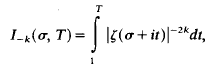
where k>0 and12, and the related discrete moments

whereruns over the complex zeros of the zeta-function. We assume the Riemann hypothesis (RH) throughout; it then follows that Ik(, T) converges for every k > 0 when>but for no k =when =. We further note that Jk(T) is only defined for all T if all the zerosare simple and, in that case, Ik(, T) converges for all k<.
MTK volume 36 issue 1 Front matter
-
- Journal:
- Mathematika / Volume 36 / Issue 1 / June 1989
- Published online by Cambridge University Press:
- 26 February 2010, pp. f1-f2
- Print publication:
- June 1989
-
- Article
-
- You have access
- Export citation
Ramsey type theorems for real functions
- Part of
-
- Journal:
- Mathematika / Volume 36 / Issue 1 / June 1989
- Published online by Cambridge University Press:
- 26 February 2010, pp. 131-141
- Print publication:
- June 1989
-
- Article
- Export citation
On p-Class Groups of Cyclic Extensions of Prime Degree p of Quadratic Fields
-
- Journal:
- Mathematika / Volume 36 / Issue 1 / June 1989
- Published online by Cambridge University Press:
- 26 February 2010, pp. 89-102
- Print publication:
- June 1989
-
- Article
- Export citation
-
Let Q denote the field of rational numbers, and let p be an odd prime number. Let K be a cyclic extension of Q of degree p, and let a be a generator of Gal (KQ). Let CK denote the p-class group of K (i.e., the Sylow p-subgroup of the ideal class group of K), and let
 for i = 1, 2, 3, . It is well known that
  is an elementary abelian p-group of rank tt1, where t is the number of ramified primes in KQ. So we focus our attention on
  . We let
 for i = 1, 2, 3, . It is well known that
  is an elementary abelian p-group of rank tt1, where t is the number of ramified primes in KQ. So we focus our attention on
  . We let
The viscous flow through symmetric collapsible channels
- Part of
-
- Journal:
- Mathematika / Volume 36 / Issue 1 / June 1989
- Published online by Cambridge University Press:
- 26 February 2010, pp. 153-181
- Print publication:
- June 1989
-
- Article
- Export citation
On -complete filters
- Part of
-
- Journal:
- Mathematika / Volume 36 / Issue 1 / June 1989
- Published online by Cambridge University Press:
- 26 February 2010, pp. 107-115
- Print publication:
- June 1989
-
- Article
- Export citation
On inductive limits of measure spaces and projective limits of Lp-spaces
-
- Journal:
- Mathematika / Volume 36 / Issue 1 / June 1989
- Published online by Cambridge University Press:
- 26 February 2010, pp. 116-130
- Print publication:
- June 1989
-
- Article
- Export citation
-
The existence of inductive limits in the category of (topological) measure spaces is proved. Next, permanence properties of inductive limits are investigated. If (X,
 , ) is the inductive limit of the measure spaces (X, , ), we prove, for 1 p 221E;, that LP(X, , ) is embeddible into the projectilimit of Lp(X, ,) in the category Ban, for p <, respectively in the category C* in the case p = +. As an application, we exten existence theorems of strong liftings to inductive limits.
 , ) is the inductive limit of the measure spaces (X,
 Tangential Limits for Certain Classes of Analytic Functions
-
- Journal:
- Mathematika / Volume 36 / Issue 1 / June 1989
- Published online by Cambridge University Press:
- 26 February 2010, pp. 39-49
- Print publication:
- June 1989
-
- Article
- Export citation
-
We begin by denning the notion of a tangential limit for a function f denned in the unit disc
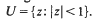
Let be a positive continuous function on (0, 1) for which

Suppose B>0, -,and define

where
 The region . makes tangential contact with the boundary U of the unit disc at ei; when (r) = ( l - r2), for instance, (, , 1) is the disc with radiusand centre ei
 The region . makes tangential contact with the boundary U of the unit disc at e