Refine search
Actions for selected content:
25990 results in Abstract analysis
XXIV.—On the Equation of Motion of a Free Particle in the Expanding Universe of Kinematical Relativity
-
- Journal:
- Proceedings of the Royal Society of Edinburgh Section A: Mathematical and Physical Sciences / Volume 61 / Issue 3 / 1943
- Published online by Cambridge University Press:
- 14 February 2012, pp. 288-297
- Print publication:
- 1943
-
- Article
- Export citation
-
In a recent paper in these Proceedings, Dr G. C. McVittie has published some criticisms of kinematical relativity. These criticisms are to a large extent based on his formula (4.10), namely,

It must be stated at the outset that McVittie's interpretation of his derivation of (1) as a derivation of “Milne's formula for the acceleration of a ‘free particle moving in the presence of a substratum,’ for the special case of one spatial co-ordinate only” is wrong. McVittie does not derive the result, as he claims, from what he calls the “axioms of kinematical relativity” alone; he deduces it from these axioms together with an additional assumption, which is equivalent to begging the answer to the whole problem it was my object to solve. Instead of considering a free particle, as I did—that is, a particle whose motion we do not a priori know—he prescribes a priori the motion of his particle as being constrained to obey the rule, in his notation,

PRM volume 61 issue 3 Cover and Front matter
-
- Journal:
- Proceedings of the Royal Society of Edinburgh Section A: Mathematical and Physical Sciences / Volume 61 / Issue 3 / 1943
- Published online by Cambridge University Press:
- 14 February 2012, pp. f1-f4
- Print publication:
- 1943
-
- Article
-
- You have access
- Export citation
Index
-
- Journal:
- Proceedings of the Royal Society of Edinburgh Section A: Mathematical and Physical Sciences / Volume 61 / Issue 3 / 1943
- Published online by Cambridge University Press:
- 14 February 2012, pp. 311-312
- Print publication:
- 1943
-
- Article
- Export citation
XVI.—Simultaneous Linear Partial Differential Equations of the Second Order
-
- Journal:
- Proceedings of the Royal Society of Edinburgh Section A: Mathematical and Physical Sciences / Volume 61 / Issue 3 / 1943
- Published online by Cambridge University Press:
- 14 February 2012, pp. 195-209
- Print publication:
- 1943
-
- Article
- Export citation
-
In the system of two linear partial differential equations of the second order
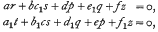
a,…,f were supposed to be polynomials in x, and a1…, f1 polynomials in y. These polynomial coefficients were subjected to certain restrictions, including conditions for the system having exactly four linearly independent solutions, and conditions for preserving the symmetrical aspect, in x and y, of the system. It has been proved that any compatible system of the contemplated form whose coefficients satisfy the stipulated conditions is equivalent with, i.e. transformable into, a hypergeometric system. More particularly it has been shown that the hypergeometric systems involved are the system of partial differential equations associated with Appell's hypergeometric function in two variables F2 and the confluent systems arising herefrom.
XVII.—Axiomatic Treatment of Kinematical Relativity
-
- Journal:
- Proceedings of the Royal Society of Edinburgh Section A: Mathematical and Physical Sciences / Volume 61 / Issue 3 / 1943
- Published online by Cambridge University Press:
- 14 February 2012, pp. 210-222
- Print publication:
- 1943
-
- Article
- Export citation
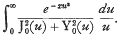
XIX.—A Short Table of
-
- Journal:
- Proceedings of the Royal Society of Edinburgh Section A: Mathematical and Physical Sciences / Volume 61 / Issue 3 / 1943
- Published online by Cambridge University Press:
- 14 February 2012, pp. 229-230
- Print publication:
- 1943
-
- Article
- Export citation
XVIII.—Heat Flow in the Region bounded Internally by a Circular Cylinder
-
- Journal:
- Proceedings of the Royal Society of Edinburgh Section A: Mathematical and Physical Sciences / Volume 61 / Issue 3 / 1943
- Published online by Cambridge University Press:
- 14 February 2012, pp. 223-228
- Print publication:
- 1943
-
- Article
- Export citation
XXV.—Axiomatic Treatment of Kinematical Relativity: A Reply to Dr G. C. McVittie
-
- Journal:
- Proceedings of the Royal Society of Edinburgh Section A: Mathematical and Physical Sciences / Volume 61 / Issue 3 / 1943
- Published online by Cambridge University Press:
- 14 February 2012, pp. 298-299
- Print publication:
- 1943
-
- Article
- Export citation
XXI.—Sylvester's Unravelment of a Ternary Quartic
-
- Journal:
- Proceedings of the Royal Society of Edinburgh Section A: Mathematical and Physical Sciences / Volume 61 / Issue 3 / 1943
- Published online by Cambridge University Press:
- 14 February 2012, pp. 247-259
- Print publication:
- 1943
-
- Article
- Export citation
XX.—Aristotle, Newton, Einstein
-
- Journal:
- Proceedings of the Royal Society of Edinburgh Section A: Mathematical and Physical Sciences / Volume 61 / Issue 3 / 1943
- Published online by Cambridge University Press:
- 14 February 2012, pp. 231-246
- Print publication:
- 1943
-
- Article
- Export citation
XXVI.—The Monomial Expansion of Determinantal Symmetric Functions
-
- Journal:
- Proceedings of the Royal Society of Edinburgh Section A: Mathematical and Physical Sciences / Volume 61 / Issue 3 / 1943
- Published online by Cambridge University Press:
- 14 February 2012, pp. 300-310
- Print publication:
- 1943
-
- Article
- Export citation
-
The quotient of alternants
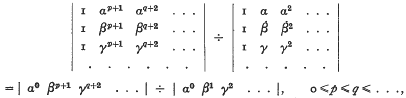
the denominator being the difference-product of the arguments a, β, γ, …, is an important symmetric function, introduced into algebra by Jacobi in 1841.
XV.—On the Estimation of Statistical Parameters
-
- Journal:
- Proceedings of the Royal Society of Edinburgh Section A: Mathematical and Physical Sciences / Volume 61 / Issue 2 / 1942
- Published online by Cambridge University Press:
- 14 February 2012, pp. 186-194
- Print publication:
- 1942
-
- Article
- Export citation
PRM volume 61 issue 2 Cover and Back matter
-
- Journal:
- Proceedings of the Royal Society of Edinburgh Section A: Mathematical and Physical Sciences / Volume 61 / Issue 2 / 1942
- Published online by Cambridge University Press:
- 14 February 2012, pp. b1-b2
- Print publication:
- 1942
-
- Article
-
- You have access
- Export citation
XIII.—Some Disputed Questions in the Philosophy of the Physical Sciences
-
- Journal:
- Proceedings of the Royal Society of Edinburgh Section A: Mathematical and Physical Sciences / Volume 61 / Issue 2 / 1942
- Published online by Cambridge University Press:
- 14 February 2012, pp. 160-175
- Print publication:
- 1942
-
- Article
- Export citation
PRM volume 61 issue 2 Cover and Front matter
-
- Journal:
- Proceedings of the Royal Society of Edinburgh Section A: Mathematical and Physical Sciences / Volume 61 / Issue 2 / 1942
- Published online by Cambridge University Press:
- 14 February 2012, pp. f1-f4
- Print publication:
- 1942
-
- Article
-
- You have access
- Export citation
XII.—Some Remarks occasioned by the Geometry of the Veronese Surface
-
- Journal:
- Proceedings of the Royal Society of Edinburgh Section A: Mathematical and Physical Sciences / Volume 61 / Issue 2 / 1942
- Published online by Cambridge University Press:
- 14 February 2012, pp. 140-159
- Print publication:
- 1942
-
- Article
- Export citation
XI.—Quantum Theory of the Chemical Bond
-
- Journal:
- Proceedings of the Royal Society of Edinburgh Section A: Mathematical and Physical Sciences / Volume 61 / Issue 2 / 1942
- Published online by Cambridge University Press:
- 14 February 2012, pp. 115-139
- Print publication:
- 1942
-
- Article
- Export citation
XIV.—Further Investigations in Factor Estimation
-
- Journal:
- Proceedings of the Royal Society of Edinburgh Section A: Mathematical and Physical Sciences / Volume 61 / Issue 2 / 1942
- Published online by Cambridge University Press:
- 14 February 2012, pp. 176-185
- Print publication:
- 1942
-
- Article
- Export citation
VII.—The Clear-Day Barometric Curve at Ben Nevis
-
- Journal:
- Proceedings of the Royal Society of Edinburgh Section A: Mathematical and Physical Sciences / Volume 61 / Issue 1 / 1941
- Published online by Cambridge University Press:
- 14 February 2012, pp. 71-76
- Print publication:
- 1941
-
- Article
- Export citation
PRM volume 61 issue 1 Cover and Back matter
-
- Journal:
- Proceedings of the Royal Society of Edinburgh Section A: Mathematical and Physical Sciences / Volume 61 / Issue 1 / 1941
- Published online by Cambridge University Press:
- 14 February 2012, pp. b1-b2
- Print publication:
- 1941
-
- Article
-
- You have access
- Export citation
