Refine search
Actions for selected content:
26080 results in Abstract analysis
Infinitely many periodic solutions of non-autonomous second-order Hamiltonian systems
-
- Journal:
- Proceedings of the Royal Society of Edinburgh. Section A: Mathematics / Volume 144 / Issue 1 / February 2014
- Published online by Cambridge University Press:
- 30 January 2014, pp. 205-223
- Print publication:
- February 2014
-
- Article
- Export citation
The bond-based peridynamic system with Dirichlet-type volume constraint
-
- Journal:
- Proceedings of the Royal Society of Edinburgh. Section A: Mathematics / Volume 144 / Issue 1 / February 2014
- Published online by Cambridge University Press:
- 30 January 2014, pp. 161-186
- Print publication:
- February 2014
-
- Article
- Export citation
12 - Characteristic functions and central limit theorems
-
- Book:
- A Basic Course in Measure and Probability
- Published online:
- 05 June 2014
- Print publication:
- 30 January 2014, pp 254-284
-
- Chapter
- Export citation
11 - Convergence and related topics 223
-
- Book:
- A Basic Course in Measure and Probability
- Published online:
- 05 June 2014
- Print publication:
- 30 January 2014, pp 223-253
-
- Chapter
- Export citation
5 - Absolute continuity and related topics
-
- Book:
- A Basic Course in Measure and Probability
- Published online:
- 05 June 2014
- Print publication:
- 30 January 2014, pp 86-117
-
- Chapter
- Export citation
1 - Point sets and certain classes of sets
-
- Book:
- A Basic Course in Measure and Probability
- Published online:
- 05 June 2014
- Print publication:
- 30 January 2014, pp 1-20
-
- Chapter
- Export citation
15 - Basic structure of stochastic processes
-
- Book:
- A Basic Course in Measure and Probability
- Published online:
- 05 June 2014
- Print publication:
- 30 January 2014, pp 340-355
-
- Chapter
- Export citation
Suspension splittings and James–Hopf invariants
-
- Journal:
- Proceedings of the Royal Society of Edinburgh. Section A: Mathematics / Volume 144 / Issue 1 / February 2014
- Published online by Cambridge University Press:
- 30 January 2014, pp. 87-108
- Print publication:
- February 2014
-
- Article
- Export citation
-
James constructed a functorial homotopy decomposition
 for path-connected, p ointed CW-complexes X. We generalize this to a p-local functorial decomposition of ΣA, where A is any functorial retract of a looped co-H-space. This is used to construct Hopf invariants in a more general context. In addition, when A = ΩY is the loops space of a co-H-space, we show that the wedge summands of ΣΩY further functorially decompose by using an action of an appropriate symmetric group. As a valuable example, we give an application to the theory of quasi-symmetric functions.
 for path-connected, p ointed CW-complexes X. We generalize this to a p-local functorial decomposition of ΣA, where A is any functorial retract of a looped co-H-space. This is used to construct Hopf invariants in a more general context. In addition, when A = ΩY is the loops space of a co-H-space, we show that the wedge summands of ΣΩY further functorially decompose by using an action of an appropriate symmetric group. As a valuable example, we give an application to the theory of quasi-symmetric functions.
Equi-exponential attraction and rate of convergence of attractors with application to a perturbed damped wave equation
-
- Journal:
- Proceedings of the Royal Society of Edinburgh. Section A: Mathematics / Volume 144 / Issue 1 / February 2014
- Published online by Cambridge University Press:
- 30 January 2014, pp. 13-51
- Print publication:
- February 2014
-
- Article
- Export citation
Preface
-
- Book:
- A Basic Course in Measure and Probability
- Published online:
- 05 June 2014
- Print publication:
- 30 January 2014, pp ix-xii
-
- Chapter
- Export citation
The exact multiplicity of positive solutions for a class of two-point boundary-value problems with the one-dimensional p-Laplacian
-
- Journal:
- Proceedings of the Royal Society of Edinburgh. Section A: Mathematics / Volume 144 / Issue 1 / February 2014
- Published online by Cambridge University Press:
- 30 January 2014, pp. 187-203
- Print publication:
- February 2014
-
- Article
- Export citation
Contents
-
- Book:
- A Basic Course in Measure and Probability
- Published online:
- 05 June 2014
- Print publication:
- 30 January 2014, pp v-viii
-
- Chapter
- Export citation
9 - Foundations of probability
-
- Book:
- A Basic Course in Measure and Probability
- Published online:
- 05 June 2014
- Print publication:
- 30 January 2014, pp 189-207
-
- Chapter
- Export citation
On the open problems connected to the results of Lazer and Solimini
-
- Journal:
- Proceedings of the Royal Society of Edinburgh. Section A: Mathematics / Volume 144 / Issue 1 / February 2014
- Published online by Cambridge University Press:
- 30 January 2014, pp. 109-118
- Print publication:
- February 2014
-
- Article
- Export citation
-
A well-known theorem proved by Lazer and Solimini claims that the singular equation
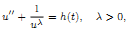
has a periodic solution if and only if the mean value of the continuous external force is positive. In this paper, we show that this result cannot be extended to the case when h is an integrable function, unless additional assumptions are introduced. In addition, for each p ≥ 1 and h-integrable function in the pth power, we give a sharp condition guaranteeing the existence of periodic solutions to the above-mentioned equation, showing that there is a close relation between p and the order of the singularity λ.
10 - Independence
-
- Book:
- A Basic Course in Measure and Probability
- Published online:
- 05 June 2014
- Print publication:
- 30 January 2014, pp 208-222
-
- Chapter
- Export citation
Positive solutions to Sturm–Liouville problems with non-local boundary conditions
-
- Journal:
- Proceedings of the Royal Society of Edinburgh. Section A: Mathematics / Volume 144 / Issue 1 / February 2014
- Published online by Cambridge University Press:
- 30 January 2014, pp. 119-138
- Print publication:
- February 2014
-
- Article
- Export citation
Quantile mechanics II: changes of variables in Monte Carlo methods and GPU-optimised normal quantiles
-
- Journal:
- European Journal of Applied Mathematics / Volume 25 / Issue 2 / April 2014
- Published online by Cambridge University Press:
- 24 January 2014, pp. 177-212
-
- Article
- Export citation
On the Importance Sampling of Self-Avoiding Walks
-
- Journal:
- Combinatorics, Probability and Computing / Volume 23 / Issue 5 / September 2014
- Published online by Cambridge University Press:
- 20 January 2014, pp. 725-748
-
- Article
- Export citation
-
In a 1976 paper published in Science, Knuth presented an algorithm to sample (non-uniform) self-avoiding walks crossing a square of side k. From this sample, he constructed an estimator for the number of such walks. The quality of this estimator is directly related to the (relative) variance of a certain random variable Xk. From his experiments, Knuth suspected that this variance was extremely large (so that the estimator would not be very efficient). But how large? For the analogous Rosenbluth algorithm, which samples unconfined self-avoiding walks of length n, the variance of the corresponding estimator is believed to be exponential in n.
A few years ago, Bassetti and Diaconis showed that, for a sampler à la Knuth that generates walks crossing a k × k square and consisting of North and East steps, the relative variance is only $O(\sqrt k)$. In this note we take one step further and show that, for walks consisting of North, South and East steps, the relative variance jumps to $2^{k(k+1)}/(k+1)^{2k}$. This is exponential in the average length of the walks, which is of order k2. We also obtain partial results for general self-avoiding walks crossing a square, suggesting that the relative variance could be exponential in k2 (which is again the average length of these walks).
Knuth's algorithm is a basic example of a widely used technique called sequential importance sampling. The present paper, following the paper by Bassetti and Diaconis, is one of very few examples where the variance of the estimator can be found.


Exact bounds for lift-to-drag ratios of profiles in the Helmholtz–Kirchhoff flow
-
- Journal:
- European Journal of Applied Mathematics / Volume 25 / Issue 2 / April 2014
- Published online by Cambridge University Press:
- 17 January 2014, pp. 231-254
-
- Article
- Export citation
9 - Cyclicity
-
- Book:
- A Primer on the Dirichlet Space
- Published online:
- 05 January 2014
- Print publication:
- 16 January 2014, pp 146-180
-
- Chapter
- Export citation
