Refine search
Actions for selected content:
26079 results in Abstract analysis
Instability thresholds in the microwave heating model with exponential non-linearity
-
- Journal:
- European Journal of Applied Mathematics / Volume 22 / Issue 3 / June 2011
- Published online by Cambridge University Press:
- 08 February 2011, pp. 187-216
-
- Article
- Export citation
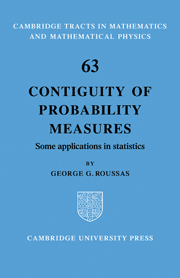
Contiguity of Probability Measures
- Some Applications in Statistics
-
- Published online:
- 04 February 2011
- Print publication:
- 05 October 1972
C*-pseudo-multiplicative unitaries, Hopf C*-bimodules and their Fourier algebras
- Part of
-
- Journal:
- Journal of the Institute of Mathematics of Jussieu / Volume 11 / Issue 1 / January 2012
- Published online by Cambridge University Press:
- 04 February 2011, pp. 189-220
- Print publication:
- January 2012
-
- Article
- Export citation
Szemerédi's Regularity Lemma for Matrices and Sparse Graphs
-
- Journal:
- Combinatorics, Probability and Computing / Volume 20 / Issue 3 / May 2011
- Published online by Cambridge University Press:
- 03 February 2011, pp. 455-466
-
- Article
- Export citation
Asymptotics for First-Passage Times on Delaunay Triangulations
-
- Journal:
- Combinatorics, Probability and Computing / Volume 20 / Issue 3 / May 2011
- Published online by Cambridge University Press:
- 03 February 2011, pp. 435-453
-
- Article
- Export citation
Dyadic Fefferman–Stein inequalities and the equivalence of Haar bases on weighted Lebesgue spaces
-
- Journal:
- Proceedings of the Royal Society of Edinburgh. Section A: Mathematics / Volume 141 / Issue 1 / February 2011
- Published online by Cambridge University Press:
- 11 February 2011, pp. 1-22
- Print publication:
- February 2011
-
- Article
- Export citation
On irregular weak solutions of the energy–momentum equations
-
- Journal:
- Proceedings of the Royal Society of Edinburgh. Section A: Mathematics / Volume 141 / Issue 1 / February 2011
- Published online by Cambridge University Press:
- 11 February 2011, pp. 193-204
- Print publication:
- February 2011
-
- Article
- Export citation
Ulyanov-type inequalities and generalized Liouville derivatives
-
- Journal:
- Proceedings of the Royal Society of Edinburgh. Section A: Mathematics / Volume 141 / Issue 1 / February 2011
- Published online by Cambridge University Press:
- 11 February 2011, pp. 205-224
- Print publication:
- February 2011
-
- Article
- Export citation
-
We study (p, q)-inequalities of Ulyanov type for moduli of smoothness of fractional order in the Lp
 and the Lp(ℝn) setting, p ≥ 1. In particular, we obtain estimates for the modulus of smoothness of a generalized Liouville derivative of a function via the modulus of smoothness of the function itself. We give examples showing the sharpness of these inequalities.
 and the L
Optimal decay rate of classical solutions to the compressible magnetohydrodynamic equations
-
- Journal:
- Proceedings of the Royal Society of Edinburgh. Section A: Mathematics / Volume 141 / Issue 1 / February 2011
- Published online by Cambridge University Press:
- 11 February 2011, pp. 109-126
- Print publication:
- February 2011
-
- Article
- Export citation
History-dependent decay rates for a logistic equation with infinite delay
-
- Journal:
- Proceedings of the Royal Society of Edinburgh. Section A: Mathematics / Volume 141 / Issue 1 / February 2011
- Published online by Cambridge University Press:
- 11 February 2011, pp. 23-44
- Print publication:
- February 2011
-
- Article
- Export citation
Braid monodromies on proper curves and pro-ℓ Galois representations
- Part of
-
- Journal:
- Journal of the Institute of Mathematics of Jussieu / Volume 11 / Issue 1 / January 2012
- Published online by Cambridge University Press:
- 01 February 2011, pp. 161-188
- Print publication:
- January 2012
-
- Article
- Export citation
Exit manifolds for lattice differential equations
-
- Journal:
- Proceedings of the Royal Society of Edinburgh. Section A: Mathematics / Volume 141 / Issue 1 / February 2011
- Published online by Cambridge University Press:
- 11 February 2011, pp. 77-92
- Print publication:
- February 2011
-
- Article
- Export citation
Well-posedness and blow-up phenomena for a periodic two-component Camassa–Holm equation
-
- Journal:
- Proceedings of the Royal Society of Edinburgh. Section A: Mathematics / Volume 141 / Issue 1 / February 2011
- Published online by Cambridge University Press:
- 11 February 2011, pp. 93-107
- Print publication:
- February 2011
-
- Article
- Export citation
Compactly supported solutions for a semilinear elliptic problem in ℝn with sign-changing function and non-Lipschitz nonlinearity
-
- Journal:
- Proceedings of the Royal Society of Edinburgh. Section A: Mathematics / Volume 141 / Issue 1 / February 2011
- Published online by Cambridge University Press:
- 11 February 2011, pp. 127-154
- Print publication:
- February 2011
-
- Article
- Export citation
-
For a sign-changing function a(x) we consider the solutions of the following semilinear elliptic problem in ℝn with n ≥ 3:

where γ > 0 and 0 < q < 1 < p < (n + 2)/(n − 2). Under an appropriate growth assumption on a− at infinity, we show that all solutions are compactly supported. When Ω+ = {x ∈ ℝn | a(x) > 0} has several connected components, we prove that there exists an interval on γ in which the solutions exist. In particular, if a(x) = a(|x|), by applying the mountain-pass theorem there are at least two solutions with radial symmetry that are positive in Ω+.
On the distributional divergence of vector fields vanishing at infinity
-
- Journal:
- Proceedings of the Royal Society of Edinburgh. Section A: Mathematics / Volume 141 / Issue 1 / February 2011
- Published online by Cambridge University Press:
- 11 February 2011, pp. 65-76
- Print publication:
- February 2011
-
- Article
- Export citation
Existence, uniqueness and stability of positive solutions to sublinear elliptic systems
-
- Journal:
- Proceedings of the Royal Society of Edinburgh. Section A: Mathematics / Volume 141 / Issue 1 / February 2011
- Published online by Cambridge University Press:
- 11 February 2011, pp. 45-64
- Print publication:
- February 2011
-
- Article
- Export citation
On p-Laplace equations with concave terms and asymmetric perturbations
-
- Journal:
- Proceedings of the Royal Society of Edinburgh. Section A: Mathematics / Volume 141 / Issue 1 / February 2011
- Published online by Cambridge University Press:
- 11 February 2011, pp. 171-192
- Print publication:
- February 2011
-
- Article
- Export citation
Supports of weight modules over Witt algebras
-
- Journal:
- Proceedings of the Royal Society of Edinburgh. Section A: Mathematics / Volume 141 / Issue 1 / February 2011
- Published online by Cambridge University Press:
- 11 February 2011, pp. 155-170
- Print publication:
- February 2011
-
- Article
- Export citation
-
As the first step towards a classification of simple weight modules with finite dimensional weight spaces over Witt algebras Wn, we explicitly describe the supports of such modules. We also obtain some descriptions of the support of an arbitrary simple weight module over a ℤn-graded Lie algebra
 having a root space decomposition
  with respect to the abelian subalgebra
  , with the property
 ![$\smash{[\mathfrak{g}_\alpha,\mathfrak{g}_\beta] = \mathfrak{g}_{\alpha+\beta}}$](//static.cambridge.org/binary/version/id/urn:cambridge.org:id:binary:20151023034317966-0654:S0308210509000912_inline4.gif?pub-status=live) for all α, β ∈ ℤn, α ≠ β (this class contains the algebra Wn).
for all α, β ∈ ℤn, α ≠ β (this class contains the algebra Wn).
 having a root space decomposition
  with respect to the abelian subalgebra
  , with the property
 ![$\smash{[\mathfrak{g}_\alpha,\mathfrak{g}_\beta] = \mathfrak{g}_{\alpha+\beta}}$](http://static.cambridge.org/binary/version/id/urn:cambridge.org:id:binary:20151023034317966-0654:S0308210509000912_inline4.gif?pub-status=live) for all α, β ∈ ℤ
for all α, β ∈ ℤCPC volume 20 issue 2 Cover and Front matter
-
- Journal:
- Combinatorics, Probability and Computing / Volume 20 / Issue 2 / March 2011
- Published online by Cambridge University Press:
- 28 January 2011, pp. f1-f2
-
- Article
-
- You have access
- Export citation
CPC volume 20 issue 2 Cover and Back matter
-
- Journal:
- Combinatorics, Probability and Computing / Volume 20 / Issue 2 / March 2011
- Published online by Cambridge University Press:
- 28 January 2011, pp. b1-b2
-
- Article
-
- You have access
- Export citation
