To save content items to your account,
please confirm that you agree to abide by our usage policies.
If this is the first time you use this feature, you will be asked to authorise Cambridge Core to connect with your account.
Find out more about saving content to .
To save content items to your Kindle, first ensure no-reply@cambridge.org
is added to your Approved Personal Document E-mail List under your Personal Document Settings
on the Manage Your Content and Devices page of your Amazon account. Then enter the ‘name’ part
of your Kindle email address below.
Find out more about saving to your Kindle.
Note you can select to save to either the @free.kindle.com or @kindle.com variations.
‘@free.kindle.com’ emails are free but can only be saved to your device when it is connected to wi-fi.
‘@kindle.com’ emails can be delivered even when you are not connected to wi-fi, but note that service fees apply.
In this chapter we construct and study associated homogeneous distributions (AHD) and quasi associated homogeneous distributions (QAHD) in the p-adic case. These results are based on the papers [16], [17], [223]. The results of this chapter will be used below in Chapters 9, 10 and 14.
In Appendix A, Sections A.2–A.7, we recall the theory of QAHDs in the better known case where the underlying field consists of the real numbers (“real QAHD”). By analogy with the theory of real QAHDs, in Sections 6.2–6.5 we develop the theory of p-adic associated and quasi associated homogeneous distributions. In Section 6.2, we recall the facts on p-adic homogeneous distributions from classical books [96, Ch.II, §2], [241, VIII]. In Section 6.3, Definition 6.2 of a p-adic QAHD is introduced. We prove Theorems 6.3.3 (Section 6.3) and 6.4.1 (Section 6.4) which give a description of all quasi associated homogeneous distributions and their Fourier transform respectively. In Section 6.5, a new type of p-adic Γ-functions is introduced. These Γ-functions are generated by QAHDs.
p-adic homogeneous distributions
Definition and characterization
Let πα be a multiplicative character of the field ℚp. We recall some facts from the theory of πα-homogeneous Bruhat–Schwartz p-adic distributions, where πα is a multiplicative character of the field ℚp [96, Ch.II, §2.3.], [241, VIII.1.].
These lecture notes are devoted to an area of current research interest that bridges functional analysis and function theory. The unifying theme is the notion of subharmonicity with respect to a uniform algebra. The topics covered include the rudiments of Choquet theory, various classes of representing measures, the duality between abstract sub-harmonic functions and Jensen measures, applications to problems of approximation of plurisubharmonic functions of several complex variables, and Cole's theory of estimates for conjugate functions. Many of the results are published here for the first time in monograph form.
The theory of Markov Processes has become a powerful tool in partial differential equations and potential theory with important applications to physics. Professor Dynkin has made many profound contributions to the subject and in this volume are collected several of his most important expository and survey articles. The content of these articles has not been covered in any monograph as yet. This account is accessible to graduate students in mathematics and operations research and will be welcomed by all those interested in stochastic processes and their applications.
Semiclassical approximation addresses the important relationship between quantum and classical mechanics. There has been a very strong development in the mathematical theory, mainly thanks to methods of microlocal analysis. This book develops the basic methods, including the WKB-method, stationary phase and h-pseudodifferential operators. The applications include results on the tunnel effect, the asymptotics of eigenvalues in relation to classical trajectories and normal forms, plus slow perturbations of periodic Schrödinger operators appearing in solid state physics. No previous specialized knowledge in quantum mechanics or microlocal analysis is assumed, and only general facts about spectral theory in Hilbert space, distributions, Fourier transforms and some differential geometry belong to the prerequisites. This book is addressed to researchers and graduate students in mathematical analysis, as well as physicists who are interested in rigorous results. A fairly large fraction can be (and has been) covered in a one semester course.
These volumes form an authoritative statement of the current state of research in Operator Algebras. They consist of papers arising from a year-long symposium held at the University of Warwick. Contributors include many very well-known figures in the field.
Some of the results on automatic continuity of intertwining operators and homomorphisms that were obtained between 1960 and 1973 are here collected together to provide a detailed discussion of the subject. The book will be appreciated by graduate students of functional analysis who already have a good foundation in this and in the theory of Banach algebras.
The book was written from lectures given at the University of Cambridge and maintains throughout a high level of rigour whilst remaining a highly readable and lucid account. Topics covered include the Planchard theory of the existence of Fourier transforms of a function of L2 and Tauberian theorems. The influence of G. H. Hardy is apparent from the presence of an application of the theory to the prime number theorems of Hadamard and de la Vallee Poussin. Both pure and applied mathematicians will welcome the reissue of this classic work. For this reissue, Professor Kahane's Foreword briefly describes the genesis of Wiener's work and its later significance to harmonic analysis and Brownian motion.
These notes treat in full detail the theory of representations of the group of automorphisms of a homogeneous tree. The unitary irreducible representations are classified in three types: a continuous series of spherical representations; two special representations; and a countable series of cuspidal representations as defined by G.I. Ol'shiankii. Several notable subgroups of the full automorphism group are also considered. The theory of spherical functions as eigenvalues of a Laplace (or Hecke) operator on the tree is used to introduce spherical representations and their restrictions to discrete subgroups. This will be an excellent companion for all researchers into harmonic analysis or representation theory.
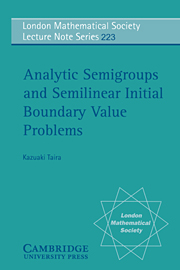
This book provides a careful and accessible exposition of the function analytic approach to initial boundary value problems for semilinear parabolic differential equations. It focuses on the relationship between two interrelated subjects in analysis: analytic semigroups and initial boundary value problems. This semigroup approach can be traced back to the pioneering work of Fujita and Kato on the Navier-Stokes equation. The author studies non homogeneous boundary value problems for second order elliptic differential operators, in the framework of Sobolev spaces of Lp style, which include as particular cases the Dirichlet and Neumann problems, and proves that these boundary value problems provide an example of analytic semigroups in Lp. This book will be a necessary purchase for researchers with an interest in analytic semigroups or initial value problems.
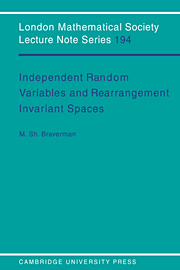
The subject of this book lies on the boundary between probability theory and the theory of function spaces. Here Professor Braverman investigates independent random variables in rearrangement invariant (r.i.) spaces. The significant feature of r.i. spaces is that the norm of an element depends on its distribution only, and this property allows the results and methods associated with r.i. spaces to be applied to problems in probability theory. On the other hand, probabilistic methods can also prove useful in the study of r.i. spaces. In this book new techniques are used and a number of interesting results are given. Most of the results are due to the author but have never before been available in English. Here they are all presented together in a volume that will be essential reading for all serious researchers in this area.
A mathematical model of the development of an oil and gas field is presented. The field development process is treated as sequential in nature. Completion of a well and its production are considered to be random processes. The model uses results from renewal theory where the completion of a well and failure to produce economical amount of oil or gas are analogous to the failure of a component. In principle, the theory described can give the complete probability distribution associated with a field development. Explicit expressions are given for the expected value and variance of the number of completed wells.
We study the number of random records in a binary search tree with n vertices (or equivalently, the number of cuttings required to eliminate the tree). We show that a classical limit theorem for convergence of sums of triangular arrays to infinitely divisible distributions can be used to determine the distribution of this number. The asymptotic distribution of the (normalized) number of records or cuts is found to be weakly 1-stable.
We study equilibrium liquid crystal configurations in three-dimensional geometries, within the continuum Landau-de Gennes theory. We obtain explicit bounds for the equilibrium scalar order parameters in terms of the temperature and material-dependent constants. We explicitly quantify the temperature regimes where the Landau-de Gennes predictions match and the temperature regimes where the Landau-de Gennes predictions do not match the probabilistic second-moment definition of the Q-tensor order parameter. The regime of agreement may be interpreted as the regime of validity of the Landau-de Gennes theory since the Landau-de Gennes theory predicts large values of the equilibrium scalar order parameters – larger than unity, in the low-temperature regime. We discuss a modified Landau-de Gennes energy functional which yields physically realistic values of the equilibrium scalar order parameters in all temperature regimes.