Refine search
Actions for selected content:
26076 results in Abstract analysis
C1-generic symplectic diffeomorphisms: partial hyperbolicity and zero centre Lyapunov exponents
- Part of
-
- Journal:
- Journal of the Institute of Mathematics of Jussieu / Volume 9 / Issue 1 / January 2010
- Published online by Cambridge University Press:
- 26 March 2009, pp. 49-93
- Print publication:
- January 2010
-
- Article
- Export citation
Universal inequalities for eigenvalues of a system of elliptic equations
-
- Journal:
- Proceedings of the Royal Society of Edinburgh. Section A: Mathematics / Volume 139 / Issue 2 / April 2009
- Published online by Cambridge University Press:
- 25 March 2009, pp. 273-285
- Print publication:
- April 2009
-
- Article
- Export citation
-
Let D be a bounded domain in an n-dimensional Euclidean space ℝn. Assume that

are eigenvalues of an eigenvalue problem of a system of n elliptic equations:

In particular, when n=3, the eigenvalue problem describes the behaviour of the elastic vibration. We obtain universal inequalities for eigenvalues of the above eigenvalue problem by making use of a direct and explicit method; our results are sharper than one of Hook. Furthermore, a universal inequality for lower-order eigenvalues of the above eigenvalue problem is also derived.
Inverse problems for invariant algebraic curves: explicit computations
-
- Journal:
- Proceedings of the Royal Society of Edinburgh. Section A: Mathematics / Volume 139 / Issue 2 / April 2009
- Published online by Cambridge University Press:
- 25 March 2009, pp. 287-302
- Print publication:
- April 2009
-
- Article
- Export citation
A non-existence result for nonlinear parabolic equations with singular measures as data
-
- Journal:
- Proceedings of the Royal Society of Edinburgh. Section A: Mathematics / Volume 139 / Issue 2 / April 2009
- Published online by Cambridge University Press:
- 25 March 2009, pp. 381-392
- Print publication:
- April 2009
-
- Article
- Export citation
-
In this paper we prove a non-existence result for nonlinear parabolic problems with zero lower-order terms whose model is
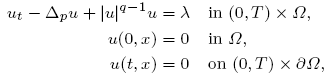
where Δp=div(|∇u|p−2∇u) is the usual p-laplace operator, λ is measure concentrated on a set of zero parabolic r-capacity (1<p<r) and q is large enough.
Convergence rate for the Boltzmann and Landau equations with soft potentials
-
- Journal:
- Proceedings of the Royal Society of Edinburgh. Section A: Mathematics / Volume 139 / Issue 2 / April 2009
- Published online by Cambridge University Press:
- 25 March 2009, pp. 393-416
- Print publication:
- April 2009
-
- Article
- Export citation
Isometries of weighted spaces of holomorphic functions on unbounded domains
-
- Journal:
- Proceedings of the Royal Society of Edinburgh. Section A: Mathematics / Volume 139 / Issue 2 / April 2009
- Published online by Cambridge University Press:
- 25 March 2009, pp. 253-271
- Print publication:
- April 2009
-
- Article
- Export citation
Lie algebras with S3- or S4-action and generalized Malcev algebras
-
- Journal:
- Proceedings of the Royal Society of Edinburgh. Section A: Mathematics / Volume 139 / Issue 2 / April 2009
- Published online by Cambridge University Press:
- 25 March 2009, pp. 321-357
- Print publication:
- April 2009
-
- Article
- Export citation
On the number of interior peaks of solutions to a non-autonomous singularly perturbed Neumann problem
-
- Journal:
- Proceedings of the Royal Society of Edinburgh. Section A: Mathematics / Volume 139 / Issue 2 / April 2009
- Published online by Cambridge University Press:
- 25 March 2009, pp. 427-448
- Print publication:
- April 2009
-
- Article
- Export citation
-
We study the following non-autonomous singularly perturbed Neumann problem:

where the index p is subcritical and a(x) is a positive smooth function in
 . We show that, given ε small enough, there exists a K(ε) such that, for any positive integer K ≤ K(ε), there always exists a solution with K interior peaks concentrating at a strict sth-order local minimum point of a.
 . We show that, given ε small enough, there exists a K(ε) such that, for any positive integer K ≤ K(ε), there always exists a solution with K interior peaks concentrating at a strict sth-order local minimum point of a.
On structure theory of pre-Hilbert algebras
-
- Journal:
- Proceedings of the Royal Society of Edinburgh. Section A: Mathematics / Volume 139 / Issue 2 / April 2009
- Published online by Cambridge University Press:
- 25 March 2009, pp. 303-319
- Print publication:
- April 2009
-
- Article
- Export citation
-
Let A be a real (non-associative) algebra which is normed as real vector space, with a norm ‖·‖ deriving from an inner product and satisfying ‖ac‖ ≤ ‖a‖‖c‖ for any a,c ∈ A. We prove that if the algebraic identity (a((ac)a))a = (a2c)a2 holds in A, then the existence of an idempotent e such that ‖e‖ = 1 and ‖ea‖ = ‖a‖ = ‖ae‖, a ∈ A, implies that A is isometrically isomorphic to ℝ, ℂ, ℍ,
![$\mathbb{O}$,\, $\stackrel{\raisebox{4.5pt}[0pt][0pt]{\fontsize{4pt}{4pt}\selectfont$\star$}}{\smash{\CC}}$,\, $\stackrel{\raisebox{4.5pt}[0pt][0pt]{\fontsize{4pt}{4pt}\selectfont$\star$}}{\smash{\mathbb{H}}}$,\, $\stackrel{\raisebox{4.5pt}[0pt][0pt]{\fontsize{4pt}{4pt}\selectfont$\star$}}{\smash{\mathbb{O}}}$](//static.cambridge.org/binary/version/id/urn:cambridge.org:id:binary:20151023033959175-0470:S0308210507000753_inline1.gif?pub-status=live) or ℙ. This is a non-associative extension of a classical theorem by Ingelstam. Finally, we give some applications of our main result.
or ℙ. This is a non-associative extension of a classical theorem by Ingelstam. Finally, we give some applications of our main result.
![$\mathbb{O}$,\, $\stackrel{\raisebox{4.5pt}[0pt][0pt]{\fontsize{4pt}{4pt}\selectfont$\star$}}{\smash{\CC}}$,\, $\stackrel{\raisebox{4.5pt}[0pt][0pt]{\fontsize{4pt}{4pt}\selectfont$\star$}}{\smash{\mathbb{H}}}$,\, $\stackrel{\raisebox{4.5pt}[0pt][0pt]{\fontsize{4pt}{4pt}\selectfont$\star$}}{\smash{\mathbb{O}}}$](http://static.cambridge.org/binary/version/id/urn:cambridge.org:id:binary:20151023033959175-0470:S0308210507000753_inline1.gif?pub-status=live) or ℙ. This is a non-associative extension of a classical theorem by Ingelstam. Finally, we give some applications of our main result.
or ℙ. This is a non-associative extension of a classical theorem by Ingelstam. Finally, we give some applications of our main result.The eigenvalue gap for one-dimensional Schrödinger operators with symmetric potentials
-
- Journal:
- Proceedings of the Royal Society of Edinburgh. Section A: Mathematics / Volume 139 / Issue 2 / April 2009
- Published online by Cambridge University Press:
- 25 March 2009, pp. 359-366
- Print publication:
- April 2009
-
- Article
- Export citation
Norm-attaining operators into Lorentz sequence spaces
-
- Journal:
- Proceedings of the Royal Society of Edinburgh. Section A: Mathematics / Volume 139 / Issue 2 / April 2009
- Published online by Cambridge University Press:
- 25 March 2009, pp. 225-235
- Print publication:
- April 2009
-
- Article
- Export citation
Two non-trivial solutions for a non-homogeneous Neumann problem: an Orlicz–Sobolev space setting
-
- Journal:
- Proceedings of the Royal Society of Edinburgh. Section A: Mathematics / Volume 139 / Issue 2 / April 2009
- Published online by Cambridge University Press:
- 25 March 2009, pp. 367-379
- Print publication:
- April 2009
-
- Article
- Export citation
Remarks on generalized elliptic integrals
-
- Journal:
- Proceedings of the Royal Society of Edinburgh. Section A: Mathematics / Volume 139 / Issue 2 / April 2009
- Published online by Cambridge University Press:
- 25 March 2009, pp. 417-426
- Print publication:
- April 2009
-
- Article
- Export citation
Lower bounds for derivatives of solutions for nonlinear Schrödinger equations
-
- Journal:
- Proceedings of the Royal Society of Edinburgh. Section A: Mathematics / Volume 139 / Issue 2 / April 2009
- Published online by Cambridge University Press:
- 25 March 2009, pp. 237-251
- Print publication:
- April 2009
-
- Article
- Export citation
-
The main goal of this paper is to obtain the lower bounds

for solutions uν of nonlinear Schrödinger equations with small viscosity ν. We also discuss the application of the above estimate to the theory of turbulence. Namely, we are interested in time-averaged lower bounds, which are important in establishing upper bounds for the turbulent space-scale.
A Spectral Approach to Analysing Belief Propagation for 3-Colouring
-
- Journal:
- Combinatorics, Probability and Computing / Volume 18 / Issue 6 / November 2009
- Published online by Cambridge University Press:
- 24 March 2009, pp. 881-912
-
- Article
- Export citation
7 - Blaschke products and their applications
-
- Book:
- Representation Theorems in Hardy Spaces
- Published online:
- 05 June 2013
- Print publication:
- 19 March 2009, pp 155-186
-
- Chapter
- Export citation
Frontmatter
-
- Book:
- Representation Theorems in Hardy Spaces
- Published online:
- 05 June 2013
- Print publication:
- 19 March 2009, pp i-vi
-
- Chapter
- Export citation
Index
-
- Book:
- Representation Theorems in Hardy Spaces
- Published online:
- 05 June 2013
- Print publication:
- 19 March 2009, pp 369-372
-
- Chapter
- Export citation
10 - Poisson integrals
-
- Book:
- Representation Theorems in Hardy Spaces
- Published online:
- 05 June 2013
- Print publication:
- 19 March 2009, pp 225-246
-
- Chapter
- Export citation
Preface
-
- Book:
- Representation Theorems in Hardy Spaces
- Published online:
- 05 June 2013
- Print publication:
- 19 March 2009, pp xi-xii
-
- Chapter
- Export citation
