Refine search
Actions for selected content:
26079 results in Abstract analysis
References
-
- Book:
- Functional Analysis for Probability and Stochastic Processes
- Published online:
- 14 January 2010
- Print publication:
- 11 August 2005, pp 385-389
-
- Chapter
- Export citation
Preface
-
- Book:
- Functional Analysis for Probability and Stochastic Processes
- Published online:
- 14 January 2010
- Print publication:
- 11 August 2005, pp xi-xii
-
- Chapter
- Export citation
2 - Basic notions in functional analysis
-
- Book:
- Functional Analysis for Probability and Stochastic Processes
- Published online:
- 14 January 2010
- Print publication:
- 11 August 2005, pp 37-79
-
- Chapter
- Export citation
3 - Conditional expectation
-
- Book:
- Functional Analysis for Probability and Stochastic Processes
- Published online:
- 14 January 2010
- Print publication:
- 11 August 2005, pp 80-120
-
- Chapter
- Export citation
8 - Markov processes and semigroups of operators
-
- Book:
- Functional Analysis for Probability and Stochastic Processes
- Published online:
- 14 January 2010
- Print publication:
- 11 August 2005, pp 294-362
-
- Chapter
- Export citation
Index
-
- Book:
- Functional Analysis for Probability and Stochastic Processes
- Published online:
- 14 January 2010
- Print publication:
- 11 August 2005, pp 390-393
-
- Chapter
- Export citation
7 - Semigroups of operators and Lévy processes
-
- Book:
- Functional Analysis for Probability and Stochastic Processes
- Published online:
- 14 January 2010
- Print publication:
- 11 August 2005, pp 234-293
-
- Chapter
- Export citation
1 - Preliminaries, notations and conventions
-
- Book:
- Functional Analysis for Probability and Stochastic Processes
- Published online:
- 14 January 2010
- Print publication:
- 11 August 2005, pp 1-36
-
- Chapter
- Export citation
6 - The Gelfand transform and its applications
-
- Book:
- Functional Analysis for Probability and Stochastic Processes
- Published online:
- 14 January 2010
- Print publication:
- 11 August 2005, pp 201-233
-
- Chapter
- Export citation
9 - Appendixes
-
- Book:
- Functional Analysis for Probability and Stochastic Processes
- Published online:
- 14 January 2010
- Print publication:
- 11 August 2005, pp 363-384
-
- Chapter
- Export citation
Contents
-
- Book:
- Functional Analysis for Probability and Stochastic Processes
- Published online:
- 14 January 2010
- Print publication:
- 11 August 2005, pp vii-x
-
- Chapter
- Export citation
5 - Dual spaces and convergence of probability measures
-
- Book:
- Functional Analysis for Probability and Stochastic Processes
- Published online:
- 14 January 2010
- Print publication:
- 11 August 2005, pp 147-200
-
- Chapter
- Export citation
Travelling waves for a reaction–diffusion system in population dynamics and epidemiology
-
- Journal:
- Proceedings of the Royal Society of Edinburgh. Section A: Mathematics / Volume 135 / Issue 4 / August 2005
- Published online by Cambridge University Press:
- 12 July 2007, pp. 663-675
- Print publication:
- August 2005
-
- Article
- Export citation
Volume, energy and generalized energy of unit vector fields on Berger spheres: stability of Hopf vector fields
-
- Journal:
- Proceedings of the Royal Society of Edinburgh. Section A: Mathematics / Volume 135 / Issue 4 / August 2005
- Published online by Cambridge University Press:
- 12 July 2007, pp. 789-813
- Print publication:
- August 2005
-
- Article
- Export citation
Stabilization to a singular steady state for the Frank-Kamenetskii equation in a critical dimension
-
- Journal:
- Proceedings of the Royal Society of Edinburgh. Section A: Mathematics / Volume 135 / Issue 4 / August 2005
- Published online by Cambridge University Press:
- 12 July 2007, pp. 777-787
- Print publication:
- August 2005
-
- Article
- Export citation
-
We study the phenomenon of the infinite-time stabilization of classical global solutions of nonlinear reaction–diffusion equations to an unbounded (singular) stationary state and we present a new case of such an asymptotic singularity pattern formation. We concentrate on the most famous parabolic model, namely the semi-linear Frank-Kamenetskii equation from combustion theory,
 where B is a ball in RN. Our goal is to show that a new asymptotic problem arises precisely in dimension 10, not being available in other dimensions (which were studied earlier). For N = 10, we fix the ball B = {|x| < 4} and take bounded initial data u0 below the singular stationary solution Us(x) = ln(16/|x|2), which is unbounded at the origin x = 0.
We establish a sharp estimate on the rate of convergence u(x, t) → Us(x) as t → ∞ on compact subsets bounded away from x = 0 and also at the singularity point. We show that u(0, t) = α0t + O(ln t) → ∞, where the positive constant α0 is given by the first eigenvalue of the associated linear differential operator. We present formal asymptotic results showing that a detailed asymptotic analysis depends on a quite involved balance between various linear and nonlinear terms. Moreover, similar critical asymptotic behaviour is shown to exist in various related nonlinear second- and higher-order parabolic equation.
Volume, energy and generalized energy of unit vector fields on Berger spheres: stability of Hopf vector fields
-
- Journal:
- Proceedings of the Royal Society of Edinburgh. Section A: Mathematics / Volume 135 / Issue 4 / August 2005
- Published online by Cambridge University Press:
- 12 July 2007, pp. 789-813
- Print publication:
- August 2005
-
- Article
- Export citation
Global attraction for systems with almost C1 vector fields
-
- Journal:
- Proceedings of the Royal Society of Edinburgh. Section A: Mathematics / Volume 135 / Issue 4 / August 2005
- Published online by Cambridge University Press:
- 12 July 2007, pp. 815-832
- Print publication:
- August 2005
-
- Article
- Export citation
-
Sufficient conditions are given for an autonomous differential system
 to have a single point global attractor (repeller) with f continuously differentiable almost everywhere. These results incorporate those of Hartman and Olech as a special case even when the condition f ∈ C1(D, ℝN) is fully met. Moreover, these criteria are simplified for a class of region-wise linear systems in ℝN.

Heat equation with singular potential and singular data
-
- Journal:
- Proceedings of the Royal Society of Edinburgh. Section A: Mathematics / Volume 135 / Issue 4 / August 2005
- Published online by Cambridge University Press:
- 12 July 2007, pp. 863-886
- Print publication:
- August 2005
-
- Article
- Export citation
Exponential attractors and finite-dimensional reduction for non-autonomous dynamical systems*
-
- Journal:
- Proceedings of the Royal Society of Edinburgh. Section A: Mathematics / Volume 135 / Issue 4 / August 2005
- Published online by Cambridge University Press:
- 12 July 2007, pp. 703-730
- Print publication:
- August 2005
-
- Article
- Export citation
Global attraction for systems with almost C1 vector fields
-
- Journal:
- Proceedings of the Royal Society of Edinburgh. Section A: Mathematics / Volume 135 / Issue 4 / August 2005
- Published online by Cambridge University Press:
- 12 July 2007, pp. 815-832
- Print publication:
- August 2005
-
- Article
- Export citation
-
Sufficient conditions are given for an autonomous differential system
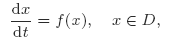 to have a single point global attractor (repeller) with f continuously differentiable almost everywhere. These results incorporate those of Hartman and Olech as a special case even when the condition f ∈ C1(D, RN) is fully met. Moreover, these criteria are simplified for a class of region-wise linear systems in RN.
