Refine search
Actions for selected content:
9084 results in Discrete Mathematics, Information Theory and Coding
Sparse Parity-Check Matrices over ${GF(q)}$
-
- Journal:
- Combinatorics, Probability and Computing / Volume 14 / Issue 1-2 / January 2005
- Published online by Cambridge University Press:
- 15 February 2005, pp. 147-169
-
- Article
- Export citation
Zigzag Structures of Simple Two-Faced Polyhedra
-
- Journal:
- Combinatorics, Probability and Computing / Volume 14 / Issue 1-2 / January 2005
- Published online by Cambridge University Press:
- 15 February 2005, pp. 31-57
-
- Article
- Export citation
MTK volume 51 issue 1-2 Cover and Front matter
-
- Journal:
- Mathematika / Volume 51 / Issue 1-2 / December 2004
- Published online by Cambridge University Press:
- 26 February 2010, pp. f1-f4
- Print publication:
- December 2004
-
- Article
-
- You have access
- Export citation
A generalization of some lattices of Coxeter
-
- Journal:
- Mathematika / Volume 51 / Issue 1-2 / December 2004
- Published online by Cambridge University Press:
- 26 February 2010, pp. 49-61
- Print publication:
- December 2004
-
- Article
- Export citation
Book Reviews - S. Alaca and K. S. Williams. Introductory Algebraic Number Theory. Cambridge University Press, 2004; 428 pp. ISBN 0 521 83250 0 (hardback), £65; 0 521 54011 9 (paperback), £24.99. - A. Baker and B. Richter (editors). Structured Ring Spectra. London Mathematical Society Lecture Note Series 315, Cambridge University Press. 2004; 236 pp. ISBN 0 521 60305 6 (paperback), £35. - R. Beals. Analysis: an Introduction. Cambridge University Press, 2004; 261 pp. ISBN 0 521 84072 4 (hardback), £50; 0 521 60047 2 (paperback), £24.99. - B. Bollobás. Random Graphs (2nd edition). Cambridge University Press, 2001; 498 pp. ISBN 0 521 80920 7 (hardback), £75; 0 521 79722 5 (paperback), £29.95. - J. A. Buchmann. Introduction to Cryptography (2nd edition). Undergraduate Texts in Mathematics, Springer-Verlag (Berlin-Heidelberg), 2004; 335 pp. ISBN 0 387 21156 X (hardback), £61.50; 0 387 20756 2 (paperback). £30.50. - Y. Bugeaud. Approximation by Algebraic Numbers. Cambridge Tracts in Mathematics 160, Cambridge University Press, 2004; 274 pp. ISBN 0 521 82329 3 (hardback), £40. - D. Cvetković, P. Rowlinson and S. Simić. Spectral Generalizations of Line Graphs: On Graphs with Least Eigenvalue 2. London Mathematical Society Lecture Note Series 314, Cambridge University Press. 2004; 298 pp. ISBN 0 521 83663 8 (paperback), £35. - H. Darmon and S.-W. Zhang (editors). Heegner Points and Rankin L-Series. MSRI Publications 49, Cambridge University Press, 2004; 367 pp. ISBN 0 521 83659 X (hardback), £45. - A. K. Dewdney. Beyond Reason: Eight Great Problems that Reveal the Limits of Science. John Wiley and Sons Inc. (Hoboken, NJ), 2004; 224 pp. ISBN 0 471 01398 6 (hardback), £19.99. - G. Gasper and M. Rahman. Basic Hypergeometric Series {2nd edition). Encyclopedia of Mathematics and its Applications 96, Cambridge University Press, 2004; 428 pp. ISBN 0 521 83357 4 (hardback), £65. - M. Georgiadou. Constantin Caratheodory: Mathematics and Politics in Turbulent Times. Springer-Verlag (Berlin), 2004; 651 pp. ISBN 3 540 20352 4 (paperback), £30.50. - C. G. Gibson. Elementary Euclidean Geometry: An Undergraduate Introduction. Cambridge University Press, 2003; 174 pp. ISBN 0 521 83448 1 (hardback), £32.50. - M. C. Golumbic and A. N. Trenk. Tolerance Graphs. Cambridge Studies in Advanced Mathematics 89, Cambridge Universtiy Press, 2004; 265 pp. ISBN 0 521 82758 2 (hardback), £40. - L. H. Harper. Global Methods for Combinatorial Isoperimetric Problems. Cambridge Studies in Advanced Mathematics 90, Cambridge University Press, 2004; 232 pp. ISBN 0 521 83268 3 (hardback), £40. - H. Kurzweil and B. Stellmacher. The Theory of Finite Groups: An Introduction. Springer Universitext, Springer-Verlag (New York-Berlin-Heidelberg), 2004; 387 pp. ISBN 0 387 40510 0 (hardback), £54. - J. H. Kwak and S. Hong. Linear Algebra (2nd edition). Birkhäuser (Boston), 2004; 390 pp. ISBN 0 8176 4294 3 (paperback), £39 (approx.) - T. Y. Lam. Exercises in Classical Ring Theory (2nd edition). Problem Books in Mathematics, Springer-Verlag (New York-Berlin-Heidelberg), 2003: 359 pp. ISBN 0 387 00500 5 (hardback), £54. - K. Mccrlmmon. A Taste of Jordan Algebras. Springer Universitext. Springer-Verlag (New York-Berlin-Heidelberg), 2004; 562 pp. ISBN 0 387 95447 3 (hardback), £57.50. - A. A. Mikhalev, V. Shpilrain and J.-T. Yu. Combinational Methods, Free Groups, Polynomials and Free Algebras. Canadian Mathematical Society Books in Mathematics 19, Springer, 2004; 315 pp. ISBN 0 387 40562 3 (hardback), £69. - M. C. Pedicchio and W. Tholen. Categorical Foundations: Special Topics in Order, Topology, Algebra and Sheaf Theory. Encyclopedia of Mathematics and its Applications 97, Cambridge University Press, 2004; 417 pp. ISBN 0 521 83414 7 (hardback), £60. - M. Reid and A. Skorobogatov. Number Theory and Algebraic Geometry. London Mathematical Society Lecture Note Series 303, Cambridge University Press, 2003; 300 pp. ISBN 0 521 54518 8 (paperback), £35. - H. K. Schenck. Computational Algebraic Geometry. London Mathematical Society Student Texts 58, Cambridge University Press, 2003; 193 pp. ISBN 0 521 82964 X (hardback), £50; 0 521 53650 2 (paperback), £18.99. - J. Stedall (translator). The Arithmetic of Infinitesimals: John Wallis 1656. Sources and Studies in the History of Mathematics and Physical Sciences, Springer (New York), 2004; 192 pp. ISBN 0 387 20709 0 (hardback), £92.50. - C. Teuscher (editor). Alan Turing: Life and Legacy of a Great Thinker. Springer-Verlag (Berlin-Heidelberg-New York), 2004; 542 pp. ISBN 3 540 20020 7 (hardback), £46. - C. T. C. Wall. Singular Points of Plane Curves. London Mathematical Society Student Texts 63, Cambridge University Press, 2004; 370 pp. ISBN 0 521 83904 1 (hardback), £55; 0 521 54774 1 (paperback), £27. - A. H. Zemanian. Graphs and Networks, Transfinite and Non-standard. Birkhäuser (Boston), 2004; 202 pp. ISBN 0 8176 4292 7 (paperback). £65 (approx.).
-
- Journal:
- Mathematika / Volume 51 / Issue 1-2 / December 2004
- Published online by Cambridge University Press:
- 26 February 2010, pp. 203-208
- Print publication:
- December 2004
-
- Article
- Export citation
The values of ternary quadratic forms at prime arguments
- Part of
-
- Journal:
- Mathematika / Volume 51 / Issue 1-2 / December 2004
- Published online by Cambridge University Press:
- 26 February 2010, pp. 83-96
- Print publication:
- December 2004
-
- Article
- Export citation
-
For the purpose of this paper, we call a set of positive reals ν a well-spaced set if there is a c > 0 such that

Random polytopes in smooth convex bodies: corrigendum
- Part of
-
- Journal:
- Mathematika / Volume 51 / Issue 1-2 / December 2004
- Published online by Cambridge University Press:
- 26 February 2010, p. 31
- Print publication:
- December 2004
-
- Article
- Export citation
Positive solutions for Dirichlet problems of singular quasilinear elliptic equations via variational methods
- Part of
-
- Journal:
- Mathematika / Volume 51 / Issue 1-2 / December 2004
- Published online by Cambridge University Press:
- 26 February 2010, pp. 187-202
- Print publication:
- December 2004
-
- Article
- Export citation
-
This paper studies the existence and multiplicity of positive solutions of the following problem:
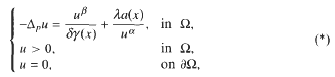
where Ω⊂RN(N≥3) is a smooth bounded domain,
 , 1 < p < N, and 0 < α < 1, p - 1 < β < p* - 1 (p* = Np/(N - p)) and 0 < γ < N + ((β + 1)(p - N)/p) are three constants. Also δ(x) = dist(x, ∂Ω), a ∈ Lp and λ < 0 is a real parameter. By using the direct method of the calculus of variations, Ekeland's Variational Principle and an idea of G. Tarantello, it is proved that problem (*) has at least two positive weak solutions if λ is small enough.
 , 1 <
, 1 < On the non-homogeneous quadratic Bessel zeta function
- Part of
-
- Journal:
- Mathematika / Volume 51 / Issue 1-2 / December 2004
- Published online by Cambridge University Press:
- 26 February 2010, pp. 123-130
- Print publication:
- December 2004
-
- Article
- Export citation
Completely 0-simple semigroups of left quotients
- Part of
-
- Journal:
- Mathematika / Volume 51 / Issue 1-2 / December 2004
- Published online by Cambridge University Press:
- 26 February 2010, pp. 111-122
- Print publication:
- December 2004
-
- Article
- Export citation
-
A subsemigroup S of a semigroup Q is a left order in Q, and Q is a semigroup of left quotients of S, if every element of Q can be written as a−1b for some a, b∈S with a belonging to a group
 -class of Q. Necessary and sufficient conditions on a semigroup S are obtained in order that S be a left order in a completely 0-simple semigroup Q. The class of all completely 0-simple semigroups of left quotients of S is related to the set of certain left congruences on S. Axioms are provided for semigroups which occur in the discussion of left orders in completely 0-simple semigroups.
 -class of
 Trapped modes in a waveguide with a thick obstacle
- Part of
-
- Journal:
- Mathematika / Volume 51 / Issue 1-2 / December 2004
- Published online by Cambridge University Press:
- 26 February 2010, pp. 171-186
- Print publication:
- December 2004
-
- Article
- Export citation
-
The problem of finding necessary and sufficient condi-tions for the existence of trapped modes in waveguides has been known since 1943. [10]. The problem is the following: consider an infinite strip M in ℝ2(or an infinite cylinder with the smooth boundary in ℝn). The spectrum of the(positive) Laplacian, with either Dirichlet or Neumann boundary conditions, acting on this strip is easily computable via the separation of variables; the spectrum is absolutely continuous and equals [v0,+∞). Here, v0 is the first threshold, i.e., eigenvalue of the cross-section of the cylinder (so v0 = 0 in the case of Neumann conditions). Let us now consider the domain
 (the waveguide) which is a smooth compact perturbation of M (for example, weinsert an obstacle inside M). The essential spectrum of the Laplacian acting on still equals [v0, +ℝ), but there may be additional eigenvalues, which are often called trapped modes; the number of these trapped modes can be quite large, see examples in [11] and [8].
 (the
(the Voronoĭ's conjecture and space tiling zonotopes
- Part of
-
- Journal:
- Mathematika / Volume 51 / Issue 1-2 / December 2004
- Published online by Cambridge University Press:
- 26 February 2010, pp. 1-10
- Print publication:
- December 2004
-
- Article
- Export citation
The values of Mahler measures
- Part of
-
- Journal:
- Mathematika / Volume 51 / Issue 1-2 / December 2004
- Published online by Cambridge University Press:
- 26 February 2010, pp. 131-148
- Print publication:
- December 2004
-
- Article
- Export citation
-
The set ℳ* of numbers which occur as Mahler measures of integer polynomials and the subset ℳ of Mahler measures of algebraic numbers (that is, of irreducible integer polynomials) are investigated. It is proved that every number α of degree d in ℳ* is the Mahler measure of a separable integer polynomial of degree at most
 with all its roots lying in the Galois closure F of ℚ(α), and every unit in ℳ is the Mahler measure of a unit in F of degree at most
  over ℚ This is used to show that some numbers considered earlier by Boyd are not Mahler measures. The set of numbers which occur as Mahler measures of both reciprocal and nonreciprocal algebraic numbers is also investigated. In particular, all cubic units in this set are described and it is shown that the smallest Pisot number is not the measure of a reciprocal number.
 with all its roots lying in the Galois closure
  over ℚ This is used to show that some numbers considered earlier by Boyd are not Mahler measures. The set of numbers which occur as Mahler measures of both reciprocal and nonreciprocal algebraic numbers is also investigated. In particular, all cubic units in this set are described and it is shown that the smallest Pisot number is not the measure of a reciprocal number.
Stochastical approximation of smooth convex bodies
- Part of
-
- Journal:
- Mathematika / Volume 51 / Issue 1-2 / December 2004
- Published online by Cambridge University Press:
- 26 February 2010, pp. 11-29
- Print publication:
- December 2004
-
- Article
- Export citation
An improvement of Artin's conjecture on average for composite moduli
- Part of
-
- Journal:
- Mathematika / Volume 51 / Issue 1-2 / December 2004
- Published online by Cambridge University Press:
- 26 February 2010, pp. 97-109
- Print publication:
- December 2004
-
- Article
- Export citation
Fell continuous selections and topologically well-orderable spaces
-
- Journal:
- Mathematika / Volume 51 / Issue 1-2 / December 2004
- Published online by Cambridge University Press:
- 26 February 2010, pp. 163-169
- Print publication:
- December 2004
-
- Article
- Export citation
-
The present paper extends the idea of characterizing topological properties of a space X by means of continuous selections for its closed subsets
 (X) endowed with a “natural” hyperspace topology. In this particular case, it is proved that the property of X to be topologically well-orderable is equivalent to the existence of a selection for (X) which is continuous with respect to the Fell topology.
 (
(A characterization of the barycentre
- Part of
-
- Journal:
- Mathematika / Volume 51 / Issue 1-2 / December 2004
- Published online by Cambridge University Press:
- 26 February 2010, pp. 149-153
- Print publication:
- December 2004
-
- Article
- Export citation
Families of surfaces lying in a null set
- Part of
-
- Journal:
- Mathematika / Volume 51 / Issue 1-2 / December 2004
- Published online by Cambridge University Press:
- 26 February 2010, pp. 155-162
- Print publication:
- December 2004
-
- Article
- Export citation
-
In this note we generalize the following result of Sawyer [5]:
Theorem 1. There is a function ψ on ℝ such that, whenever g is a real-valued Borel measurable function on (a subset of) ℝ. × ℝn-1 with the property that y ↦ g(y, t) is C1 for a.e. t, the set

has measure zero.
Index to volume 51
-
- Journal:
- Mathematika / Volume 51 / Issue 1-2 / December 2004
- Published online by Cambridge University Press:
- 26 February 2010, p. 209
- Print publication:
- December 2004
-
- Article
- Export citation
The Santaló point of a function, and a functional form of the Santaló inequality
- Part of
-
- Journal:
- Mathematika / Volume 51 / Issue 1-2 / December 2004
- Published online by Cambridge University Press:
- 26 February 2010, pp. 33-48
- Print publication:
- December 2004
-
- Article
- Export citation
-
Let L(f) denote the Legendre transform of a function f: ℝn → ℝ. A theorem of K. Ball about even functions is generalized, and it is proved that, for any measurable function f ≥ 0, there exists a translation f(x) = f(x−a) such that

