To save content items to your account,
please confirm that you agree to abide by our usage policies.
If this is the first time you use this feature, you will be asked to authorise Cambridge Core to connect with your account.
Find out more about saving content to .
To save content items to your Kindle, first ensure no-reply@cambridge.org
is added to your Approved Personal Document E-mail List under your Personal Document Settings
on the Manage Your Content and Devices page of your Amazon account. Then enter the ‘name’ part
of your Kindle email address below.
Find out more about saving to your Kindle.
Note you can select to save to either the @free.kindle.com or @kindle.com variations.
‘@free.kindle.com’ emails are free but can only be saved to your device when it is connected to wi-fi.
‘@kindle.com’ emails can be delivered even when you are not connected to wi-fi, but note that service fees apply.
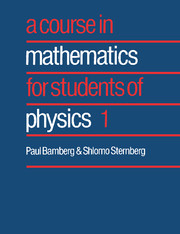
This textbook, available in two volumes, has been developed from a course taught at Harvard over the last decade. The course covers principally the theory and physical applications of linear algebra and of the calculus of several variables, particularly the exterior calculus. The authors adopt the 'spiral method' of teaching, covering the same topic several times at increasing levels of sophistication and range of application. Thus the reader develops a deep, intuitive understanding of the subject as a whole, and an appreciation of the natural progression of ideas. Topics covered include many items previously dealt with at a much more advanced level, such as algebraic topology (introduced via the analysis of electrical networks), exterior calculus, Lie derivatives, and star operators (which are applied to Maxwell's equations and optics). This then is a text which breaks new ground in presenting and applying sophisticated mathematics in an elementary setting. Any student, interpreted in the widest sense, with an interest in physics and mathematics, will gain from its study.
We propose a Lagrangian approach to deriving energy-preserving finite difference schemes for the Euler–Lagrange partial differential equations. Noether’s theorem states that the symmetry of time translation of Lagrangians yields the energy conservation law. We introduce a unique viewpoint on this theorem: “the symmetry of time translation of Lagrangians derives the Euler–Lagrange equation and the energy conservation law, simultaneously.” The proposed method is a combination of a discrete counter part of this statement and the discrete gradient method. It is also shown that the symmetry of space translation derives momentum-preserving schemes. Finally, we discuss the existence of discrete local conservation laws.
Our concern is the computation of optimal shapes in problems involving(−Δ)1/2. We focus on the energyJ(Ω) associated to the solution uΩ of thebasic Dirichlet problem( − Δ)1/2uΩ = 1in Ω, u = 0 in Ωc. We show that regularminimizers Ω of this energy under a volume constraint are disks. Our proof goes throughthe explicit computation of the shape derivative (that seems to be completely new in thefractional context), and a refined adaptation of the moving plane method.
We propose an unconditionally stable semi-implicit time discretization of the phase fieldcrystal evolution. It is based on splitting the underlying energy into convex and concaveparts and then performing H-1 gradient descent steps implicitly for the formerand explicitly for the latter. The splitting is effected in such a way that the resultingequations are linear in each time step and allow an extremely simple implementation andefficient solution. We provide the associated stability and error analysis as well asnumerical experiments to validate the method’s efficiency.
Using Burgers’ equation with mixed Neumann–Dirichlet boundary conditions, we highlight aproblem that can arise in the numerical approximation of nonlinear dynamical systems oncomputers with a finite precision floating point number system. We describe the dynamicalsystem generated by Burgers’ equation with mixed boundary conditions, summarize some ofits properties and analyze the equilibrium states for finite dimensional dynamical systemsthat are generated by numerical approximations of this system. It is important to notethat there are two fundamental differences between Burgers’ equation with mixedNeumann–Dirichlet boundary conditions and Burgers’ equation with both Dirichlet boundaryconditions. First, Burgers’ equation with homogenous mixed boundary conditions on a finiteinterval cannot be linearized by the Cole–Hopf transformation. Thus, on finite intervalsBurgers’ equation with a homogenous Neumann boundary condition is truly nonlinear. Second,the nonlinear term in Burgers’ equation with a homogenous Neumann boundary condition isnot conservative. This structure plays a key role in understanding the complex dynamicsgenerated by Burgers’ equation with a Neumann boundary condition and how this structureimpacts numerical approximations. The key point is that, regardless of the particularnumerical scheme, finite precision arithmetic will always lead to numerically generatedequilibrium states that do not correspond to equilibrium states of the Burgers’ equation.In this paper we establish the existence and stability properties of these numericalstationary solutions and employ a bifurcation analysis to provide a detailed mathematicalexplanation of why numerical schemes fail to capture the correct asymptotic dynamics. Weextend the results in [E. Allen, J.A. Burns, D.S. Gilliam, J. Hill and V.I. Shubov,Math. Comput. Modelling 35 (2002) 1165–1195] and provethat the effect of finite precision arithmetic persists in generating a nonzero numericalfalse solution to the stationary Burgers’ problem. Thus, we show that the results obtainedin [E. Allen, J.A. Burns, D.S. Gilliam, J. Hill and V.I. Shubov, Math. Comput.Modelling 35 (2002) 1165–1195] are not dependent on a specifictime marching scheme, but are generic to all convergent numerical approximations ofBurgers’ equation.
Nous étudions l’effet d’une couche mince rugueuse périodique déposée sur une structuresemi-infinie, dans le contexte Helmholtz bi-dimensionnel. Formellement, nous obtenons desconditions de transmission équivalentes à l’ordre 1, par des techniques de typehomogénéisation. Suivent alors la résolution du problème du milieu effectif éclairé parune onde plane, et le calcul de la fonction de Green effective ; le tout par analyse deFourier. Dans un deuxième temps, nous considérons le problème de diffraction par un objetpénétrable enfoui dans la structure recouverte par la couche rugueuse. Nous le résolvonspar la méthode des éléments finis de frontière, dans le milieu effectif. Des résultatsnumériques sont présentés. Enfin, le modèle effectif est validé dans le cas d’une coucheplate, et l’approximation de Born est utilisée pour tester le code des équationsintégrales.
In this work we study a fully discrete mixed scheme, based on continuous finite elementsin space and a linear semi-implicit first-order integration in time, approximating anEricksen–Leslie nematic liquid crystal model by means of aGinzburg–Landau penalized problem. Conditional stability of this schemeis proved via a discrete version of the energy law satisfied by thecontinuous problem, and conditional convergence towards generalized Young measure-valuedsolutions to the Ericksen–Leslie problem is showed when the discreteparameters (in time and space) and the penalty parameter go to zero at the same time.Finally, we will show some numerical experiences for a phenomenon of annihilation ofsingularities.
Cultivating oleaginous microalgae in specific culturing devices such as raceways is seenas a future way to produce biofuel. The complexity of this process coupling non linearbiological activity to hydrodynamics makes the optimization problem very delicate. Thelarge amount of parameters to be taken into account paves the way for a usefulmathematical modeling. Due to the heterogeneity of raceways along the depth dimensionregarding temperature, light intensity or nutrients availability, we adopt a multilayerapproach for hydrodynamics and biology. For free surface hydrodynamics, we use amultilayer Saint–Venant model that allows mass exchanges, forced by a simplifiedrepresentation of the paddlewheel. Then, starting from an improved Droop model thatincludes light effect on algae growth, we derive a similar multilayer system for thebiological part. A kinetic interpretation of the whole system results in an efficientnumerical scheme. We show through numerical simulations in two dimensions that ourapproach is capable of discriminating between situations of mixed water or calm andheterogeneous pond. Moreover, we exhibit that a posteriori treatment ofour velocity fields can provide lagrangian trajectories which are of great interest toassess the actual light pattern perceived by the algal cells and therefore understand itsimpact on the photosynthesis process.
An extension of the local projection stabilization (LPS) finite element method for convection-diffusion-reaction equations is presented and analyzed, both in the steady-state and the transient setting. In addition to the standard LPS method, a nonlinear crosswind diffusion term is introduced that accounts for the reduction of spurious oscillations. The existence of a solution can be proved and, depending on the choice of the stabilization parameter, also its uniqueness. Error estimates are derived which are supported by numerical studies. These studies demonstrate also the reduction of the spurious oscillations.
We consider a bilinear optimal control problem for a von Kármán plate equation. The control is a function of the spatial variables and acts as a multiplier of the velocity term. We first state the existence of solutions for the von Kármán equation and then derive optimality conditions for a given objective functional. Finally, we show the uniqueness of the optimal control.
We consider a Canham − Helfrich − type variational problem defined over closed surfacesenclosing a fixed volume and having fixed surface area. The problem models the shape ofmultiphase biomembranes. It consists of minimizing the sum of the Canham − Helfrichenergy, in which the bending rigidities and spontaneous curvatures are nowphase-dependent, and a line tension penalization for the phase interfaces. By restrictingattention to axisymmetric surfaces and phase distributions, we extend our previous resultsfor a single phase [R. Choksi and M. Veneroni, Calc. Var. Partial Differ. Equ.(2012). DOI:10.1007/s00526-012-0553-9] and prove existence of a globalminimizer.
We analyse the steady-state operation of a continuous flow bioreactor in which the biochemical reaction is governed by noncompetitive substrate inhibition (Andrews kinetics). A generalized reactor model is used in which the well-stirred bioreactor and the idealized membrane bioreactor are special cases. As generic properties of systems subject to substrate inhibition have been obtained by other authors, we discuss reaction engineering features specific to Andrews kinetics.
In a review of the book Mathematics for Physics: A Guided Tour for Graduate Students by Michael Stone and Paul Goldbart (2009), David Khmelnitskii perceptively writes:
Without textbooks, the education of scientists is unthinkable. Textbook authors rearrange, repackage, and present established facts and discoveries – along the way straightening logic, excluding unnecessary details, and, finally, shrinking the volume of preparatory reading for the next generation. Writing them is therefore one of the most important collective tasks of the academic community, and an often underrated one at that. Textbooks are not easy to create, but once they are, the good ones become cornerstones, often advancing and redefining common knowledge.
There is perhaps no other branch of applied mathematics that is more in need of such a “repackaging” than the calculus of variations.
A glance through the reference list at the end of the book will reveal that there are a number of now-classic texts on the calculus of variations from up through the mid-1960s, such as Weinstock (1952) and Gelfand and Fomin (1963), with a sharp drop subsequent to that period. The classic texts that emphasize applications, such as Morse and Feshback (1953) and Courant and Hilbert (1953), typically focus the majority of their discussion of variational methods on classical mechanics, for example, statics, dynamics, elasticity, and vibrations. Since that time, it has been more common to simply include the necessary elements of variational calculus in books dedicated to specific topics, such as analytical dynamics, dynamical systems, mechanical vibrations, elasticity, finite-element methods, and optimal control theory. More recently, the trend has been to avoid treating these subjects from a variational point of view altogether.
To those who do not know mathematics it is difficult to get across a real feeling as to the beauty, the deepest beauty, of nature … If you want to learn about nature, to appreciate nature, it is necessary to understand the language that she speaks in.
(Richard Feynman)
Calculus is the mathematics of change. Differential calculus addresses the change of a function as one moves from point to point. A function u(x) is such that the dependent variable u takes on a unique value for each value of the independent variable x, and the derivative of the function at a point indicates the rate of change, or slope, at that point. In calculus of variations, we deal with the functional, which may be regarded as a “function of functions,” that is, a function that depends on other functions. More specifically, a functional is a definite integral whose integrand contains a function that is yet to be determined. A functional I[u(x)] is such that I takes on a unique scalar value for each function u(x). In Section 1.3, the travel time T[u(x)] and total energy E[u(z)] are functionals, which are functions of the path of light or the boat u(x) and bubble shape u(z), respectively. Variational calculus addresses the change in a functional as one moves from function to function. Accordingly, whereas differential calculus is the calculus of functions, variational calculus is the calculus of functionals.
Calculus of variations, more than any other branch of mathematics, is intimately connected with the physical world in which we live. Nature favors extremum principles, and calculus of variations provides the mathematical framework in which to express such principles. As a result, many of the laws of physics find their most natural mathematical expression in variational form. In Chapter 1, we considered the cases of Fermat's principle of optics and minimization of total energy to determine the shape of a liquid drop on a solid surface. The objective of Part II is to provide a brief introduction to a variety of physical phenomena from a unified variational point of view. The emphasis is on illustrating the wide range of applications of the calculus of variations, and the reader is referred to dedicated texts for more complete treatments of each topic. The centerpiece of these seemingly disparate subjects is Hamilton's principle, which provides a compact form of the dynamical equations of motion – its traditional area of application – and the governing equations for many other physical phenomena as illustrated throughout this and subsequent chapters. Much of the historical development of the calculus of variations is centered around its application to dynamical systems; therefore, a number of the important principles and historical figures intimately connected with the calculus of variations will be highlighted in this chapter.