Refine search
Actions for selected content:
6997 results in Mathematical modeling and methods
Stabilized Galerkin methods for magneticadvection
-
- Journal:
- ESAIM: Mathematical Modelling and Numerical Analysis / Volume 47 / Issue 6 / November 2013
- Published online by Cambridge University Press:
- 07 October 2013, pp. 1713-1732
- Print publication:
- November 2013
-
- Article
- Export citation
Automatic simplification of Darcy’s equations with pressuredependent permeability
-
- Journal:
- ESAIM: Mathematical Modelling and Numerical Analysis / Volume 47 / Issue 6 / November 2013
- Published online by Cambridge University Press:
- 07 October 2013, pp. 1797-1820
- Print publication:
- November 2013
-
- Article
- Export citation
A Galerkin strategy with Proper Orthogonal Decomposition forparameter-dependent problems – Analysis, assessments and applications to parameterestimation
-
- Journal:
- ESAIM: Mathematical Modelling and Numerical Analysis / Volume 47 / Issue 6 / November 2013
- Published online by Cambridge University Press:
- 07 October 2013, pp. 1821-1843
- Print publication:
- November 2013
-
- Article
- Export citation
Eigenvalues of polyharmonic operators on variabledomains
-
- Journal:
- ESAIM: Control, Optimisation and Calculus of Variations / Volume 19 / Issue 4 / October 2013
- Published online by Cambridge University Press:
- 06 September 2013, pp. 1225-1235
- Print publication:
- October 2013
-
- Article
- Export citation
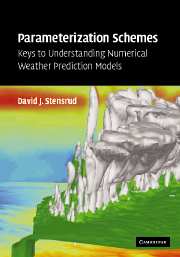
Parameterization Schemes
- Keys to Understanding Numerical Weather Prediction Models
-
- Published online:
- 05 September 2013
- Print publication:
- 03 May 2007
A EUROPEAN OPTION GENERAL FIRST-ORDER ERROR FORMULA
- Part of
-
- Journal:
- The ANZIAM Journal / Volume 54 / Issue 4 / April 2013
- Published online by Cambridge University Press:
- 04 September 2013, pp. 248-272
-
- Article
-
- You have access
- Export citation
-
We study the value of European security derivatives in the Black–Scholes model when the underlying asset $\xi $ is approximated by random walks ${\xi }^{(n)} $. We obtain an explicit error formula, up to a term of order $ \mathcal{O} ({n}^{- 3/ 2} )$, which is valid for general approximating schemes and general payoff functions. We show how this error formula can be used to find random walks ${\xi }^{(n)} $ for which option values converge at a speed of $ \mathcal{O} ({n}^{- 3/ 2} )$.


ANZ VOLUME 54 ISSUE 4 COVER AND BACK MATTER
-
- Journal:
- The ANZIAM Journal / Volume 54 / Issue 4 / April 2013
- Published online by Cambridge University Press:
- 04 September 2013, pp. b1-b7
-
- Article
-
- You have access
- Export citation
DETERMINATION OF JOIN REGIONS BETWEEN CARBON NANOSTRUCTURES USING VARIATIONAL CALCULUS
- Part of
-
- Journal:
- The ANZIAM Journal / Volume 54 / Issue 4 / April 2013
- Published online by Cambridge University Press:
- 04 September 2013, pp. 221-247
-
- Article
-
- You have access
- Export citation
APPROXIMATING THE KOHLRAUSCH FUNCTION BY SUMS OF EXPONENTIALS
- Part of
-
- Journal:
- The ANZIAM Journal / Volume 54 / Issue 4 / April 2013
- Published online by Cambridge University Press:
- 04 September 2013, pp. 306-323
-
- Article
-
- You have access
- Export citation
-
The Kohlrausch functions $\exp (- {t}^{\beta } )$, with $\beta \in (0, 1)$, which are important in a wide range of physical, chemical and biological applications, correspond to specific realizations of completely monotone functions. In this paper, using nonuniform grids and midpoint estimates, constructive procedures are formulated and analysed for the Kohlrausch functions. Sharper estimates are discussed to improve the approximation results. Numerical results and representative approximations are presented to illustrate the effectiveness of the proposed method.


ANZ VOLUME 54 ISSUE 4 COVER AND FRONT MATTER
-
- Journal:
- The ANZIAM Journal / Volume 54 / Issue 4 / April 2013
- Published online by Cambridge University Press:
- 04 September 2013, pp. f1-f2
-
- Article
-
- You have access
- Export citation
Dimension reduction for −Δ1
-
- Journal:
- ESAIM: Control, Optimisation and Calculus of Variations / Volume 20 / Issue 1 / January 2014
- Published online by Cambridge University Press:
- 03 September 2013, pp. 42-77
- Print publication:
- January 2014
-
- Article
- Export citation
Optimal uncertainty quantification for legacy data observationsof Lipschitz functions
-
- Journal:
- ESAIM: Mathematical Modelling and Numerical Analysis / Volume 47 / Issue 6 / November 2013
- Published online by Cambridge University Press:
- 30 August 2013, pp. 1657-1689
- Print publication:
- November 2013
-
- Article
- Export citation
Shape optimization problems for metric graphs
-
- Journal:
- ESAIM: Control, Optimisation and Calculus of Variations / Volume 20 / Issue 1 / January 2014
- Published online by Cambridge University Press:
- 29 August 2013, pp. 1-22
- Print publication:
- January 2014
-
- Article
- Export citation
-
We consider the shape optimization problem \hbox{$\min\big\{\E(\Gamma)\ :\ \Gamma\in\A,\ \H^1(\Gamma)=l\\big\},$}

min{ℰ(Γ):Γ ∈ 𝒜,ℋ1(Γ) = l}, where ℋ1 is the one-dimensional Hausdorffmeasure and𝒜is an admissible class of one-dimensional setsconnecting some prescribed set of points \hbox{$\D=\{D_1,\dots,D_k\}\subset\R^d$}
𝒟 = { D1,...,Dk } ⊂ Rd . The cost functional ℰ(Γ) is theDirichlet energy of Γ defined through the Sobolev functions onΓ vanishing on the pointsDi. We analyze the existence of a solutionin both the families of connected sets and of metric graphs. At the end, several explicitexamples are discussed.
Controllability of Schrödinger equation with a nonlocalterm
-
- Journal:
- ESAIM: Control, Optimisation and Calculus of Variations / Volume 20 / Issue 1 / January 2014
- Published online by Cambridge University Press:
- 29 August 2013, pp. 23-41
- Print publication:
- January 2014
-
- Article
- Export citation
Nash equilibrium payoffs for stochastic differential games withreflection
-
- Journal:
- ESAIM: Control, Optimisation and Calculus of Variations / Volume 19 / Issue 4 / October 2013
- Published online by Cambridge University Press:
- 27 August 2013, pp. 1189-1208
- Print publication:
- October 2013
-
- Article
- Export citation
On the cost of null-control of an artificialadvection-diffusion problem
-
- Journal:
- ESAIM: Control, Optimisation and Calculus of Variations / Volume 19 / Issue 4 / October 2013
- Published online by Cambridge University Press:
- 27 August 2013, pp. 1209-1224
- Print publication:
- October 2013
-
- Article
- Export citation
Two shallow-water type models for viscoelastic flows fromkinetic theory for polymers solutions
-
- Journal:
- ESAIM: Mathematical Modelling and Numerical Analysis / Volume 47 / Issue 6 / November 2013
- Published online by Cambridge University Press:
- 26 August 2013, pp. 1627-1655
- Print publication:
- November 2013
-
- Article
- Export citation
Error estimates for the Coupled Cluster method∗
-
- Journal:
- ESAIM: Mathematical Modelling and Numerical Analysis / Volume 47 / Issue 6 / November 2013
- Published online by Cambridge University Press:
- 26 August 2013, pp. 1553-1582
- Print publication:
- November 2013
-
- Article
- Export citation
Derivation of Langevin dynamics in a nonzero background flowfield
-
- Journal:
- ESAIM: Mathematical Modelling and Numerical Analysis / Volume 47 / Issue 6 / November 2013
- Published online by Cambridge University Press:
- 20 August 2013, pp. 1583-1626
- Print publication:
- November 2013
-
- Article
- Export citation
First order second moment analysis for stochastic interfaceproblems based on low-rank approximation∗
-
- Journal:
- ESAIM: Mathematical Modelling and Numerical Analysis / Volume 47 / Issue 5 / September 2013
- Published online by Cambridge University Press:
- 14 August 2013, pp. 1533-1552
- Print publication:
- September 2013
-
- Article
- Export citation
