To save content items to your account,
please confirm that you agree to abide by our usage policies.
If this is the first time you use this feature, you will be asked to authorise Cambridge Core to connect with your account.
Find out more about saving content to .
To save content items to your Kindle, first ensure no-reply@cambridge.org
is added to your Approved Personal Document E-mail List under your Personal Document Settings
on the Manage Your Content and Devices page of your Amazon account. Then enter the ‘name’ part
of your Kindle email address below.
Find out more about saving to your Kindle.
Note you can select to save to either the @free.kindle.com or @kindle.com variations.
‘@free.kindle.com’ emails are free but can only be saved to your device when it is connected to wi-fi.
‘@kindle.com’ emails can be delivered even when you are not connected to wi-fi, but note that service fees apply.
This is the second of a series of four volumes covering all stages of development of the Calculus, from the last years at school to degree standard. The books are written for students of science and engineering as well as for specialist mathematicians, and are designed to bridge the gap between the works used in schools and more advanced studies. with their emphasis on rigour. This treatment of algebraic and trigonometric functions is here developed to cover logarithmic, exponential and hyperbolic functions and the expansion of all these functions as power series. There is a chapter on curves and the idea of complex numbers is introduced for the first time. In the two final chapters, the author begins a systematic treatment of methods of integrating functions, introducing principles into what often seems rather a haphazard process. This volume, like the others, is well endowed with examples.
Boundary-layer separation from a rigid body surface is one of the fundamental problems of classical and modern fluid dynamics. The major successes achieved since the late 1960s in the development of the theory of separated flows at high Reynolds numbers are in many ways associated with the use of asymptotic methods. The most fruitful of these has proved to be the method of matched asymptotic expansions, which has been widely used in mechanics and mathematical physics. There have been many papers devoted to different problems in the asymptotic theory of separated flows and we can confidently speak of the appearance of a very productive direction in the development of theoretical hydrodynamics. This book will present this theory in a systematic account. The book will serve as a useful introduction to the theory, and will draw attention to the possibilities that application of the asymptotic approach provides.
We introduce a phenomenological model for anti-angiogenic therapy in the treatment of metastatic cancers. It is a structured transport equation with a nonlocal boundary condition describing the evolution of the density of metastases that we analyze first at the continuous level. We present the numerical analysis of a lagrangian scheme based on the characteristics whose convergence establishes existence of solutions. Then we prove an error estimate and use the model to perform interesting simulations in view of clinical applications.
We present an alternative framework for designing efficient numerical schemes for non-conservative hyperbolic systems. This approach is based on the design of entropy conservative discretizations and suitable numerical diffusion operators that mimic the effect of underlying viscous mechanisms. This approach is illustrated by considering two model non-conservative systems: Lagrangian gas dynamics in non-conservative form and a form of isothermal Euler equations. Numerical experiments demonstrating the robustness of this approach are presented.
We study here some asymptotic models for the propagation of internal and surface waves in a two-fluid system. We focus on the so-called long wave regime for one-dimensional waves, and consider the case of a flat bottom. Following the method presented in [J.L. Bona, T. Colin and D. Lannes,Arch. Ration. Mech. Anal.178 (2005) 373–410] for the one-layer case, we introduce a new family of symmetric hyperbolic models, that are equivalent to the classical Boussinesq/Boussinesq system displayed in [W. Choi and R. Camassa, J. Fluid Mech.313 (1996) 83–103]. We study the well-posedness of such systems, and the asymptotic convergence of their solutions towards solutions of the full Euler system. Then, we provide a rigorous justification of the so-called KdV approximation, stating that any bounded solution of the full Euler system can be decomposed into four propagating waves, each of them being well approximated by the solutions of uncoupled Korteweg-de Vries equations. Our method also applies for models with the rigid lid assumption, using the Boussinesq/Boussinesq models introduced in [J.L. Bona, D. Lannes and J.-C. Saut, J. Math. Pures Appl.89 (2008) 538–566]. Our explicit and simultaneous decomposition allows to study in details the behavior of the flow depending on the depth and density ratios, for both the rigid lid and free surface configurations. In particular, we consider the influence of the rigid lid assumption on the evolution of the interface, and specify its domain of validity. Finally, solutions of the Boussinesq/Boussinesq systems and the KdV approximation are numerically computed, using a Crank-Nicholson scheme with a predictive step inspired from [C. Besse,C. R. Acad. Sci. Paris Sér. I Math.326 (1998) 1427–1432;C. Besse and C.H. Bruneau,Math. Mod. Methods Appl. Sci.8 (1998) 1363–1386].
Motivated by a long-standing conjecture of Pólya and Szegö about the Newtonian capacityof convex bodies, we discuss the role of concavity inequalities in shape optimization, andwe provide several counterexamples to the Blaschke-concavity of variational functionals,including capacity. We then introduce a new algebraic structure on convex bodies, whichallows to obtain global concavity and indecomposability results, and we discuss theirapplication to isoperimetric-like inequalities. As a byproduct of this approach we alsoobtain a quantitative version of the Kneser-Süss inequality. Finally, for a large class offunctionals involving Dirichlet energies and the surface measure, we perform a localanalysis of strictly convex portions of the boundary via second ordershape derivatives. This allows in particular to exclude the presence of smooth regionswith positive Gauss curvature in an optimal shape for Pólya-Szegö problem.
The “freezing” method for ordinary differential equations is extended to multivariable retarded systems with distributed delays and slowly varying coefficients. Explicit stability conditions are derived. The main tool of the paper is a combined usage of the generalized Bohl-Perron principle and norm estimates for the fundamental solutions of the considered equations.
In this paper, we study the one-dimensional wave equation with Boltzmann damping. Two different Boltzmann integrals that represent the memory of materials are considered. The spectral properties for both cases are thoroughly analyzed. It is found that when the memory of system is counted from the infinity, the spectrum of system contains a left half complex plane, which is sharp contrast to the most results in elastic vibration systems that the vibrating dynamics can be considered from the vibration frequency point of view. This suggests us to investigate the system with memory counted from the vibrating starting moment. In the latter case, it is shown that the spectrum of system determines completely the dynamic behavior of the vibration: there is a sequence of generalized eigenfunctions of the system, which forms a Riesz basis for the state space. As the consequences, the spectrum-determined growth condition and exponential stability are concluded. The results of this paper expositorily demonstrate the proper modeling the elastic systems with Boltzmann damping.
In this paper necessary and sufficient conditions of L∞-controllability andapproximate L∞-controllability are obtained for the control systemwtt = wxx − q2w,w(0,t) = u(t),x > 0, t ∈ (0,T), whereq ≥ 0, T > 0,u ∈ L∞(0,T) is a control. This system isconsidered in the Sobolev spaces.
We analyze the stability and stabilizability properties of mixed retarded-neutral typesystems when the neutral term may be singular. We consider an operator differentialequation model of the system in a Hilbert space, and we are interested in the criticalcase when there is a sequence of eigenvalues with real parts converging to zero. In thiscase, the system cannot be exponentially stable, and we study conditions under which itwill be strongly stable. The behavior of spectra of mixed retarded-neutral type systemsprevents the direct application of retarded system methods and the approach of pureneutral type systems for the analysis of stability. In this paper, two techniques arecombined to obtain the conditions of asymptotic non-exponential stability: the existenceof a Riesz basis of invariant finite-dimensional subspaces and the boundedness of theresolvent in some subspaces of a special decomposition of the state space. For unstablesystems, the techniques introduced enable the concept of regular strong stabilizabilityfor mixed retarded-neutral type systems to be analyzed.
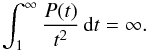
We study the regularity of finite energy solutions to degeneraten-harmonic equations. The functionK(x), which measures the degeneracy, is assumed to besubexponentially integrable, i.e. it verifies the condition exp(P(K)) ∈ Lloc1. The function P(t) is increasing on [0,∞[ and satisfies the divergence condition \begin{equation}\int_1^\infty\frac{P(t)}{t^2}\,{\rm d}t=\infty.\end{equation}
We study in an abstract setting the indirect stabilization of systems of two wave-likeequations coupled by a localized zero order term. Only one of the two equations isdirectly damped. The main novelty in this paper is that the coupling operator is notassumed to be coercive in the underlying space. We show that the energy of smoothsolutions of these systems decays polynomially at infinity, whereas it is known thatexponential stability does not hold (see [F. Alabau, P. Cannarsa and V. Komornik,J. Evol. Equ. 2 (2002) 127–150]). We give applications ofour result to locally or boundary damped wave or plate systems. In any space dimension, weprove polynomial stability under geometric conditions on both the coupling and the dampingregions. In one space dimension, the result holds for arbitrary non-empty open damping andcoupling regions, and in particular when these two regions have an empty intersection.Hence, indirect polynomial stability holds even though the feedback is active in a regionin which the coupling vanishes and vice versa.
A control system is said to be finite if the Lie algebra generated by its vector fieldsis finite dimensional. Sufficient conditions for such a system on a compact manifold to becontrollable are stated in terms of its Lie algebra. The proofs make use of theequivalence theorem of [Ph. Jouan, ESAIM: COCV 16 (2010)956–973]. and of the existence of an invariant measure on certain compact homogeneousspaces.
In 1955 Fermi, Pasta and Ulam (FPU) (Fermi et al., 1955) and Tsingou (see Douxois, 2008) undertook a numerical study of a one-dimensional anharmonic (nonlinear) lattice. They thought that due to the nonlinear coupling, any smooth initial state would eventually lead to an equipartition of energy, i.e., a smooth state would eventually lead to a state whose harmonics would have equal energies. In fact, they did not see this in their calculations. What they found is that the solution nearly recurred and the energy remained in the lower modes.
To quote them (Fermi et al., 1955):
The results of our computations show features which were, from beginning to end, surprising to us. Instead of a gradual, continuous flow of energy from the first mode to the higher modes, … the energy is exchanged, essentially, among only a few. … There seems to be little if any tendency toward equipartition of energy among all the degrees of freedom at a given time. In other words, the systems certainly do not show mixing.
Their model consisted of a nonlinear spring–mass system (see Figure 1.1) with the force law: F(Δ) = –k(Δ+α Δ2), where Δ is the displacement between the masses, k > 0 is constant, and α is the nonlinear coefficient.