To save content items to your account,
please confirm that you agree to abide by our usage policies.
If this is the first time you use this feature, you will be asked to authorise Cambridge Core to connect with your account.
Find out more about saving content to .
To save content items to your Kindle, first ensure no-reply@cambridge.org
is added to your Approved Personal Document E-mail List under your Personal Document Settings
on the Manage Your Content and Devices page of your Amazon account. Then enter the ‘name’ part
of your Kindle email address below.
Find out more about saving to your Kindle.
Note you can select to save to either the @free.kindle.com or @kindle.com variations.
‘@free.kindle.com’ emails are free but can only be saved to your device when it is connected to wi-fi.
‘@kindle.com’ emails can be delivered even when you are not connected to wi-fi, but note that service fees apply.
Ageism is the stereotyping, inequity, exclusion, and discrimination of people on the basis of their age. At the same time the older population is growing rapidly—over 2 billion people will be over 60 by 2050—ageism is rampant. An astounding 80% of older adults report ageism has impacted their lives. Even more serious, many heallth professionals may assess older people incorrectly—diagnosing problems such as cognitive impairment or psychological disorders as the result of their age rather than the real culprit: too many drugs, some unsafe being prescribed; undiagnosed medical problems. 2020 Global research report of 7 million people worldwide from 45 countries showed that ageism led to worse health outcomes in 95% of the studies. Studies also document that having positive feelings about aging can add 7.5 years to your life. This chapter gives 5 action items you can do to reduce Ageism in general and in your own thinking.
Healthy aging is a hot topic. The baby boomer generation is changing the face of aging around the world. Baby boomers are turning 65 at startling rates: 100 people every 13 minutes—a trend replicated globally. Our book describes normal changes of aging at 80, 90, 100, and how we can successfully adapt to these changes.! Today we are acting 20 years younger than our parents did at the same age, and have the bodies and brains to go with it. It is possible, if we begin planning now, to thrive in our later years, and to live with joy until life’s end.
Career wellbeing is one of the major differentiators that helps people live into their 90s. Planning for the future. When plans don’t plan out the way you hope, though, that’s when you turn the page and make a new list. Developed Bob’s Red Mill, Healthy Foods. There are great benefits of keeping working. Important to help others. Search for something important to you, something you believe in. Even after significant setbacks and losses, keep believing. Never give up.
Aging and Memory in the African American Community. Pregnant women exposed to high temperatures or air pollution are more likely to have children who are premature, underweight, or stillborn, and the effects hurt African American mothers and babies most. The population of those over 80 will increase 80% in the next ten years. Many older Americans who live with disabilities will not be able to pay for adequate housing, food, medicine and personal care. Many families of color are unable to pay for healthcare.
Indigenous perspective on aging is different from what we are used to seeing in our current culture. In native culture, it is not only important to be respectful of your elders but responsible for caring for them. You learn very quickly that elders are a part of your life because they teach you what you need to know. Elders are the architects of the culture. They instill the traditions. Now we have the great distractions of technology—distractions that take us away from what our generations begore us gave to us. In Native communities, elders and young people are held in high esteem. Young people are the purpose for it all. That’s why elders have an obligation. Everyone must understand their obligation to the next generation, especially as we grow older . You always have the gift of youth inside you. But it’s up to you to rekindle it and to bring it back. It is our duty as elders to live, not just for ourselves, but for the generations of young people coming after us and for the earth.
The best way to ensure that both your financial and emotional legacies are understood and appreciated is to memorialize them in writing. The ethical will becomes the missing piece of a comprehensive and meaningful estate plan. The focus of an ethical will is the distribution of emotional assts. Chapter details ways to write an ethical will.
Best places in the world to grow old based on income, employment, health, education, and environment. In Sweden, health has improved in the older population over the last decades, so Sweden’s health care needs have decreased overall. Sweden has the largest health care workforce in the world serving citizens over 65. 94 % of people over 65 live at home! Elders receive in-home assistance when needed. Only 4% of all care—health care or home care-is paid for by patients themselves. Municipal fixers—people who can come and do chores to help reduce falls, such as change a lightbulb. They come to your home. Totally free. If your needs are high enough, someone can come in every two hours around the clock to help care for you—totally without cost to you. High satisfaction. No stigma around dementia. Swedish government develops list of drugs that older people should not be prescribed. Sweden has implemented community-based care and practical approaches to older adult safety.
Today in US, thousands of older people are living in social isolation. Research shows that loneliness leads to poor health outcomes. Social isolation increases risk of developing dementia and heart disease as one ages. Humanitude is an internationally recognized network. It is a well-researched treatment of compassionate care. A kind gaze, a gentle touch or tender speech immediately triggers oxytocin, and releases in people confidence and love. Unfortunately, too many senior end up trapped in their own living arrangements and become cut off socially …removed from humanity. Nursing home study: In a 24-hour period researchers found that patients were spoken to for only two minutes. Studies of hundreds of patients in care settings where Humanitude is offered, reveal a very different scenario. Humanitude procedures reduce the incidence of delirium, agitation, and use of antipsychotic drugs by as much as 88%. The goal of Humanitude is not to ‘cure’ a person but to ‘care’ a person. All people deserve to stay a citizen of humanity until their final day.
Half of people over 65 have pain that limits their daily function. Pain can lead to problems with sleep, mobility, falls, depression, appetite, social isolation and memory. Many reasons older adults have pain: arthritis, nerve pain, headaches, poor teeth, injuries and fractures, back problems. Is pain a normal part of aging, and just something we have to get used to as we age? Is it better just to tolerate pain, or is it better to take pain medication? Will pain just continue to get worse as we age. The answer is no, no, no, no. If you start young to prevent aging-related illnesses, you will have a much better chance of remaining pain free as you age. It is probably not possible to be pain free all day every day but with good pain relief strategies, practiced daily, , it is possible to do everything you want to do. It may not be possible to relieve all your pain 100%, but the goal should be to retain 100% of your function. Pain reduction strategies are explained
Our immune system is our greatest ally when it comes to protecting us from harm. It is designed to fight off infections, heal our wounds, and protect us from malignancy and autoimmune disease. Like all the other systems of our body, this system changes progressively through our lives. Unfortunately, its performance and skills of detection wane as we grow older. This makes us more vulnerable to infections. Some of these effects are inevitable. Others are not. There are things we can do to protect our immune system and mitigate some of the normal forces of aging. This becomes especially important when we reach 70 and older. Chapter outlines seven actions we can do to strengthen our immune system: Mediterranean Diet. Exercise. Keep up to date on vaccinations. Practice good hygiene. Sleep. Lower stress. Practice optimism.
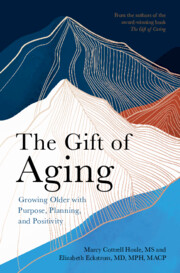
When you get older you can see more deeply into the things around you and get more satisfaction. The spiritual is coming at you, and it creates, if not a physical, but a mental and emotional adventure. No senior should be left inside. The gift of aging is climbing higher up this beautiful mountain that lets you see further each day. The base gets wider and the pinnacle gets higher. Life experience has built the mountain you stand on. From here you will find amazing discoveries because you can see far beneath you
Most of us don’t build muscle mass after young adulthood. After we turn 50 our muscle mass decreases 1-2% per year. From our 20s until the age of 80, our muscle mass decreases by 30 – 50%! This becomes increasingly noticeable after age 70.Our strength declines by 10%-15% per decade until age 70, when this loss accelerates to 25% to 40% per decade. Sarcopenia, or muscle loss, often serves as a harbinger of frailty. But frailty is not normal with aging. The five factors of frailty (three must be met to be considered frail): Unintentional weight loss; exhaustion; muscle weakness; slowness in walking; low levels of activity. Multiple studies show that a good exercise program, including aerobic, strength, and balance regimens, preserves muscle mass in older generations. Chapter explains how frailty is a group of symptoms that can be effectively avoided or treated.
Fleeing the Hungarian Revolution. Becoming refugees in multiple countries.. Never give up and have a better attitude. The best way to work through your suffering? Helping others. Having compassion for the well-being of others will make you happy. I realized that if I shifted my focus and concern to another person, my own pain lessened. Fastest way to finding a happy brain is to start with love and compassion with others. It was drilled into us: respect for others. That was our culture; how we were raised. We took care of our parents and grandparents awsthey got older. Facing the Pandemic. If we all do what we’re supposed to do, keep our faith and have courage, and recognize the need we have for one another, then we’ll be fine.
Older people often come into their evaluation discouraged by a poor prognosis from a physician or imaging that reveals more wear and tear on their bodies than they feel they can overcome. There is a tendency to discount the likelihood that progress can be made in older patients. But that is generally not the case! There are strategies for pain management and home exercises to work on strength, flexibility or mobility that allows them to transition from feeling like a victim, betrayed by their body, to a person empowered to halt these unwanted changes. X-rays and MRI’s that show degenerative changes don’t account for pain that is caused by inflexibility and strength deficits or poor movement patterns. These are things which can be addressed and corrected with physical therapy. Correcting a patient’s biomechanics can take the burden off arthritic joints and facilitate pain free movement. Physical therapy can facilitate meaningful gains by addressing musculoskeletal impairments. It can correct biomechanical faults , lead to decreased pain, and allow for safe return to many desired hobbies and improve quality of life.
We have a choice of when and how to plan. We can choose to plan proactively or reactively. Optimal time to start is when you are young and healthy. Studies show a direct correlation between the quality of life of those who are suffering from illness or incapacity and their level of planning. Creating a clear and comprehensive plan is a gift to your loved ones. Estate planning is too important to be considered a “do-it-yourself” project. Principal estate planning documents explained: 1. Last Will and Testament. 2. Trust. 3. Power of Attorney. 4. Health Care Proxy. 5. Living Will. Chapter give strategies on the best estate planning through the decades.