To save content items to your account,
please confirm that you agree to abide by our usage policies.
If this is the first time you use this feature, you will be asked to authorise Cambridge Core to connect with your account.
Find out more about saving content to .
To save content items to your Kindle, first ensure no-reply@cambridge.org
is added to your Approved Personal Document E-mail List under your Personal Document Settings
on the Manage Your Content and Devices page of your Amazon account. Then enter the ‘name’ part
of your Kindle email address below.
Find out more about saving to your Kindle.
Note you can select to save to either the @free.kindle.com or @kindle.com variations.
‘@free.kindle.com’ emails are free but can only be saved to your device when it is connected to wi-fi.
‘@kindle.com’ emails can be delivered even when you are not connected to wi-fi, but note that service fees apply.
In the Gilded Age, Genevieve Lee Stebbins (1857–1934) became a dance soloist admired in New York City's theater world. Stebbins created a foundation from which a new “serious” dance aesthetic emerged and notably inspired the early dance work of Ruth St. Denis and Isadora Duncan; however, she remains an overlooked figure within American dance history. This article chronicles Stebbins's innovations and clarifies misrepresentations of her work in recent scholarship. Unlike other American dance pioneers, there is no public archive dedicated to Stebbins, therefore this article draws upon newly available primary sources to explore Stebbins's foundational work.
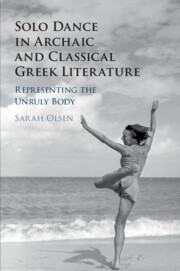
“Ancient Greek dance” traditionally evokes images of stately choruses or lively Dionysiac revels – communal acts of performance. This is the first book to look beyond the chorus to the diverse and complex representation of solo dancers in Archaic and Classical Greek literature. It argues that dancing alone signifies transgression and vulnerability in the Greek cultural imagination, as isolation from the chorus marks the separation of the individual from a range of communal social structures. It also demonstrates that the solo dancer is a powerful figure for literary exploration and experimentation, highlighting the importance of the singular dancing body in the articulation of poetic, narrative, and generic interests across Greek literature. Taking a comparative approach and engaging with current work in dance and performance studies, this book reveals the profound literary and cultural importance of the unruly solo dancer in the ancient Greek world.
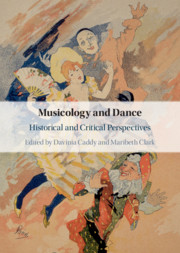
Long treated as peripheral to music history, dance has become prominent within musicological research, as a prime and popular subject for an increasing number of books, articles, conference papers and special symposiums. Despite this growing interest, there remains no thorough-going critical examination of the ways in which musicologists might engage with dance, thinking not only about specific repertoires or genres, but about fundamental commonalities between the two, including embodiment, agency, subjectivity and consciousness. This volume begins to fill this gap. Ten chapters illustrate a range of conceptual, historical and interpretive approaches that advance the interdisciplinary study of music and dance. This methodological eclecticism is a defining feature of the volume, integrating insights from critical theory, film and cultural studies, the visual arts, phenomenology, cultural anthropology and literary criticism into the study of music and dance.
Joseph Fort ponders a specific case of late eighteenth-century musical embodiment, one that has its origins in social and popular dance: a minuet by Joseph Haydn (Minuet in D major, Hob. IX/11, no. 1), emblematic not of contemporary concert-hall music, but of the music performed in front of a living – and physically mobile – audience at the charity ball held at the Hofburg Redoutensäle in Vienna, 25 November 1792. Reconstructing both the music and the dancing, Fort offers a revealing account of the Vienna dance scene, as well as the minuet’s position within it. More than this, though, he presents a close reading of the interrelations between music and dance from a specifically somatic perspective – one that is deeply intuitive, subjective and sensorial. Realizing his innovative approach alongside similar scholarly attempts at ‘live’ musical embodiment (particularly the work of Elisabeth Le Guin), Fort offers an analysis of the movement that reveals insights into not only the musical score, but also the intrinsically musical and gestural experience of dancing to it.
Wayne Heisler Jr addresses ‘song-ballets’ from the 1960s and 70s, choreography set to Lieder by Gustave Mahler, in order to explore inter-relationships between music, dance and the written word. He pursues the historical implications of his subject matter, considering social, cultural and philosophical discourses, and their appeals to music and the body with an aim to expanding interpretive pathways, suggesting ways in which dance can refuel Mahler’s music, repurposing its expressive vocabulary. Through critical readings of both live and recorded performances, Heisler suggests the resonance of Mahler’s danced songs with the composer’s biography and musical personality, as well as their impact on characterization, drama and musical structure. In doing so, Heisler acknowledges the inter-disciplinary methods underpinning his analysis, noting in particular the relevance of both performance studies and phenomenology.
While noting the usual scholarly snubbing of ‘excessive’ and ‘insubstantial’ dance tunes, Carlo Caballero explores dance’s significance and popularity – not only with audiences, but also with ‘serious’ composers. Writing about late nineteenth-century French musical culture, Caballero examines a vogue for the sixteenth-century pavane (with reference to examples by Saint-Saëns, Delibes, Fauré, Ravel and Debussy, amongst others), considering how and why the genre of the pavane became emblematic of a constellation of contemporary cultural strains of influence. As Caballero recounts, dance took on new significance during the period, aligned with historical prestige, antique exoticism, the French aristocracy, musical nationalism and modernity itself. Guided by this case history, Caballero reminds us of the cultural embeddedness of both dance and musical practices, and why we need ways of understanding these practices as both socially conditioned and conditioning.
The introduction describes the ten chapters of the volume, and how they provide models for a historically grounded musicology that recognizes relationships between gestures and words, music and dance, human bodies and social acts over time. It describes how these chapters address many of the challenges that arise in the study of European music and dance together: the ephemerality of performance, the fuzzy boundaries between theatrical and social dance, the legacies and inequalities associated with colonialism and imperialism, the complexity of the sources (choreographic notation and its absence, musical scores and their absences, film, treatises and reviews, to name just a few). It also grapples with the divides among related areas, disciplines and fields, including performance studies, theatre and dance history, comparative literature, film studies, philosophy, cognitive psychology, music theory, history, anthropology and sociology as well as musicology.
Davinia Caddy examines the role of music and music-listening in the stage shows and reception histories of dancer Loie Fuller. A midwestern American, Fuller found fame across Western Europe and the United States with her dance-and-light effects, theatrical performances that seemed to transform her body into a flower, fire, waves or the sun: to her symbolist observers, into pure metaphor or idea. Music was often incorporated into this abstract mélange, thought to symbolize a sphere of influence or aesthetic condition that text and visuals (dance, set design, props) could only aspire to. With reference to little-known source material, the author offers a revisionist reading of Fuller’s musical initiative and her spectators’ attention to it. Drawing analogies with early modernist visual art and advertising, the chapter suggests new and different ways of envisaging music, and music-listening, in relation to Fuller’s dance shows and the copy-cat craze they inspired.
This chapter by Marian Wilson Kimber explores the relation between music, dance and poetry in late nineteenth-century amateur dance performances in the United States, specifically Delsarte. With reference to little-known archival sources (musical scores, photographs, programme leaflets and educational guides), Wilson Kimber examines how elocutionists combined their recitation with posing in imitation of ancient Greek statuary. These performances grew from the expressive physical fitness movement named after the nineteenth-century French musician and teacher Delsarte. The practice is itself rooted in elocution, recitation or public speaking that was a common form of entertainment on programmes with chamber music throughout the United States. To the accompaniment of hymns, women recited and posed to entertain one another, but also with the goal of self-improvement. Describing these practices, Wilson Kimber articulates a historical case of what we might call choreographic legitimization, considering ways in which dancers sought to elevate the seemingly suspect status of their art with reference to ancient Classical values and sacred music.
John Butt raises questions about J. S. Bach and his relationship to dance. As Butt describes it, the standard musicological way of thinking about Bach and his music turns on ideas of compositional authority and control, aesthetic abstraction and religiosity, and a music-stylistic complexity that betrays the composer engaged in intricate motivic working-out. Butt steers away from the mental or cerebral sphere towards the physical, the material and the bodily. Drawing on the phenomenology of Merleau-Ponty, he ponders the applicability of the notion of embodiment to Bach’s music, not only to pieces labelled ‘bourée’ or ‘gigue’, but also to music with more oblique dance associations. His chapter suggests that there is no mental sphere without the physical, no music without dance.