To save content items to your account,
please confirm that you agree to abide by our usage policies.
If this is the first time you use this feature, you will be asked to authorise Cambridge Core to connect with your account.
Find out more about saving content to .
To save content items to your Kindle, first ensure no-reply@cambridge.org
is added to your Approved Personal Document E-mail List under your Personal Document Settings
on the Manage Your Content and Devices page of your Amazon account. Then enter the ‘name’ part
of your Kindle email address below.
Find out more about saving to your Kindle.
Note you can select to save to either the @free.kindle.com or @kindle.com variations.
‘@free.kindle.com’ emails are free but can only be saved to your device when it is connected to wi-fi.
‘@kindle.com’ emails can be delivered even when you are not connected to wi-fi, but note that service fees apply.
In the autumn of 1786, Bondini’s latest attempt to improve the provision of German theatre in Prague backfired badly. A company headed by Carl von Morocz opened on 10 September and the result, according to Teuber, was a ‘colossal fiasco’. The season was terminated almost immediately, though members of the failed company were permitted to stage three further performances in an attempt to defray some of their travel expenses. Following this debacle there were no German plays for three months, and Bondini’s looming financial crisis would have been obvious to all. Only on 26 December was a new company assembled. There was no repeat of the earlier failure, yet the new troupe still struggled to meet its costs in the early months of 1787.
It was against this very inauspicious background that the Bondini–Guardasoni opera company returned from its summer season in Leipzig. A successful winter programme in Prague was now imperative, and by a stroke of good fortune the newest operatic import from the Vienna stage was able to deliver a much needed success. Writing several years later, Niemetschek was well aware that the Prague production of Figaro had come at a critical moment in the fortunes of the impresario. He gives no details, but in commenting that the opera played the whole winter almost without a break, he implies that the opera received very much more than the usual Leipzig run of three performances. For Mozart this undoubted success marked the start of a highly productive relationship.
Even at this undoubted high point, one critic at least was sounding an unmistakable note of concern over the future of Guardasoni’s chosen genre. In December 1794, a very downbeat appraisal of the prospects for Italian opera in Prague appeared in the Brno Allgemeines Europäisches Journal. The main article ‘Einige Nachrichten über den Zustand des Theaters in Prag’ was followed by a less well-known continuation ‘Fortsetzung der Nachrichten über das Theater zu Prag’. The latter provides a commentary on German theatre, but the two parts should be read together. The review is often attributed to Niemetschek, but the first instalment is only signed ‘***k’, which hardly allows for a firm identification of a Czech surname. According to Volek, the continuation was signed ‘N**k’, which again is not conclusive. Given that Niemetschek took up an appointment in Prague in the autumn of 1793, it is certainly possible that he would have been sufficiently well informed about the state of opera in the city to have written the piece. Yet the sharp tone of the critique differs radically from the warmth of his biography, even though some of the themes are recognisably the same. While it is certainly possible that a writer might adopt a markedly different tone in signed and unsigned pieces, the authorship of the article must remain an open question. Whoever he was, this critic was deeply worried about the state of Italian opera in Prague. He contrasts the current level of support – boxes left unsubscribed or shared between families – with former years in which the music-loving nature of the Bohemian public was most evident. He attributes the decline of Italian opera not just to management failings on the part of Guardasoni and the poor calibre of his singers – a common gripe – but to a fundamental change in the taste of the Prague audience itself. More and more, he complains, they are being seduced by Singspiel productions. Writing with heavy irony, he notes that thanks to the popularity of works such as Zauberzyther and Das Sonntagskind, the public is steadily losing its once correct and respectable taste, in favour of the refined feeling of the aforementioned masterpieces of music and wit from the Fatherland (Vienna and Italy). Yet its taste has not become so corrupt that it has lost all liking for true beauty and greatness. Why then, the critic wonders, does not Guardasoni nourish what remains of it with respectable fare? A nationalist antipathy to the imperial capital (‘Hauptstadt’) is manifest. On the other hand, in his biography Niemetschek is fair to Vienna, for all that he takes justifiable pride in the supportive attitude of his home city towards Mozart. Harsh criticism of the cabals and conspiracies of the Italian singers in the Court Theatre aside, he is even-handed in his approach, noting the difficulties Mozart had with the expensive Viennese lifestyle, but acknowledging his successes there, such as Die Entführung and the piano concertos, and reporting both his immediate failure to win a court position (blamed on his unworldly nature rather than any institutional hostility) and his eventual success. There is a brief allusion to the supposed decline in Prague taste, but only in a footnote.
Outside Vienna, no theatre company was more receptive to Mozart’s music than the Italiänische Opera-Virtuosen, a small commercial ensemble based in Prague which also gave summer seasons in Leipzig. Directed by Pasquale Bondini and Domenico Guardasoni, it played a significant role in the composer’s later career. In 1786, its production of Figaro was received with such enthusiasm that Mozart was invited to visit Prague, where he reported with pride that tunes from the opera were being whistled in the street. The Italiänische Opera-Virtuosen did not make a practice of commissioning works, but because an opera was required to celebrate the imperial marriage of the Archduchess Maria Theresia an agreement was reached for a new work on the Don Juan story. Even though it was not ready in time for its festive première, Don Giovanni was a popular success, and Guardasoni began to consider the possibility of another commission for Mozart. In the summer of 1789, however, the Italiänische Opera-Virtuosen relocated to Warsaw and nothing further was heard about this proposal. During his second season at the Court of Stanisław August Poniatowski, Guardasoni introduced a programme of opera seria, a new venture for his company, but a timely one, as the troupe was recalled to Prague in the summer of 1791 in order to stage La clemenza di Tito in honour of the Coronation of Leopold II. In the years following Mozart’s death, the Italiänische Opera-Virtuosen, far from abandoning his Italian operas, continued to play a pivotal role in sustaining interest in them, while elsewhere German Singspiel versions swept the field. An especially notable success was a Leipzig production of Cosìfan tutte in 1792, and this was followed in 1794 by a well-attended second performance run for La clemenza in Prague. All these events were developed by Niemetschek, the composer’s early biographer, into a compelling narrative which saw the formation of a ‘special relationship’ between the discerning Prague audience and its favoured visitor. A powerful blend of history and myth, it remains to this day one of the central strands of Mozart historiography, but Leipzig was largely written out of the picture.
The significant role of concert performances in sustaining interest in Figaro and Don Giovanni following the departure of the Italiänische Opera-Virtuosen from Leipzig is very evident in the months leading up to Mozart’s brief visits to the city. At that period there were three regular series: the Gewandhaus subscription concerts under the direction of Johann Gottfried Schicht and his wife Constanze Valdesturla; a complementary series of ‘Extra’ concerts, usually held in the Thomäisches Haus; and a stream of one-off benefits promoted by visiting artists in a wide variety of venues including the Saal des Rannstädter Schießhauses, the Sala della Biblioteca del Magistrato, the Theater am Rannstädter Thore, the Hôtel de Saxe and the Saal der Drey Schwanen. Also very fashionable at Christmas and Easter were large-scale concerts spirituels. Despite the city’s relatively small size, it therefore enjoyed an exceptionally rich culture of public concerts.
The resources of the Stadtgeschichtliches Museum allow us to trace the slowly rising profile of Mozart’s music during the 1780s, and the sharp increase in interest that occurred in 1788. The first ‘Mozart’ work to be heard in Leipzig was by Leopold. On 9 September 1779, his Schlittenfahrt was advertised in a bill which gave full details of the instrumentation and movements. Then on 24 January 1782 there was a performance of a ‘Sinfonie vom jüngern Mozart’. Throughout the mid-1780s, a selection of Mozart’s keyboard and chamber music was advertised by Breitkopf. Examples include: ‘Auch sind daselbst neue Amsterdamer, Lyoner, Mannheimer und Wiener Musikalien von Bocherini, Kozeluch, Hayda [sic], Mozart etc zu haben’ (1782); ‘sind folgende neue Musikalien zu bekommen … Mozard Sonaten’ (1783); ‘Mozard Clavier-Auszug, aus der Opera: die Entführung aus dem Serail, 2 fl. 30 kr. oder 1 Thlr. 16 Gr.; Mozard 3 neue Clavier-Sonaten, mit Begleitung einer Violine, 2 fl. oder I Thlr. 8 Gr.’ (1784). Another publisher who actively advertised his stock in Leipzig was Bossler. On 19 November 1785, he informed the public that his entire music list (‘meinen ganzen Musicalien-Verlag’) would henceforth be available from the retailer Christian Gottfried Martini. In 1787, Bossler had on offer ‘das 3te und 4te Stück Variat. von Förster & Mozart, 10 Gr.; / das 5te, 6te 7te Stück Variat. von Vanhall & Mozart, 18 Gr.; / das 10te Stück Mozart Quartet, 20 Gr; / das 11te Stück Mozart Sonat. 14 Gr.; / das 12te Stück Mozart 12 Variat. mit 1 Rondo, 11 Gr.; / 1 großen Clavier-Concert von Mozart, 1 Thle, 12 Gr.’ On 19 September 1789, Martini drew attention to: ‘Mozart Quartetto Op.14 per il Flauto, Viol. e Basso’.
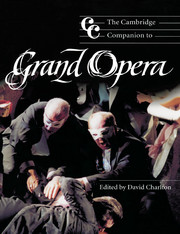
This 2003 Companion is a fascinating and accessible exploration of the world of grand opera. Through this volume a team of scholars and writers on opera examine those important Romantic operas which embraced the Shakespearean sweep of tragedy, history, love in time of conflict, and the struggle for national self-determination. Rival nations, rival religions and violent resolutions are common elements, with various social or political groups represented in the form of operatic choruses. The book traces the origins and development of a style created during an increasingly technical age, which exploited the world-renowned skills of Parisian stage-designers, artists, and dancers as well as singers. It analyses in detail the grand operas by Rossini, Auber, Meyerbeer and Halévy, discusses grand opera in Russia and Germany, and also in the Czech lands, Italy, Britain and the Americas. The volume also includes an essay by the renowned opera director David Pountney.
This essay frames Erich Wolfgang Korngold's Die tote Stadt (1920) as a mise-en-abyme narrative containing four nested realms of diegesis: (1) the opera's ‘real’ world, (2) a prolonged dream sequence, (3) a dance troupe's rehearsal of an opera within that dream, and (4) an expressly requested baritone song performed by a ‘Pierrot’ character in the midst of that dreamt rehearsal. I conceptualise the opera's dense meta-theatrics as a reflexive celebration (and also a didactic warning against the escapist pleasures) of sung spectacle. Excerpts from my interviews with Inga Levant – director of the 2001 Strasbourg production of Die tote Stadt – are used to supplement my broader examination of the ways in which Korngold's reputation as a ‘problemless’ and ‘apolitical’ child prodigy has impacted critical, dramaturgical and hermeneutical orientations towards this opera since its earliest post-war performances.
Catherine Tofts, ‘the first English prima donna’, was the female lead in the all-sung operas in the Italian style performed on the London stage from1705, but little has previously been known about her early life or musical training. This article draws on various sources, including her father's will, a petition she wrote in 1704 and Delarivier Manley's Memoirs of Europe to show that her family background was Scottish and that she grew up in the household of Bishop Gilbert Burnet. It names possible singing teachers and lovers, and shows that she did not leave the stage in 1709 because of mental instability, as has been assumed, but because of debt and the consequent need to escape from her creditors. The end of her career shows the difficulties faced by a leading English singer when Italians, particularly the castrati, came to dominate the operatic scene in London.
With a diverse and colourful cast of animals, birds, insects and human villagers, Příhody lišky Bystroušky (known in English as The Cunning Little Vixen), is one of Leoš Janáček's most popular, if peculiar, operas. Though nowadays Bystrouška is typically characterised as a charming portrayal of the continuous renewal of life in nature, this idea emerged only gradually from a tangle of competing and occasionally contradictory views in which, however, the complexity of the moral laws by which the opera's inhabitants live was frequently central. By tracing the history of the opera's stagings in the Czech Republic; drawing out themes that developed in the journalistic and critical discourse around those performances; and reading the opera's music and stage action closely, this article argues that the amoral codes of Bystrouška's world not only inhere in the story, its text, and even, perhaps, in the idea of nature's cycle of life itself, but that at certain times in the opera they are also given expression through particular correlations and disjunctions between the opera's music and the physical actions and gestures of the singers on stage.
Through investigating the production and reception of Death in Venice (1973), this essay considers the ways Britten and his audiences responded to the fraught discourse surrounding opera in the twentieth century. If the genre as a whole often threatened to fall on the wrong side of contemporaneous aesthetic oppositions – between abstraction and immediacy, the intellectual and the visceral, the high and the low – early critics of this particular work tended to translate its visual spectacles and musical rhetoric into more rarefied terms. Taking my cue from elements of contradiction and ambivalence in this sublimating criticism, I will examine how Britten's opera resists the very suppressions it promotes. I will suggest that, in simultaneously staging and confounding oppositions at the heart of contemporary operatic discourse, Death in Venice offers a powerful case study of the way composers, directors, critics and audiences responded to and overcame the terminal illness with which opera had been diagnosed in the middle third of the twentieth century.
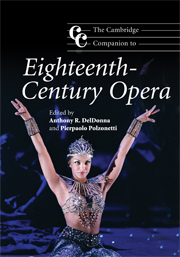
Reflecting a wide variety of approaches to eighteenth-century opera, this Companion brings together leading international experts in the field to provide a valuable reference source. Viewing opera as a complex and fascinating form of art and social ritual, rather than reducing it simply to music and text analysis, individual essays investigate aspects such as audiences, architecture of the theaters, marketing, acting style, and the politics and strategy of representing class and gender. Overall, the volume provides a synthesis of well established knowledge, reflects recent research on eighteenth-century opera, and stimulates further research. The reader is encouraged to view opera as a cultural phenomenon that can reveal aspects of our culture, both past and present. Eighteenth-century opera is experiencing continuing critical and popular success through innovative and provoking productions world-wide, and this Companion will appeal to opera goers as well as to students and teachers of this key topic.
Richard Strauss is a composer much loved among audiences throughout the world, both in the opera house and the concert hall. Despite this popularity, Strauss was for many years ignored by scholars, who considered his commercial success and his continued reliance on the tonal system to be liabilities. However, the past two decades have seen a resurgence of scholarly interest in the composer. This Companion surveys the results, focusing on the principal genres, the social and historical context, and topics perennially controversial over the last century. Chapters cover Strauss's immense operatic output, the electrifying modernism of his tone poems, and his ever-popular Lieder. Controversial topics are explored, including Strauss's relationship to the Third Reich and the sexual dimension of his works. Reintroducing the composer and his music in light of recent research, the volume shows Strauss's artistic personality to be richer and much more complicated than has been previously acknowledged.
This 2004 Companion provides a biographical, theatrical and social-cultural background for Verdi's music, examines in detail important general aspects of its style and method of composing, and synthesizes stylistic themes in discussions of representative works. Aspects of Verdi's milieu, style, creative process and critical reception are explored in essays by highly reputed specialists. Individual chapters address themes in Verdi's life, his role in transforming the theater business, and his relationship to Italian Romanticism and the Risorgimento. Chapters on four operas representative of the different stages of Verdi's career, Ernani, Rigoletto, Don Carlos and Otello synthesize analytical themes introduced in the more general chapters and illustrate the richness of Verdi's creativity. The Companion also includes chapters on Verdi's non-operatic songs and other music, his creative process, and scholarly writing about Verdi from the nineteenth-century to the present day.
This Companion celebrates the extraordinary riches of the twentieth-century operatic repertoire in a collection of specially commissioned essays written by a distinguished team of academics, critics and practitioners. Beginning with a discussion of the century's vital inheritance from late-romantic operatic traditions in Germany and Italy, the text embraces fresh investigations into various aspects of the genre in the modern age, with a comprehensive coverage of the work of individual composers from Debussy and Schoenberg to John Adams and Harrison Birtwistle. Traditional stylistic categorizations (including symbolism, expressionism, neo-classicism and minimalism) are reassessed from new critical perspectives, and the distinctive operatic traditions of Continental and Eastern Europe, Russia and the Soviet Union, the United Kingdom and United States are subjected to fresh scrutiny. The volume includes essays devoted to avant-garde music theatre, operettas and musicals, filmed opera, and ends with a discussion of the position of the genre in today's cultural marketplace.
Beginning several generations before Schubert, the Lied first appears as domestic entertainment. In the century that follows it becomes one of the primary modes of music-making. By the time German song comes to its presumed conclusion with Richard Strauss's 1948 Vier letzte Lieder, this rich repertoire has moved beyond the home and keyboard accompaniment to the symphony hall. This is a 2004 introductory chronicle of this fascinating genre. In essays by eminent scholars, this Companion places the Lied in its full context - at once musical, literary, and cultural - with chapters devoted to focal composers as well as important issues, such as the way in which the Lied influenced other musical genres, its use as a musical commodity, and issues of performance. The volume is framed by a detailed chronology of German music and poetry from the late 1730s to the present and also contains a comprehensive bibliography.