To save content items to your account,
please confirm that you agree to abide by our usage policies.
If this is the first time you use this feature, you will be asked to authorise Cambridge Core to connect with your account.
Find out more about saving content to .
To save content items to your Kindle, first ensure no-reply@cambridge.org
is added to your Approved Personal Document E-mail List under your Personal Document Settings
on the Manage Your Content and Devices page of your Amazon account. Then enter the ‘name’ part
of your Kindle email address below.
Find out more about saving to your Kindle.
Note you can select to save to either the @free.kindle.com or @kindle.com variations.
‘@free.kindle.com’ emails are free but can only be saved to your device when it is connected to wi-fi.
‘@kindle.com’ emails can be delivered even when you are not connected to wi-fi, but note that service fees apply.
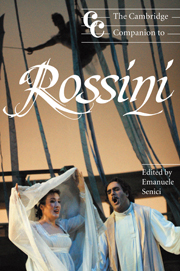
This 2004 Companion is a collection of specially commissioned essays on one of the most influential opera composers in the repertoire. The volume is divided into four parts, each exploring an important element of Rossini's life, his world, and his works: biography and reception; words and music; representative operas; and performance. Within these sections accessible chapters, written by a team of specialists, examine Rossini's life and career; the reception of his music in the nineteenth century and today; the librettos and their authors; the dramaturgy of the operas; and Rossini's non-operatic works. Additional chapters centre on key individual operas chosen for their historical importance or position in the present repertoire, and include Tancredi, Il barbiere di Siviglia, Semiramide, and Guillaume Tell. The last section, Performance, focuses on the history of Rossini's operas from the viewpoint of singing and staging, as well as the influence of editorial work on contemporary performance practice.
Richard Wagner is remembered as one of the most influential figures in music and theatre, but his place in history has been marked by a considerable amount of controversy. His attitudes towards the Jews and the appropriation of his operas by the Nazis, for example, have helped to construct a historical persona that sits uncomfortably with modern sensibilities. Yet Wagner's absolutely central position in the operatic canon continues. This volume serves as a timely reminder of his ongoing musical, cultural, and political impact. Contributions by specialists from such varied fields as musical history, German literature and cultural studies, opera production, and political science consider a range of topics, from trends and problems in the history of stage production to the representations of gender and sexuality. With the inclusion of invaluable and reliably up-to-date biographical data, this collection will be of great interest to scholars, students, and enthusiasts.
Claudio Monteverdi is one of the most important figures of 'early' music, a composer whose music speaks powerfully and directly to modern audiences. This book, first published in 2007, provides an authoritative treatment of Monteverdi and his music, complementing Paolo Fabbri's standard biography of the composer. Written by leading specialists in the field, it is aimed at students, performers and music-lovers in general and adds significantly to our understanding of Monteverdi's music, his life, and the contexts in which he worked. Chapters offering overviews of his output of sacred, secular and dramatic music are complemented by 'intermedi', in which contributors examine individual works, or sections of works in detail. The book draws extensively on Monteverdi's letters and includes a select discography/videography and a complete list of Monteverdi's works together with an index of first lines and titles.
Memorable melodies and fanciful worlds – the comic operas of Gilbert and Sullivan remain as popular today as when they were first performed. This Companion provides a timely guide to the history and development of the collaboration between the two men, including a fresh examination of the many myths and half-truths surrounding their relationship. Written by an international team of specialists, the volume features a personal account from film director Mike Leigh on his connection with the Savoy Operas and the creation of his film Topsy-Turvy. Starting with the early history of the operatic stage in Britain, the Companion places the operas in their theatrical and musical context, investigating the amateur performing tradition, providing new perspectives on the famous patter songs and analysing their dramatic and operatic potential. Perfect for enthusiasts, performers and students of Gilbert and Sullivan's enduring work, the book examines their legacy and looks forward to the future.
Setting opera within a variety of contexts - social, aesthetic, historical - Lindenberger illuminates a form that has persisted in recognizable shape for over four centuries. The study examines the social entanglements of opera, for example the relation of Mozart's Abduction from the Seraglio and Verdi's Il trovatore to its initial and later audiences. It shows how modernist opera rethought the nature of theatricality and often challenged its viewers by means of both musical and theatrical shock effects. Using recent experiments in neuroscience, the book demonstrates how different operatic forms developed at different periods to create new ways of exciting a public. Lindenberger considers selected moments of operatic history from Monteverdi's Orfeo to the present to study how the form has communicated with its diverse audiences. Of interest to scholars and operagoers alike, this book advocates and exemplifies opera studies as an active, emerging area of interdisciplinary study.
Abitare la battaglia, Gabriele Baldini's study of the operas of Verdi from Oberto to Un ballo in maschera, has, since its posthumous publication in 1970, received much critical acclaim both in Italy and elsewhere. Its lack of technical language makes it easily accessible to the general music lover, but its original and sometimes controversial ideas have stimulated a great deal of discussion among Verdi specialists. The book's central concern is to present an analysis of Verdi the musical dramatist, and its conclusions constitute a radical reassessment of the vexed relationship between opera and literary form, between words and music. As Julian Budden says in his foreword: 'It blows a breath of fresh air into the weary platitudes of traditional Verdian criticism.' This English translation, The Story of Giuseppe Verdi, includes some new editorial additions, bringing various factual matters into line with recent Verdi scholarship. But the book's discussion of the music is always left to speak for itself. While many of the comments may offend the purist, they are always based on a profound knowledge and love of Verdi's operatic masterpieces as seen on the stage. They rarely fail to stimulate the reader into thinking more deeply about this immensely rich repertoire.
During March 1588, Maria d'Aragona, the Marchesa of Vasto, sponsored a set of four intermedi at her palazzo in Chiaia, Naples. The centrepiece of the entertainment was the intermedio entitled ‘Queen Cleopatra on her Ship’. This article explores d'Aragona's role as sponsor of the entertainment, particularly in relation to her interest in the historical figure of Cleopatra. Drawing on sources that informed perceptions of the Egyptian queen during the early- to mid-Cinquecento, it will be shown that within a performance context governed by a strong-willed female patron, the often negatively depicted Cleopatra could be cast as a positive role model, particularly for d'Aragona-related noblewomen who themselves had experienced strong female mentorship and enjoyed the relative autonomy of widowhood. D'Aragona's decision to cast the Neapolitan virtuosa Eufemia Jozola as Cleopatra reinforced the female-orientated nature of the intermedio, and sheds new light on mid-Cinquecento Neapolitan performance practice.
Once Wagner's most popular opera, Lohengrin has suffered scholarly neglect in the post-war period. This essay re-engages with the work from the novel perspective of game theory analysis. Centring on Elsa's breach of the Frageverbot, it offers a close epistemological study of the opera's main characters. As an alternative to traditional interpretations of the heroine's fatal decision, we propose a complex and psychologically more compelling account. Elsa asks the forbidden question because she needs to confirm Lohengrin's belief in her innocence, a belief that Ortrud successfully erodes in Act II. This interpretation reveals Elsa as a rational individual, upgrades the dramatic significance of the Act I combat scene, and, more broadly, signals a return to a hermeneutics of Wagnerian drama.
During the Paris Commune of 1871, four spectacular concerts took place at the Tuileries Palace. Although the musical genre most often associated with the Communards is popular song, these Tuileries concerts primarily featured instrumental works and operatic numbers. Indeed, during much of their short reign the Communards sought to nurture elite music, in particular through attempts to control the Paris Opéra and its repertory. This article treats the Tuileries concerts as a starting point for understanding the Commune's brief direction of the Opéra, exploring ways in which the movement's attitude towards elite music at both venues engaged with a number of its central preoccupations. It suggests that Communards, often depicted as merely destructive, were anxious to rehabilitate their reputation and legitimise their status through the appropriation of high culture.
The turning point of Madame Bovary, which Flaubert memorably set at the opera, is only the most famous example of a surprisingly long tradition, one common to a range of French literary styles and sub-genres. In the first book-length study of that tradition to appear in English, Cormac Newark examines representations of operatic performance from Balzac's La Comédie humaine to Proust's À la recherche du temps perdu, by way of (among others) Dumas père's Le Comte de Monte-Cristo and Leroux's Le Fantôme de l'Opéra. Attentive to textual and musical detail alike in the works, the study also delves deep into their reception contexts. The result is a compelling cultural-historical account: of changing ways of making sense of operatic experience from the 1820s to the 1920s, and of a perennial writerly fascination with the recording of that experience.
Emma Bovary may be the most famous spectator of the soirée à l'Opéra tradition, but when judged against some of its established conventions she is far from typical. The distinction can be summed up simply: she does not know how the music goes. Nevertheless her experience has a compelling musical teleology – structuring extended periods of depicted time, requiring a technical descriptive language that here and there makes the plot-narrative bulge uncharacteristically – that figures only momentarily in that of Monte-Cristo or his fellow audience-members. When the count hushes his companion because Duprez is about to sing a favourite line, he draws attention not so much to the progress of the music but rather to how little it has impinged on that of the dialogue up until that point; he also demonstrates that, for all his insistence on ignorance of Parisian society, in his knowledge of a particular operatic repertoire he is a bona fide part of it – and yet, in his interrupting a conversation to listen, irredeemably a foreigner.
Emma's rapt attentiveness is in this sense further expression (if any were needed, more than two-thirds of the way through the novel) of her not fitting in: the whole scene is out of keeping with its literary equivalents set in Paris, which are mainly predicated on regularity of attendance and sophisticated ignoring of the on-stage action (Flaubert's subtitle is, of course, Mœurs de province), but she is not like the other patrons of the Rouen opera house either, who are habitués and therefore depicted very much at their ease.
In E. M. Forster's novel Where angels fear to tread (1905), members of the Herriton family travel to Italy on a mission to rescue the offspring of a woman gone astray. That is, they search for the infant son of their sister-in-law Lilia, who has died in childbirth, with the intention of ensuring that he will be brought up in civilised, well-bred southern England and not by Gino, his Italian father, son of a provincial dentist. The most important illustration of the chasm of social and cultural difference that separates them from Gino, and that motivates them in their quest, is to be found three-quarters of the way through the book, when they attend a performance of Donizetti's Lucia di Lammermoor at the opera house in Monteriano, a small Tuscan town Forster modelled on San Gimignano. Philip Herriton, who is enthusiastically Italophile, has cajoled his rather severe sister Harriet into joining him by using the magic words ‘Sir Walter Scott – classical, you know.’ In the event, she is appalled by the locals' shouting and throwing of bouquets during the performance: ‘“Call this classical?” she cried, rising from her seat. “It's not even respectable!”’
Like a number of other nineteenth- and early twentieth-century novels, including notable later examples by Forster himself, Where angels fear to tread associates receptivity to music with emotional and (at least as far as the class-conscious English are concerned) social liberation.
If in Le Fantôme de l'Opéra, a book full of representations of live operatic performance, the motivating conceit is nevertheless the aura of opera that is dead and gone, the works that followed it in the genre of the soirée à l'Opéra moved even further away from active dialogue between boxes and stage towards a mise en scène that was almost entirely imaginary. In line with the Modernist novel's general tendency towards interiority, but also as if following a progressively more domestic trajectory of its own, this novelistic set piece became tantalisingly amorphous, no longer tied to datable performances and real-life singers (as in Dumas), nor even to plausible, if fictional, outings (as in Flaubert), but rather a creatively indeterminate space for reflection on the widest possible questions of art and existence. As in Leroux (and before him, Verne), developments in consumer technology were frequently at the centre of this new disposition of musical production and reception. In the case of Marcel Proust, this exploration of new kinds of attendance at (or, better, to) opera manifested itself in his enthusiasm for the so-called ‘théâtrophone’, a telephone service that allowed the subscriber to listen to whatever happened to be on at the Opéra, Opéra-Comique or any of half a dozen other Parisian theatres.
Obviously an exciting advance in the dissemination of music so far as opera-lovers in belle-époque Paris were concerned, the théâtrophone is an irresistible critical tool for the present purposes too.
It is tempting to see in Proust's rendition of Tristan – clearly the example of opera in the novel most closely connected with actual performance, and no doubt also the most involved passage of counterpoint between operatic composition and literary character ever written – the ne plus ultra of the soirée à l'Opéra. Certainly the obsolescence of its original, theatrical manifestation seems persuasively demonstrated in À la recherche, not only by the enormously enriched reception made possible by its alternative, the explicit collapsing of the performer/audience distinction in the Tristan scene, but also by the petrifaction of the social structure portrayed in the one actual visit to the Palais Garnier described in the book. In the latter there is no music – the occasion is a gala performance of spoken theatre that includes an act of Racine's Phèdre featuring the great actress Berma – but for the Narrator the audience is as calcified as the operatic institution itself:
un panorama éphémère que les morts, les scandales, les maladies, les brouilles modifieraient bientôt, mais qui en ce moment était immobilisé par l'attention, la chaleur, le vertige, la poussière, l'élégance et l'ennui, dans cette espèce d'instant éternel et tragique d'inconsciente attente et de calme engourdissement qui, rétrospectivement, semble avoir précédé l'explosion d'une bombe ou la première flamme d'un incendie. […]
In December 2008 the Bibliothèque Nationale put on show some recently unearthed treasures from the French musical-archaeological patrimony: a pair of copper urns that had lain buried beneath the Paris Opéra for a century. Together they formed a musical time capsule containing a gramophone, instructions for its use, and two dozen shellac discs on which had been recorded performances by some of the most prominent artists of the late nineteenth century. The discs were donated in 1907 by Alfred Clark, the American head of the Compagnie Française du Gramophone. His only condition was that the containers should not be disinterred until a hundred years had passed, by which time the recordings inside would surely represent a priceless performance-practice legacy. In fact they were brought up from their silent resting place in 1989, when work on the Opéra's ventilation system revealed they were at risk, but the terms of the bequest were respected and only in December 2007 were they ceremoniously unsealed. A year later, the necessary restoration work having been completed, the library hosted a commemorative conference and reproduced the recordings on its website, where some of the exhumed voices may now be heard with eerie clarity despite their crackly patina of historical distance. Obviously pleased with its long-term publicity stunt, Clark's company announced that in its twenty-first century incarnation it would continue catering for the posterity market by creating another time capsule to house, in the words of the library's press release, ‘recordings representative of contemporary music’.