To save content items to your account,
please confirm that you agree to abide by our usage policies.
If this is the first time you use this feature, you will be asked to authorise Cambridge Core to connect with your account.
Find out more about saving content to .
To save content items to your Kindle, first ensure no-reply@cambridge.org
is added to your Approved Personal Document E-mail List under your Personal Document Settings
on the Manage Your Content and Devices page of your Amazon account. Then enter the ‘name’ part
of your Kindle email address below.
Find out more about saving to your Kindle.
Note you can select to save to either the @free.kindle.com or @kindle.com variations.
‘@free.kindle.com’ emails are free but can only be saved to your device when it is connected to wi-fi.
‘@kindle.com’ emails can be delivered even when you are not connected to wi-fi, but note that service fees apply.
Moonstruck isn't heartfelt; it's an honest contrivance – the mockery is a giddy homage to our desire for grand passion.
Pauline Kael
Pauline Kael captures the quirky but exhilarating quality of Moonstruck, the popular 1987 film that garnered three Academy Awards. Roger Ebert also identifies something special when he writes, “The most enchanting quality about Moonstruck is the hardest to describe, and that is the movie's tone.” One might characterize the film as a wacky marriage between Italian-American ethnic comedy and romantic idealism tethered to the magic of the moon. The combination should not work, yet it succeeds brilliantly, perhaps because both are rooted in exaggeration. Kael expresses the operative conceit as parody playing against what is being parodied, or contrivance against the real thing. We are dazzled by their juxtaposition and convinced by the rightness of each. The film's originality “is that the mockery doesn't destroy the overblown romanticism – it intensifies it.”
Opera figures in this special tone. Puccini's La Bohème, one of the most popular and lush operas of the repertoire, plays a major role in Moonstruck. Excerpts feature prominently on the soundtrack, the protagonists attend a performance of Bohème and display affinities with the opera's characters, and Bohème's connection with the Metropolitan Opera is underlined. In addition, the dualistic tone of the film is itself operatic and resembles an encounter between opera buffa and verismo.
May the wind be gentle, may the sea be calm, and may the elements respond kindly to our desires.
“Soave sia il vento,” in Così fan tutte
Mozart's Così fan tutte is one of the most sensuous operas in the repertoire. With ravishing sonorities that linger in the imagination long after it is over, Così holds a special place in the operatic canon and inspires awe-struck admiration in many opera lovers. The Così sound comes from a surfeit of thirds and sixths, which often function dramatically, and magical orchestration that assigns the winds a prominent role, especially the clarinet. Not surprisingly, desire looms large in the heightened aesthetic realm, and Mozart's opera centers on this rarefied quality. Così pays particular attention to the desire for ideal love, which drives the plot, and the consequences for the characters when that desire is denied. While the opera features many numbers that touch on desire, the trio “Soave sia il vento” embodies this quality more than any other, and it serves as a signature piece for the work.
We explore two major films that link “Soave” with desire: John Schlesinger's Sunday, Bloody Sunday (1971) and Mike Nichols's Closer (2004). Sunday, which appeared shortly after Schlesinger's Oscar-winning film Midnight Cowboy, captures Britain's social confusion after the heady Mod culture of the 1960s. Closer, with a mixed Anglo-American cast, replays themes of sexual competition and psychic brutality from early Nichols movies, especially Who's Afraid of Virginia Woolf? (1966) and Carnal Knowledge (1971).
Jean-Pierre Ponnelle is one of the most important opera directors of the late twentieth century. From the 1960s through his death in 1988, his work appeared in leading venues across the world, from Salzburg to San Francisco, and he usually served as designer as well as director. Ponnelle's reputation rests on imaginative productions steeped in a thorough knowledge of music, libretto, and cultural context, and an obsessive attention to detail. He was considered a leading interpreter of Mozart, and his twenty-year relationship with the Salzburg Festival led to memorable productions. In addition, his legendary Monteverdi cycle at Zürich in collaboration with Nikolaus Harnoncourt (1975–77) marked a major moment in the revival of early opera.
Extending his operatic reach to the screen, Ponnelle began a fruitful relationship with Unitel, the German media company, and from 1972 to 1988 they collaborated on sixteen opera-films for television. While many are little more than stage productions captured by the camera, for example Il barbiere di Siviglia (1972), several make extensive use of cinematic techniques: Madama Butterfly (1974), Le nozze di Figaro (1976), and Rigoletto (1982). Others, such as Orfeo (1979) and Così fan tutte (1988), feature cinematic touches but remain close to the stage. Although a few use real locations (La clemenza di Tito [1980] and Rigoletto), Ponnelle's work was shot mainly in the studio, a common approach in European televised opera at the time.
Full-length opera-films for cinema blossomed in the late 1970s and 1980s, roughly the heyday of Ponnelle's television films.
We come full circle to an idea implied at the beginning. Chapter 1 opened with operatic qualities in film, and we saw what that meant in the Godfather trilogy. Operaticness, a related idea, has been mentioned elsewhere, most recently in Chapter 6. Here I would like to close with a few remarks on this important concept. I hope this will help to fill in the picture of opera's involvement with film, and leave the reader with something to think about when opera and film are encountered again.
Operaticness implies that opera is foregrounded, that it is present in an obvious way that makes it recognizable. But what does that mean? It can suggest that essential qualities of opera are emphasized, especially artifice, exaggeration, and emotion. It can imply that opera is celebrated. By that I don't mean that opera is necessarily praised (although it can be), but that it is recognized as something significant or influential. Even opera-films can be assessed for operaticness. Among famous works, for example, Bergman's Magic Flute and Syberberg's Parsifal exhibit operaticness, while Rosi's Bizet's Carmen and Losey's Don Giovanni do not. Rosi's film does its best to minimize opera's essential qualities and cultural significance in a glorification of the common people. Losey also minimizes opera for the purposes of social criticism, but in the process opera itself is a target.
Operaticness ranges widely in our films. In Godfather Part i and Godfather Part ii, operaticness arguably acts as the main aesthetic feature of the films.
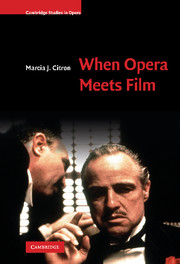
The Godfather trilogy of Francis Ford Coppola is an icon of American culture and international cinema. Released over a span of eighteen years, the group includes The Godfather (1972), The Godfather Part ii (1974), and The Godfather Part iii (1990). Godfather i set box-office records and became that rare film that achieved both commercial and artistic success. While not as popular with audiences, Godfather ii earned high praise from critics and like Godfather i received the Oscar for Best Picture. The final installment inspired much less enthusiasm, and many reviews thought the series had outrun its time. There was no plan at the outset for sequels, but they evolved because Paramount was eager to profit from the success of the predecessor.
The films have attracted considerable critical attention. In reviews and scholarly studies alike, operatic features are often ascribed to the films. Literary critic Paul Giles, for instance, writes that “Whereas Puzo's novel emphasizes plot and fast action, Coppola's films emphasize lavish, operatic ritual,” and he mentions “the hyperbolic and operatic elements in the films – the decapitated horses, the ritual slaughters, and so on …” For film critic Pauline Kael, “Coppola is the inheritor of the traditions of the novel, the theater, and – especially – opera and movies.” She contends that Godfather ii has “the same mythic and operatic visual scheme as the first …” Part i, she observes two years earlier, is characterized by a “dark-and-light contrast [that] is so operatic and so openly symbolic that it perfectly expresses the basic nature of the material.”
The study of the intersection of opera and film is relatively new. It began two decades ago with Jeremy Tambling's influential volume Opera, Ideology and Film (1987), which stresses opera's political role when it appears in filmic form. Musicology turned to opera and film a bit later, and the area has flourished amid the field's embrace of interdisciplinary topics and music for film. Three books have laid a foundation and formed a critical first stage. Opera on Screen, my study from 2000, offers a preliminary framework for interpreting full-length screen versions of opera. In an exploration of key repertoire, it addresses medial differences among cinema, television, and video and suggests ways of thinking about the relationship between live and filmed opera. Two years later a vibrant collection extends the conversation. Between Opera and Cinema, edited by Jeongwon Joe and Rose Theresa, juxtaposes diverse approaches to a wide swath of repertoire. In addition to studies of full-length opera treatments, many essays discuss opera's role in mainstream films or non-Western traditions. The third book is Michal Grover-Friedlander's Vocal Apparitions: The Attraction of Cinema to Opera (2005). Through readings of selected films, this innovative study explores the spectral implications of the voice in operatic encounters with visual and aural media. Meanwhile, major articles have appeared in journals and edited volumes.
I see the present study as part of a second generation of scholarship, joining recent publications such as the collection Wagner and Cinema.
Opera presented on television in a film's story is rare in cinema. One of the most striking examples occurs in Claude Chabrol's film La Cérémonie (1995). In this adaptation of Ruth Rendell's crime novel A Judgement in Stone (1977), a well-heeled family is murdered by their illiterate maid and her zany girlfriend as they watch a telecast of Don Giovanni. Resentment quietly builds in the film until it implodes in the climactic scene of the opera broadcast, which is key to the film's success. Not only does Chabrol deploy his formidable subjective methods in the presentation of the opera, but he leaves us with an interpretation of Don Giovanni that is suggestive for Mozart's work.
Chabrol has enjoyed a productive career and emerged as an éminence grise of French cinema. A founding member of the New Wave and contributor to its mouthpiece Cahiers du cinéma, Chabrol has made over fifty films and is one of the most prolific living directors. His output is eclectic and influenced by key developments of the late twentieth century. According to biographer Guy Austin, these include “neorealism, the new wave, the trauma of the Algerian War, the political legacy of 1968, the rise of the consumer society and the ‘pompidolien’ bourgeoisie, the perennial popularity of the thriller, the tension between television and cinema, the decline of Marxism.”
At the end of Aria one must decide, I suppose, what it all means … You could almost call Aria the first MTV version of opera.
Roger Ebert
In 1987 British producer Don Boyd released an unusual operatic film. Entitled Aria, it consists of ten segments drawn from different operas, each filmed by a different director. Each could choose their own repertoire and film it any way they wished. Boyd encouraged contributors to devise fanciful visualizations for the music and avoid traditional renditions of the story. Each segment had to be less than ten minutes in length and use music from the recorded catalogue of RCA, a major sponsor of the project. Celebrity directors such as Federico Fellini and Woody Allen were originally going to participate, but had to drop out because of scheduling conflicts. The final result includes a few famous names – notably, Jean-Luc Godard, Robert Altman, and Ken Russell – but most of the contributors are British directors who were young and relatively unknown at the time (see Table 2.1).
Not surprisingly for an anthology, the filming styles that resulted are quite varied – from dreamlike exotic fantasy (Russell) to gloomy black-and-white documentary (Charles Sturridge), from swooping cam-like montage (Altman) to a relatively fixed camera (Bruce Beresford), from hyper-real color schemes (Franc Roddam) to a matter-of-fact palette (Godard). The repertoire also spans a wide range.