To save content items to your account,
please confirm that you agree to abide by our usage policies.
If this is the first time you use this feature, you will be asked to authorise Cambridge Core to connect with your account.
Find out more about saving content to .
To save content items to your Kindle, first ensure no-reply@cambridge.org
is added to your Approved Personal Document E-mail List under your Personal Document Settings
on the Manage Your Content and Devices page of your Amazon account. Then enter the ‘name’ part
of your Kindle email address below.
Find out more about saving to your Kindle.
Note you can select to save to either the @free.kindle.com or @kindle.com variations.
‘@free.kindle.com’ emails are free but can only be saved to your device when it is connected to wi-fi.
‘@kindle.com’ emails can be delivered even when you are not connected to wi-fi, but note that service fees apply.
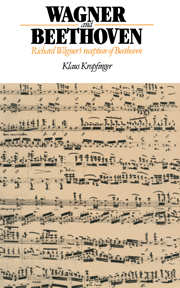
This book analyses the lifelong impact of Beethoven's music on Wagner and its importance for his conception of music drama. Kropfinger charts and scrutinises Wagner's early responses to the composer and considers his experience as a conductor of Beethoven's music. A discussion of the Romantic 'Beethoven image' leads to a careful study of Wagner's aesthetic writings, including his 'programmatic explanations', the text 'Concerning Franz Liszt's symphonic poems', and his Beethoven centenary essay. The penultimate chapter addresses Wagner's theory and practice of music drama which he came to regard as the preordained successor to the Beethovenian symphony. Through his study, Kropfinger offers a fresh understanding of Wagner, music drama, and the development of musical structures.
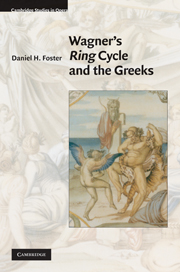
Through his reading of primary and secondary classical sources, as well as his theoretical writings, Richard Wagner developed a Hegelian-inspired theory linking the evolution of classical Greek politics and poetry. This book demonstrates how, by turning theory into practice, Wagner used this evolutionary paradigm to shape the music and the libretto of the Ring cycle. Foster describes how each of the Ring's operas represents a particular phase of Greek poetic and political development: Das Rheingold and Die Walküre create epic national identity in its earlier and later stages respectively; Siegfried expresses lyric personal identity; and Götterdämmerung destructively culminates with a tragi-comedy about civic identity. This study sees the Greeks through the lens of those scholars whose work influenced Wagner most, focusing on epic, lyric, and comedy, as well as Greek tragedy. Most significantly, the book interrogates the ways in which Wagner uses Greek aesthetics to further his own ideological goals.
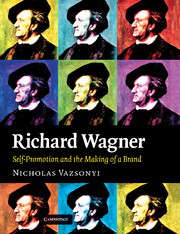
All modern artists have had to market themselves in some way. Richard Wagner may just have done it better than anyone else. In a self-promotional effort that began around 1840 in Paris, and lasted for the remainder of his career, Wagner claimed convincingly that he was the most German composer ever and the true successor of Beethoven. More significantly, he was an opera composer who declared that he was not composing operas. Instead, during the 1850s, he mapped out a new direction, conceiving of works that would break with tradition and be literally 'brand new'. This is the first study to examine the innovative ways in which Wagner made himself a celebrity, promoting himself using every means available: autobiography, journal articles, short stories, newspaper announcements, letters, even his operas themselves. Vazsonyi reveals how Wagner created a niche for his works in the crowded opera market that continues to be unique.
Twenty years of Cambridge Opera Journal: in view of the journal's place in the discipline, the occasion seemed worth marking. When Roger Parker and Arthur Groos founded Cambridge Opera Journal in 1989, it offered the first forum to the musical community for serious opera criticism that took into account changing orientations in literary studies and seriously engaged with ideology, reception history, and representations of race, class and gender. Subsequent editors – Mary Hunter, Mary Ann Smart, and Emanuele Senici – continued to foster this wide intellectual perspective and to engage with an extraordinary variety of methodologies. For the current issue, we gave carte blanche to authors who contributed in the first two years of publication to reflect on their past work, or on opera studies, or on the journal, either informally as an opinion piece or through new scholarship – and so to measure time by developments in the discipline itself.
Lucretia's principal virtue is her undoing. Her chastity is vaunted as the guarantor of Collatinus's honour and standing, as the trigger for Tarquinius's lust, and its brutal loss as the symbol of the corruption of the Etruscans and thus the catalyst for Junius's ascent to power. She is established in a patriarchal system as a desexed woman, as innocent as a child, who can only exist as a chaste wife. When her virtue is polluted by rape, she has no choice but to kill herself in an attempt to restore her function as chaste wife.
Britten's opera encodes the naming of Lucretia in terms redolent of the oppressive ‘speech-acts’ of Peter Grimes. Through tonal and motivic association the projection of her innocence and the ‘stain’ introduced by her rape are worked into the opera's design at the level of long-range musical structure. Through analysis of the thematic implications of musical process in the work, this article opens to view the complex and at times conflicting moral hermeneutics of the work.
The emphasis of the foregoing on specific episodes or examples of Wagner's self-promotional activities has necessarily meant that certain issues and key individuals in Wagner's life were not mentioned at all, or given only passing attention. Even the discussion of his self-marketing has been selective; to document and analyze every example between 1840 and 1883 would be a tedious exercise and would soon become annoying to read. For instance, only the fewest of Wagner's thousands of published letters contain no form of self-promotion. As his fame grew, along with the sense that these letters would become part of the permanent record, the self-stylization becomes ever more pronounced. Over a period of forty-plus years, self-marketing and branding became a daily exercise for Wagner to an extent that has no precedent, especially when juxtaposed with his equally insistent and sustained condemnation of the very social and economic conditions that encouraged and even required such behaviors.
Several important supporters of the Wagnerian cause, whose work falls into the chronological period covered by this book, have not been discussed in sufficient, or any, detail. I justify this in part because the impact of their contributions belongs more properly to the phase that followed Wagner's death, when his “undertaking” became an “industry.”
Starting with the secretarial work of writing out Wagner's most extensive autobiography, My Life, not to mention the meticulous and self-effacing labor of her diaries, Cosima Wagner's increasingly archival and proprietary contribution to the Wagnerian image during the remainder of his life turned out to be the ideal preparation for the monumental role she assumed after his death to perpetuate and sustain – quite literally – the Wagnerian legacy, a role already anticipated by her active participation in the initial establishment of the Wagner societies.