To save content items to your account,
please confirm that you agree to abide by our usage policies.
If this is the first time you use this feature, you will be asked to authorise Cambridge Core to connect with your account.
Find out more about saving content to .
To save content items to your Kindle, first ensure no-reply@cambridge.org
is added to your Approved Personal Document E-mail List under your Personal Document Settings
on the Manage Your Content and Devices page of your Amazon account. Then enter the ‘name’ part
of your Kindle email address below.
Find out more about saving to your Kindle.
Note you can select to save to either the @free.kindle.com or @kindle.com variations.
‘@free.kindle.com’ emails are free but can only be saved to your device when it is connected to wi-fi.
‘@kindle.com’ emails can be delivered even when you are not connected to wi-fi, but note that service fees apply.
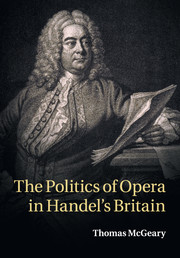
The Politics of Opera in Handel's Britain examines the involvement of Italian opera in British partisan politics in the first half of the eighteenth century, which saw Sir Robert Walpole's rise to power and George Frideric Handel's greatest period of opera production. McGeary argues that the conventional way of applying Italian opera to contemporary political events and persons by means of allegory and allusion in individual operas is mistaken; nor did partisan politics intrude into the management of the Royal Academy of Music and the Opera of the Nobility. This book shows instead how Senesino, Faustina, Cuzzoni and events at the Haymarket Theatre were used in political allegories in satirical essays directed against the Walpole ministry. Since most operas were based on ancient historical events, the librettos - like traditional histories - could be sources of examples of vice, virtue, and political precepts and wisdom that could be applied to contemporary politics.
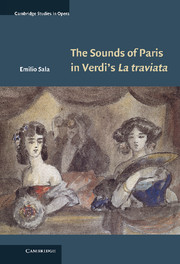
How did Paris and its musical landscape influence Verdi's La traviata? In this book, Emilio Sala re-examines La traviata in the cultural context of the French capital in the mid-nineteenth century. Verdi arrived in Paris in 1847 and stayed for almost two years: there, he began his relationship with Giuseppina Strepponi and assiduously attended performances at the popular theatres, whose plays made frequent use of incidental music to intensify emotion and render certain dramatic moments memorable to the audience. It is in one of these popular theatres that Verdi probably witnessed one of the first performances of Dumas fils' La Dame aux camélias, which became hugely successful in 1852. Making use of primary source material, including unpublished musical works, journal articles and rare documents and images, Sala's close examination of the incidental music of La Dame aux camélias - and its musical context - offers an invaluable interpretation of La traviata's modernity.
In the contemporary theatre there are directors who overtly strive to create ‘Total Theatre’. These are, generally, also directors who create the work they stage – frequently supplanting the playwright – choreograph the movements, design the setting and plot the lighting, and sometimes perform on stage as well, qualifying them as ‘auteurs’, a French term developed in New Wave film theory to describe a director who so dominates the film-making process that he or she can be seen as the ‘author’ because the final product is a personal expression. We have chosen to apply this term to theatre directors who, similarly, embrace the whole creative process. Strikingly, many of these directors are also visual artists; their performances are primarily physical rather than text-based; and they promote a style of ‘Total Theatre’ that seeks not only artistic unity as in Wagner’s Gesamtkunstwerk, but also to break through the naturalistic ‘fourth wall’ and unite performers and audience. In addition, where the structure is primarily pictorial rather than linear, the effect is perceptibly episodic, and the same is true of cinematic structuring. So there is a direct line running from, say, Kandinsky’s 1912 play The Yellow Sound – where in ‘Picture 3’ ‘Everything is motionless’ until (in a technique paralleling Craig) light brings movement – to Lepage’s 1999 Damnation of Faust with its multiple cinema frames on stage, or Robert Wilson’s Dream Play (1998) with its cinematic blackouts or dissolves between vignettes. This episodic quality links these visual directors to the epic theatre pioneered by Brecht; and while the most conspicuous auteurs are from the contemporary theatre – Robert Wilson, Richard Foreman or Robert Lepage being obvious examples – the justification for this degree of directorial control has a history going back to the beginning of the twentieth century, where it was first formulated by Gordon Craig.
The directors who feature in this chapter have the goal of ensemble theatre, as first envisaged by Stanislavsky, even if all follow their own path to advance the possibilities of directing. This influence has been world-wide. Some, like Harley Granville Barker in Britain in the 1910s, furthered Stanislavsky’s principles, not least the principle of ensemble acting, without fully realizing them. Joan Littlewood too promoted ensemble practices in the Theatre Workshop (thus renamed in 1945), drawing on the examples of both Stanislavsky and Brecht that led to productions such as her seminal Oh What a Lovely War in 1963; and Peter Hall was inspired by the idea of a creative ensemble when he founded the Royal Shakespeare Company in 1961. Then, too, there are directors who, like Elia Kazan in the United States, have come out of Method Acting, Lee Strasberg’s particular take on Stanislavsky’s ‘system’.
However, ensemble theatre has a particularly firm tradition in Eastern Europe that has continued unbroken to the present in, for instance, the meticulously crafted productions of Krystian Lupa in Poland, where Stanislavsky’s legacy as regards ensemble work came via Juliusz Osterwa. Osterwa had come into contact with the Moscow Art Theatre when, in the mid 1910s, he directed in Moscow. The younger generation of Polish directors exemplified by Krzysztof Warlikowski and Grzegorz Jarzyna, both of whom were assistant directors to Lupa before taking off on independent careers, rely on finely tuned ensemble playing for the impact of their productions.
Towards the end of the nineteenth century, theatrical conditions fostered the emergence of the modern director. Already foreshadowed by the Intendant system, established in Germany almost exactly a hundred years earlier, the earliest came out of that system: Georg II, Duke of Saxe-Meiningen (1826–1914). He was followed by a group of near contemporaries: André Antoine (1858–1943), working with Zola (1840–1902), Konstantin Stanislavsky (1863–1938), Adolphe Appia (1862–1928) and Gordon Craig (1872–1966). The first who qualify as modern directors, they created and represent the major lines of stylistic development at the beginning of the twentieth century. Each contributes different elements; but as we shall see, all share certain standards in dealing with dramatic material as well as common approaches to staging, and each combines theatre practice and theory: either developing theory from the work, or basing work on theory. Two – Antoine and Stanislavsky – continued to act major parts in the plays they directed, while Craig gave up an acting career specifically to reform the stage. One other influence needs to be noted: as a composer, Richard Wagner (1813–1883) conducted his own operas, and, in adding the function of commissioning settings and costumes as well as orchestrating the singers’ moves, offered a model of the theatrical auteur that was to be picked up by Appia and Craig, working on principles of design.
The Meiningen Players and the conditions for naturalism
As the owner of his own court theatre, and taking over the position of Intendant himself, the Duke of Saxe-Meiningen had complete freedom to experiment. In contrast to the English-speaking theatre’s focus on stars, in the form of the actor-manager, the Intendant system encouraged ensemble acting. And unity of expression on the stage, as well as ensemble work, was epitomized by his Meiningen Players.