To save content items to your account,
please confirm that you agree to abide by our usage policies.
If this is the first time you use this feature, you will be asked to authorise Cambridge Core to connect with your account.
Find out more about saving content to .
To save content items to your Kindle, first ensure no-reply@cambridge.org
is added to your Approved Personal Document E-mail List under your Personal Document Settings
on the Manage Your Content and Devices page of your Amazon account. Then enter the ‘name’ part
of your Kindle email address below.
Find out more about saving to your Kindle.
Note you can select to save to either the @free.kindle.com or @kindle.com variations.
‘@free.kindle.com’ emails are free but can only be saved to your device when it is connected to wi-fi.
‘@kindle.com’ emails can be delivered even when you are not connected to wi-fi, but note that service fees apply.
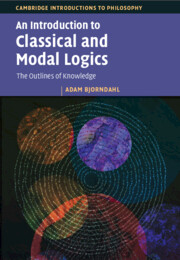
Classical logic – which studies the structural features of purported claims of fact – and modal logic – which studies relations of necessity and possibility – are different but complementary areas of logical thought. In this lively and accessible textbook, Adam Bjorndahl provides a comprehensive and unified introduction to the two subjects, treating them with the same level of rigour and detail and showing how they fit together. The core material appears in the main text, with hundreds of supplemental examples, comments, clarifications, and connections presented throughout in easy-to-read sidenotes, giving the book a distinct conversational feel. A detailed, multi-part appendix covers important background mathematical material that some students may lack, such as induction or the concept of countable infinity. A fully self-contained learning resource, this book will be ideal for a semester-long upper-level university course on either or both of the topics.
Reasoning from inconclusive evidence, or 'induction', is central to science and any applications we make of it. For that reason alone it demands the attention of philosophers of science. This element explores the prospects of using probability theory to provide an inductive logic: a framework for representing evidential support. Constraints on the ideal evaluation of hypotheses suggest that the overall standing of a hypothesis is represented by its probability in light of the total evidence, and incremental support, or confirmation, indicated by the hypothesis having a higher probability conditional on some evidence than it does unconditionally. This proposal is shown to have the capacity to reconstruct many canons of the scientific method and inductive inference. Along the way, significant objections are discussed, such as the challenge of inductive scepticism, and the objection that the probabilistic approach makes evidential support arbitrary.
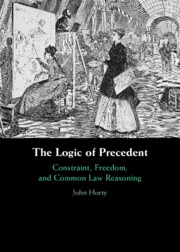
Unlike statutory law, which relies on the explicit formulation of rules, common law is thought to emerge from a complex doctrine of precedential constraint, according to which decisions in earlier cases constrain later courts while still allowing these courts the freedom to address new situations in creative ways. Although this doctrine is applied by legal practitioners on a daily basis, it has proved to be considerably more difficult to develop an adequate theoretical account of the doctrine itself. Drawing on recent work in legal theory, as well as AI and law, this book develops a new account of precedential constraint and the balance achieved in the common law between constraint and freedom. This account, which involves construction of a group priority ordering among reasons, is then applied to other topics including the semantics of open-textured predicates and the practice of making exceptions to general rules.
Classical logic assumes that names are univocal: every name refers to exactly one existing individual. This Principle of Univocality has two parts: an existence assumption and a uniqueness assumption. The existence assumption holds that every name refers to at least oneindividual, and the uniqueness assumption states that every name refers to at most one individual. The various systems of free logic which have been developed and studied since the 1960s relax the existence assumption, but retain the uniqueness assumption. The present work investigates violations of both halves of the Principle of Univocality. That is, whereas the free logics developed from the 1960s are called 'free' because they are free of existential assumptions, the current Element generalizes this idea, to study logics that are free of uniqueness assumptions. We explore several versions of free logic, comparing their advantages and disadvantages. Applications of free logic to other areas of philosophy are explored.
Meinongianism (named after Alexius Meinong) is, roughly, the view that there are not only existent but also nonexistent objects. In this book, Meinong's so-called object theory as well as “neo-Meinongian” reconstructions are presented and discussed, especially with respect to logical issues, both from a historical and a systematic perspective. Among others, the following topics are addressed: basic principles and motivations for Meinongianism; the distinction between “there is” (“x”) and “exists” (“E!”); interpretations and kinds of quantification; Meinongianism, the principle of excluded middle and the principle of non-contradiction; the nuclear-extranuclear distinction and modes of predication; varieties of neo-Meinongianism and Meinongian logics.
The concept of grounding – of a fact obtaining in virtue of other facts – has been a topic of intensive philosophical and logical investigation over roughly the past two decades. Many philosophers take grounding to deserve a central place in metaphysical theorizing, in great part because it is thought to do a better job than other concepts – e.g., reduction and supervenience – at capturing certain phenomena. Studies on the logic of grounding have largely been conducted with this philosophical background in mind. In this Element, I try to give a faithful picture of the contemporary development of the logic of grounding in a way that is both reasonably comprehensive and reasonably systematic.
This chapter expands propositional logic to include quantification, namely “all” and “some”, which allows for reasoning about more sophisticated statements like “all dogs are animals” or “every cat that’s been chased by a dog is afraid of all dogs”. The material presented here builds directly on the previous chapter; taken together these constitute an upper-year university course on classical logic. We introduce first-order structures—ubiquitious in mathematics—and define the interpretation of the language of predicate logic in such structures. We establish axioms, prove they are sound, and culminate with a proof of the completeness theorem for first-order logic—a major milestone in the history of logic, not to mention one of the hardest proofs one can find in an undergraduate curriculum!
This chapter introduces modal logic, an expansion of propositional logic designed for reasoning about more subtle ways of modifying statements, including claims about what is known or believed, what might happen tomorrow or after some action is taken, what is justified, permitted, obligatory, and so on. There is a huge variety of different modal logics, but they all share the same common mathematical core, which we motivate and rigorously define. For intuition we focus especially on logics of knowledge, known as epistemic logics. No prior background in modal logic is assumed. After establishing the basics we progress to deeper model-theoretic results including invariance and expressivity, definability, and several important and useful completeness theorems. Altogether this chapter consitutes the core of an upper-year university course on modal logic.
In this short “exploration” chapter we consider an alternative semantics for modal logic using topological spaces. No background whatsoever in topology is assumed. We motivate the fundamental mathematical definition of a topological space from an epistemic perspective, and connect it to the modal logics studied previously, both intuitively and formally. We also show how to transform reflexive and transitive frames into topological spaces in a truth-preserving way, and use this to establish completeness.
This chapter starts at the beginning and introduces propositional logic, designed for reasoning about how we combine and modify statements with simple words like “and”, “or”, “not”, and “if … then”. The beginning of the chapter is pitched at an audience that has, perhaps, never seen logic before in a formal context. After establishing the basic intuitions and definitions, we cover all the standard mathematical content of propositional logic, including the use of truth tables to provide semantic content to formulas, the idea of writing formal deductions from axioms to prove new things, and the fundamental connection between truth and provability captured by the soundness and completness theorems.