To save content items to your account,
please confirm that you agree to abide by our usage policies.
If this is the first time you use this feature, you will be asked to authorise Cambridge Core to connect with your account.
Find out more about saving content to .
To save content items to your Kindle, first ensure no-reply@cambridge.org
is added to your Approved Personal Document E-mail List under your Personal Document Settings
on the Manage Your Content and Devices page of your Amazon account. Then enter the ‘name’ part
of your Kindle email address below.
Find out more about saving to your Kindle.
Note you can select to save to either the @free.kindle.com or @kindle.com variations.
‘@free.kindle.com’ emails are free but can only be saved to your device when it is connected to wi-fi.
‘@kindle.com’ emails can be delivered even when you are not connected to wi-fi, but note that service fees apply.
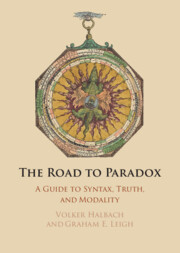
A more expressive axiomatic theory of syntax is presented. It is shown that this theory generalises the theory of chapter 5 and allows the derivation of many natural properties of syntax.
It is investigated what it means for formulae of the syntax to express informal concepts. The Gödel incompleteness theorems and related results are proved for the syntax theory.
Truth, provability, necessity, and other concepts are fundamental to many branches of philosophy, mathematics, computer science, and linguistics. Their study has led to some of the most celebrated achievements in logic, such as Gödel's incompleteness theorems, Tarski's theorem on the undefinability of truth, and numerous accounts of the paradoxes associated with these concepts. This book provides a clear and direct introduction to the theory of paradoxes and the Gödel incompleteness theorems. It offers new analyses of the ideas of self-reference, circularity, and the semantic paradoxes, and helps readers to see both how paradoxes arise and what their common features are. It will be valuable for students and researchers with a minimal background in logic and will equip them to understand and discuss a wide variety of topics in philosophical logic.
This Element looks at two projects that relate logic and information: the project of using logic to integrate, manipulate and interpret information and the proect of using the notion of information to provide interpretations of logical systems. The Element defines 'information' in a manner that includes misinformation and disinformation and uses this general concept of information to provide an interpretation of various paraconsistent and relevant logics. It also integrates these logics into contemporary theories of informational updating, probability theory and (rather informally) some ideas from the theory of the complexity of proofs. The Element assumes some prior knowledge of modal logic and its possible world semantics, but all the other necessary background is provided.
Propositional quantifiers are quantifiers binding proposition letters, understood as variables. This Element introduces propositional quantifiers and explains why they are especially interesting in the context of propositional modal logics. It surveys the main results on propositionally quantified modal logics which have been obtained in the literature, presents a number of open questions, and provides examples of applications of such logics to philosophical problems.
Relevance logics are a misunderstood lot. Despite being the subject of intense study for nearly a century, they remain maligned as too complicated, too abstruse, or too silly to be worth learning much about. This Element aims to dispel these misunderstandings. By focusing on the weak relevant logic B, the discussion provides an entry point into a rich and diverse family of logics. Also, it contains the first-ever textbook treatment of quantification in relevance logics, as well as an overview of the cutting edge on variable sharing results and a guide to further topics in the field.
Categorization is an essential and unavoidable instrumentality for conceptually navigating a world-indeed for being able to conceptualize a world to be navigated. Classification is a pivotal instrument for scientific systemization, featured as a basis for the philosophical understanding of reality since Aristotle, but classificatory concepts of sorts, types and natural kinds inevitably pervade our understanding of ourselves and our position in the social as well as the natural world at all levels. The authors argue that the character, purpose-, context-, and culture-relativity of categories and categorization have been widely misunderstood - that standard philosophical views are substantially correct in some respects but markedly mistaken in others. The book offers a comprehensive survey of basic principles of classification and categorization, a survey of relevant empirical work, and a multitude of illustrative examples accompanied by instructive analysis of ways and means. The work traces wide-ranging implications of the current approach for philosophical problematic and paradox in philosophy of mind, epistemology and metaphysics, philosophy of science, social philosophy and ethics.
Possible worlds have revolutionised philosophy and some related fields. But, in recent years, tools based on possible worlds have been found to be limited in many respects. Impossible worlds have been introduced to overcome these limitations. This Element aims to raise and answer the neglected question of what is characteristically impossible about impossible worlds. The Element sheds new light on the nature of impossible worlds. It also aims to analyse the main features and utility of impossible worlds and examine how impossible worlds can capture distinctions which are unavailable if we limit ourselves to possible world-based tools.
In this chapter, the semantical framework of Chapter 7 is fine-tuned in order to provide a semantics for Anderson and Belnap’s logic E of relevant entailment. It is shown how a form of logical necessity can be represented in the semantics, and this is used to motivate the postulates that are needed to characterize that logic. A labelled deduction system (introduced in Chapter 7) is also used to show how to derive the axioms of E easily.
The model theory for quantified relevant logic developed by Robert Goldblatt and Mares is adapted to the present semantical framework. A universally quantified statement ‘For all x A(x)’ is taken to mean that there is some proposition in the present theory that entails every instance of A(x). An axiomatization of the logic is given, and completeness is proven in the Appendix to the book. Identity, the nature of domains, and higher-order quantification are also discussed.
In this chapter, negation and disjunction are integrated into the semantics developed in Chapters 7 and 8. Here, the semantics of negation is given in terms of an incompatibility relation between theories. A corresponding incompatibility relation is added to the formal language, and a more intuitive and conceptually satisfying set of rules for negation are added to the natural deduction system.
This chapter examines Dana Scott’s project of treating a logic of entailment as one that captures its own deducibility relation in the sense that it represents (and vindicates) the way in which the theorems of the logic themselves are derived. For example, a reflexive logic that is axiomatized using the rule of modus ponens also contains the entailment ‘(A and A entails B) entails B’. It is argued in this chapter that the reflexivity constraints get in the way of the logic’s being used as a general theory of theory closure. A logic should be closed under its own principles of inference, but the logic should be able to be used with theories that are radically different from itself.
This chapter introduces Anderson and Belnap’s natural deduction treatment of entailment and the idea that hypotheses in deductions should really be used in those deductions. The idea of real use motivates relevant logic and is a key idea in the chapters that follow. The chapter outlines the development of Fitch-style natural deduction systems and introduces the reader to them.