To save content items to your account,
please confirm that you agree to abide by our usage policies.
If this is the first time you use this feature, you will be asked to authorise Cambridge Core to connect with your account.
Find out more about saving content to .
To save content items to your Kindle, first ensure no-reply@cambridge.org
is added to your Approved Personal Document E-mail List under your Personal Document Settings
on the Manage Your Content and Devices page of your Amazon account. Then enter the ‘name’ part
of your Kindle email address below.
Find out more about saving to your Kindle.
Note you can select to save to either the @free.kindle.com or @kindle.com variations.
‘@free.kindle.com’ emails are free but can only be saved to your device when it is connected to wi-fi.
‘@kindle.com’ emails can be delivered even when you are not connected to wi-fi, but note that service fees apply.
This is the third volume of Hilary Putnam's philosophical papers, published in paperback for the first time. The volume contains his major essays from 1975 to 1982, which reveal a large shift in emphasis in the 'realist' position developed in his earlier work. While not renouncing those views, Professor Putnam has continued to explore their epistemological consequences and conceptual history. He now, crucially, sees theories of truth and of meaning that derive from a firm notion of reference as inadequate.
The Annual European Meeting of the Association for Symbolic Logic, generally known as the Logic Colloquium, is the most prestigious annual meeting in the field. Many of the papers presented there are invited surveys of developments, and the rest of the papers are chosen to complement the invited talks. This 2007 volume includes surveys, tutorials, and selected research papers from the 2005 meeting. Highlights include three papers on different aspects of connections between model theory and algebra; a survey of major advances in combinatorial set theory; a tutorial on proof theory and modal logic; and a description of Bernay's philosophy of mathematics.
This collection of essays by one of the most prominent and internationally respected philosophers of action theory is concerned with deepening our understanding of the notion of intention. In Bratman's view, when we settle on a plan for action we are committing ourselves to future conduct in ways that help support important forms of coordination and organization both within the life of the agent and interpersonally. These essays enrich that account of commitment involved in intending, and explore its implications for our understanding of temptation and self-control, shared intention and shared cooperative activity, and moral responsibility. The essays offer extensive discussions of related views by, among others, Donald Davidson, Hector-Neri Castañeda, Christine Korsgaard, Harry Frankfurt, and P. F. Strawson. This collection will be a valuable resource for a wide range of philosophers and their students.
An international team of four authors, led by distinguished philosopher of science, Nancy Cartwright, and leading scholar of the Vienna Circle, Thomas E. Uebel, have produced this lucid and elegant study of a much-neglected figure. The book, which depicts Neurath's science in the political, economic and intellectual milieu in which it was practised, is divided into three sections: Neurath's biographical background and the socio-political context of his economic ideas; the development of his theory of science; and his legacy as illustrated by his contemporaneous involvement in academic and political debates. Coinciding with the renewal of interest in logical positivism, this is a timely publication which will redress a current imbalance in the history and philosophy of science, as well as making a major contribution to our understanding of the intellectual life of Austro-Germany in the inter-war years.
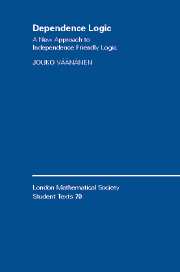
Dependence is a common phenomenon, wherever one looks: ecological systems, astronomy, human history, stock markets - but what is the logic of dependence? This book is the first to carry out a systematic logical study of this important concept, giving on the way a precise mathematical treatment of Hintikka's independence friendly logic. Dependence logic adds the concept of dependence to first order logic. Here the syntax and semantics of dependence logic are studied, dependence logic is given an alternative game theoretic semantics, and results about its complexity are proven. This is a graduate textbook suitable for a special course in logic in mathematics, philosophy and computer science departments, and contains over 200 exercises, many of which have a full solution at the end of the book. It is also accessible to readers, with a basic knowledge of logic, interested in new phenomena in logic.
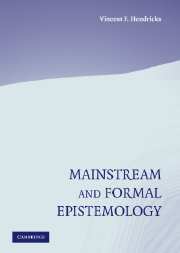
Mainstream and Formal Epistemology provides the first, easily accessible, yet erudite and original analysis of the meeting point between mainstream and formal theories of knowledge. These two strands of thinking have traditionally proceeded in isolation from one another, but in this book, Vincent F. Hendricks brings them together for a systematic comparative treatment. He demonstrates how mainstream and formal epistemology may significantly benefit from one another, paving the way for a new unifying program of 'plethoric' epistemology. His book will both define and further the debate between philosophers from two very different sides of the epistemological spectrum.
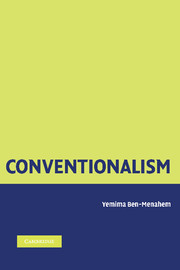
The daring idea that convention - human decision - lies at the root both of necessary truths and much of empirical science reverberates through twentieth-century philosophy, constituting a revolution comparable to Kant's Copernican revolution. This book provides a comprehensive study of Conventionalism. Drawing a distinction between two conventionalist theses, the under-determination of science by empirical fact, and the linguistic account of necessity, Yemima Ben-Menahem traces the evolution of both ideas to their origins in Poincaré's geometric conventionalism. She argues that the radical extrapolations of Poincaré's ideas by later thinkers, including Wittgenstein, Quine, and Carnap, eventually led to the decline of conventionalism. This book provides a fresh perspective on twentieth-century philosophy. Many of the major themes of contemporary philosophy emerge in this book as arising from engagement with the challenge of conventionalism.
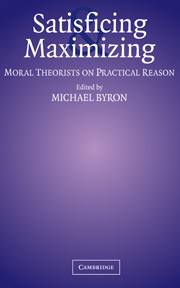
How do we think about what we plan to do? One dominant answer is that we select the best possible option available. However, a growing number of philosophers would offer a different answer: since we are not equipped to maximize we often choose the next best alternative, one that is no more than satisfactory. This strategy choice is called satisficing (a term coined by the economist Herb Simon). This collection of essays explores both these accounts of practical reason, examining the consequences for adopting one or the other for moral theory in general and the theory of practical rationality in particular. It aims to address a constituency larger than contemporary moral philosophers and bring these questions to the attention of those interested in the applications of decision theory in economics, psychology and political science.
Life, on a day to day basis, is a sequence of emotional states: hope, disappointment, irritation, anger, affection, envy, pride, embarrassment, joy, sadness and many more. We know intuitively that these states express deep things about our character and our view of the world. But what are emotions and why are they so important to us? In one of the most extensive investigations of the emotions ever published, Robert Roberts develops a novel conception of what emotions are and then applies it to a large range of types of emotion and related phenomena. In so doing he lays the foundations for a deeper understanding of our evaluative judgments, our actions, our personal relationships and our fundamental well-being. Aimed principally at philosophers and psychologists, this book will certainly be accessible to readers in other disciplines such as religion and anthropology.
This book makes a stimulating contribution to the philosophy of language and philosophy of mind. It begins with a spirited defence of the view that propositions are structured and that propositional structure is 'psychologically real'. The author then develops a subtle view of propositions and attitude ascription. The view is worked out in detail with attention to such topics as the semantics of conversations, iterated attitude ascriptions, and the role of propositions as bearers of truth. Along the way important issues in the philosophy of mind are addressed. Though intended primarily for professional philosophers and graduate students the book will also interest cognitive scientists and linguists.
Written by one of today's most creative and innovative philosophers, Ruth Garrett Millikan, this book examines basic empirical concepts; how they are acquired, how they function, and how they have been misrepresented in the traditional philosophical literature. Millikan places cognitive psychology in an evolutionary context where human cognition is assumed to be an outgrowth of primitive forms of mentality, and assumed to have 'functions' in the biological sense. Of particular interest are her discussions of the nature of abilities as different from dispositions, her detailed analysis of the psychological act of reidentifying substances, and her critique of the language of thought for mental representation. In a radical departure from current philosophical and psychological theories of concepts, this book provides the first in-depth discussion on the psychological act of reidentification.
Widely regarded as one of the foremost figures in contemporary philosophy of religion, this book by Linda Zagzebski is a major contribution to ethical theory and theological ethics. At the core of the book lies a form of virtue theory based on the emotions. Quite distinct from deontological, consequentialist and teleological virtue theories, this one has a particular theological, indeed Christian, foundation. The theory helps to resolve philosophical problems and puzzles of various kinds: the dispute between cognitivism and non-cognitivism in moral psychology, the claims and counterclaims of realism and anti-realism in the metaphysics of value, and paradoxes of perfect goodness in natural theology, including the problem of evil. As with Zagzebski's previous Cambridge book Virtues of the Mind, this book will be sought out eagerly by a broad swathe of professionals and graduate students in philosophy and religious studies.
When, if ever, is one justified in accepting the premises of an argument? What is the proper criterion of premise acceptability? Can the criterion be theoretically or philosophically justified? This is the first book to provide a comprehensive theory of premise acceptability and it answers the questions above from an epistemological approach that the author calls common sense foundationalism. It will be eagerly sought out not just by specialists in informal logic, critical thinking, and argumentation theory but also by a broader range of philosophers and those teaching rhetoric.
This challenging and provocative book argues against much contemporary orthodoxy in philosophy and the social sciences by showing why objectivity in the domain of ethics is really no different from the objectivity of scientific knowledge. Many philosophers and social scientists have challenged the idea that we act for objectively authoritative reasons. Jean Hampton takes up the challenge by undermining two central assumptions of this contemporary orthodoxy: that one can understand instrumental reasons without appeal to objective authority, and that the adoption of the scientific world view requires no such appeal. In the course of the book Jean Hampton examines moral realism, the general nature of reason and norms, internalism and externalism, instrumental reasoning, and the expected utility model of practical reasoning. The book is sure to prove to be a seminal work in the theory of rationality that will be read by a broad swathe of philosophers and social scientists.
In this book Frederic Schick develops his challenge to standard decision theory. He argues that talk of the beliefs and desires of an agent is not sufficient to explain choices. To account for a given choice we need to take into consideration how the agent understands the problem, how he sees in a selective way the options open to him. The author applies his new logic to a host of common human predicaments. Why do people in choice experiments act so often against expectations? Why do people cooperate in situations where textbook logic predicts that they won't? What exactly is weakness of will? What are people reporting when they say their lives have no meaning for them? This book questions the foundations of technical and philosophical decision theory and will appeal to all those who work in that field, be they philosophers, economists and psychologists.
This book, first published in 2000, is about the nature of skeptical arguments and their role in philosophical inquiry. John Greco delineates three main theses: that a number of historically prominent skeptical arguments make no obvious mistake, and therefore cannot be easily dismissed; that the analysis of skeptical arguments is philosophically useful and important, and should therefore have a central place in the methodology of philosophy; and that taking skeptical arguments seriously requires us to adopt an externalist, reliabilist epistemology. Greco argues that the importance of skeptical arguments is methodological. It is further argued that taking skeptical arguments seriously requires us to adopt a version of 'virtue epistemology', or a theory of knowledge that makes intellectual virtue central in the analysis of knowledge. The above methodology has consequences for moral and religious epistemology; in particular, a theory of moral perception is defended.
Physicalism, a topic that has been central to modern philosophy of mind and metaphysics, is the philosophical view that everything in the space-time world is ultimately physical. The physicalist will claim that all facts about the mind and the mental are physical facts and deny the existence of mental events and state insofar as these are thought of as independent of physical things, events and states. This collection of essays, first published in 2001, offers a series of perspectives on this important doctrine and brings depth and breadth to the philosophical debate. A group of distinguished philosophers, comprising both physicalists and their critics, consider a wide range of issues including the historical genesis and present justification of physicalism, its metaphysical presuppositions and methodological role, its implications for mental causation, and the account it provides of consciousness.
One of the main tasks of logic is to give an analysis of argumentation. Traditionally this analysis is of premise-conclusion argumentation. If formal methods are used, one begins with propositional logic.
The most common form of propositional logic is truth-table logic. Truthtable logic extends very easily into truth-tree logic. We assume that the reader is familiar with propositional logic in both truth-table and truth-tree forms. From this point we shall use the term propositional logic to refer to truthtable and truth-tree propositional logic unless we make it clear otherwise. Most of this text can be read with a knowledge of propositional logic only.
Propositional logic is usually extended to predicate or first-order logic. To read the whole of this volume the reader should be familiar with predicate logic and the system of truth-trees for predicate logic. Several texts introduce the reader to propositional and predicate logic and the truth-tree system. They are listed in the further reading at the end of the chapter.
Argument analysis
There are arguments that are clearly valid, but that cannot be shown to be so by propositional logic. Arguments such as:
“All Athenians are Greeks.
Socrates is Athenian.
So Socrates is Greek.”
require a more detailed analysis of their logical form than can be given by propositional logic. We need a logic that can deal not only with the negation, disjunction and conjunction of propositions, but also with quantifiers (all, some), predicates (is Φ) and relations (loves). The result is predicate logic.