To save content items to your account,
please confirm that you agree to abide by our usage policies.
If this is the first time you use this feature, you will be asked to authorise Cambridge Core to connect with your account.
Find out more about saving content to .
To save content items to your Kindle, first ensure no-reply@cambridge.org
is added to your Approved Personal Document E-mail List under your Personal Document Settings
on the Manage Your Content and Devices page of your Amazon account. Then enter the ‘name’ part
of your Kindle email address below.
Find out more about saving to your Kindle.
Note you can select to save to either the @free.kindle.com or @kindle.com variations.
‘@free.kindle.com’ emails are free but can only be saved to your device when it is connected to wi-fi.
‘@kindle.com’ emails can be delivered even when you are not connected to wi-fi, but note that service fees apply.
“I once asked Carnap with which philosopher of the past he felt a close kinship,” writes Abraham Kaplan in a memoir. “His reply was Leibniz” (Kaplan [1991], p. 40). This feeling of kinship with Leibniz was something Gödel and Carnap had in common, and it distinguished them from the other members of the Vienna Circle and its following, who had less rationalist inclinations. However, Carnap and Gödel were in good company when we look more widely at the founders of modern logic and scientifically-oriented philosophy. Frege, Cantor, and Russell, among others, would likely also have named Leibniz if asked the same question. One obvious source of fascination for all these thinkers was Leibniz's idea of a universal deductive system, a calculus philosophicus or characteristica universalis, to connect all knowledge in a single, uniform deductive structure. The various efforts during the Enlightenment to classify and codify the new knowledge, in competition with theological and traditional lore, had overlooked or forgotten Leibniz's proposal, as had the subsequent positivist tradition. It was only with the more powerful logical tools developed in the later nineteenth century that Leibniz's dreams once again became relevant.
Of course these latter-day admirers of Leibniz diverged widely in their attitude toward this universal logical program. They diverged, for instance, along the left-right scale or “schema of possible philosophical world-views” that Gödel set up in a lecture written around 1961:
I believe that the most fruitful principle for gaining a perspective on the range of possible world-views [Weltanschauungen] will be to divide them up according to the degree and the manner of their affinity to or departure from metaphysics (or religion). […]
Analyzing Love is concerned with four basic and neglected problems concerning love. The first is identifying its relevant features: distinguishing it from liking and benevolence and from sexual desire; describing the objects that can be loved and the judgements and aims required by love. The second question is how we recognize the presence of love and what grounds we may have for thinking it present in any particular case. The third is that of relating it to other emotions such as anger and fear, and, more generally, deciding where love stands in the contrast between emotions and attitudes. Finally, the book examines how we justify our loves: can we have, and do we need, reasons for loving? What types of judgement are appropriate to love? Can we criticize a lover for his or her choices?
Supervenience is one of the 'hot discoveries' of analytic philosophy, and this collection of essays on the topic represents an examination of it and its application to major areas of philosophy. The interest in supervenience has much to do with the flexibility of the concept. To say that x supervenes on y indicates a degree of dependence without committing one to the view that x can be reduced to y. Thus supervenience is a relationship that has the potential of replacing the traditional notion of dependence, while performing at least part of the function reductive relationships were supposed to fulfil. Moreover, since it is a topic-neutral concept, supervenience has a wide range of applicability.
This book is a major contribution to the philosophical literature on the nature of the self, personal identity and survival. Its distinctive methodology is one that is phenomenologically descriptive rather than metaphysical and normative. On the basis of this approach Raymond Martin shows that the distinction between self and other is not nearly as fundamental a feature of our so-called egoistic values as has been traditionally thought. He explains how the belief in a self as a fixed, continuous point of observation enters into our experience of ourselves and the world. He also reveals the explosive implications this thesis has for recent debates over personal identity and what matters in survival. This is the first book of analytic philosophy directly on the phenomenology of identity and survival. It builds bridges between analytic and phenomenological traditions and, thus, to open up a new field of investigation.
Isaac Levi's new book is concerned with how one can justify changing one's beliefs. The discussion is deeply informed by the belief-doubt model advocated by C. S. Peirce and John Dewey, of which the book provides a substantial analysis. Professor Levi then addresses the conceptual framework of potential changes available to an inquirer. A structural approach to propositional attitudes is proposed, which rejects the conventional view that a propositional attitude involves a relation between an agent and either a linguistic entity or some other intentional object such as a proposition or set of possible worlds. The last two chapters offer an account of change in states of full belief understood as changes in commitments rather than changes in performance; one chapter deals with adding new information to a belief state, the other with giving up information. The book builds upon topics discussed in some of Levi's earlier work. It will be of particular interest to discussion theorists, epistemologists, philosophers of science, computer scientists, and cognitive psychologists.
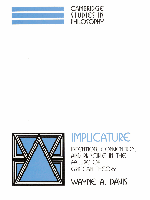
H. P. Grice virtually discovered the phenomenon of implicature (to denote the implications of an utterance that are not strictly implied by its content). Gricean theory claims that conversational implicatures can be explained and predicted using general psycho-social principles. This theory has established itself as one of the orthodoxes in the philosophy of language. Wayne Davis argues controversially that Gricean theory does not work. He shows that any principle-based theory understates both the intentionality of what a speaker implicates and the conventionality of what a sentence implicates. In developing his argument the author explains that the psycho-social principles actually define the social function of implicature conventions, which contribute to the satisfaction of those principles. This challenging book will be of importance to philosophers of language and linguists, especially those working in pragmatics and sociolinguistics.
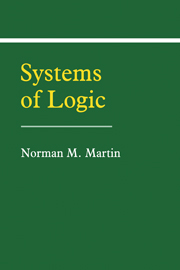
This is an advanced study of systems of propositional logic which offers a comprehensive account of a wide variety of logical systems and which encourages students to take a critical stance towards the subject. A great variety of systems and subsystems are defined and compared as regards their deductive power and relation to their model theory. Interesting features include a more refined treatment of modal logic and the special attention given to the weakenings of classical logic. Useful appendices provide a topical bibliography and review of basic set theory.
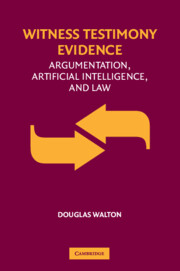
Recent work in artificial intelligence has increasingly turned to argumentation as a rich, interdisciplinary area of research that can provide new methods related to evidence and reasoning in the area of law. Douglas Walton provides an introduction to basic concepts, tools and methods in argumentation theory and artificial intelligence as applied to the analysis and evaluation of witness testimony. He shows how witness testimony is by its nature inherently fallible and sometimes subject to disastrous failures. At the same time such testimony can provide evidence that is not only necessary but inherently reasonable for logically guiding legal experts to accept or reject a claim. Walton shows how to overcome the traditional disdain for witness testimony as a type of evidence shown by logical positivists, and the views of trial sceptics who doubt that trial rules deal with witness testimony in a way that yields a rational decision-making process.
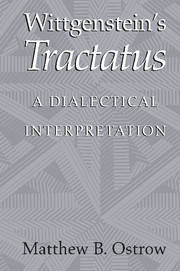
Wittgenstein once wrote that 'The philosopher strives to find the liberating word, that is, the word that finally permits us to grasp what up until now has intangibly weighed down our consciousness'. Would Wittgenstein have been willing to describe the Tractatus as an attempt to find 'the liberating word'? This is the basic contention of this strikingly innovative study of the Tractatus. Matthew Ostrow argues that, far from seeking to offer a new theory in logic in the tradition of Frege and Russell, Wittgenstein from the very beginning viewed all such endeavors as the ensnarement of thought. Providing a lucid and systematic analysis of the Tractatus, he argues that Wittgenstein's ultimate aim is to put an end to philosophy itself. He also highlights the intrinsic obstacles to any kind of interpretation that claims to summarize Wittgenstein's thought.
Jaegwon Kim is one of the most pre-eminent and most influential contributors to the philosophy of mind and metaphysics. This collection of essays presents the core of his work on supervenience and mind with two sets of postscripts especially written for the book. The essays focus on such issues as the nature of causation and events, what dependency relations other than causal relations connect facts and events, the analysis of supervenience, and the mind-body problem. A central problem in the philosophy of mind is the problem of explaining how the mind can causally influence bodily processes. Professor Kim explores this problem in detail, criticises the nonreductionist solution of it, and offers a modified reductionist solution of his own. Both professional philosophers and their graduate students will find this an invaluable collection.
One of the most important and influential philosophers of the last 30 years, John Searle has been concerned throughout his career with a single overarching question: how can we have a unified and theoretically satisfactory account of ourselves and of our relations to other people and to the natural world? In other words, how can we reconcile our common-sense conception of ourselves as conscious, free, mindful, rational agents in a world that we believe comprises brute, unconscious, mindless, meaningless, mute physical particles in fields of force? The essays in this collection are all related to the broad overarching issue that unites the diverse strands of Searle's work. Gathering in an accessible manner essays available only in relatively obscure books and journals, this collection will be of particular value to professionals and upper-level students in philosophy as well as to Searle's more extended audience in such fields as psychology and linguistics.
Professor Hilary Putnam has been one of the most influential and sharply original of recent American philosophers in a whole range of fields. His most important published work is collected here, together with several new and substantial studies, in two volumes. The first deals with the philosophy of mathematics and of science and the nature of philosophical and scientific enquiry; the second deals with the philosophy of language and mind. Volume one is now issued in a new edition, including an essay on the philosophy of logic first published in 1971.
Michael Devitt is a distinguished philosopher of language. In this book he takes up one of the most important difficulties that must be faced by philosophical semantics: namely, the threat posed by holism. Three important questions lie at the core of this book: what are the main objectives of semantics; why are they worthwhile; how should we accomplish them? Devitt answers these 'methodological' questions naturalistically and explores what semantic programme arises from the answers. The approach is anti-Cartesian, rejecting the idea that linguistic or conceptual competence yields any privileged access to meanings. This new methodology is used first against holism. Devitt argues for a truth-referential localism, and in the process rejects direct-reference, two-factor, and verificationist theories. The book concludes by arguing against revisionism, eliminativism, and the idea that we should ascribe narrow meanings to explain behaviour.
What are preferences and are they reasons for action? Is it rational to cooperate with others even if that entails acting against one's preferences? The dominant position in philosophy on the topic of practical rationality is that one acts so as to maximize the satisfaction of one's preferences. This view is most closely associated with the work of David Gauthier, and in this collection of essays some of the most innovative philosophers working in this field explore the controversies surrounding Gauthier's position. Several essays argue against influential conceptions of preference, while others suggest that received conceptions of rational action misidentify the normative significance of rules and practices. This collection will be of particular interest to philosophers of social theory and to reflective social scientists in such fields as economics, political science and psychology.
Designed for use by philosophy students, this 2006 book provides an accessible, yet technically sound treatment of modal logic and its philosophical applications. Every effort has been made to simplify the presentation by using diagrams in place of more complex mathematical apparatus. These and other innovations provide philosophers with easy access to a rich variety of topics in modal logic, including a full coverage of quantified modal logic, non-rigid designators, definite descriptions, and the de-re de-dictio distinction. Discussion of philosophical issues concerning the development of modal logic is woven into the text. The book uses natural deduction systems and also includes a diagram technique that extends the method of truth trees to modal logic. This feature provides a foundation for a novel method for showing completeness, one that is easy to extend to systems that include quantifiers.
This book, written by one of the most distinguished of contemporary philosophers of mathematics, is a fully rewritten and updated successor to the author's earlier The Unprovability of Consistency (1979). Its subject is the relation between provability and modal logic, a branch of logic invented by Aristotle but much disparaged by philosophers and virtually ignored by mathematicians. Here it receives its first scientific application since its invention. Modal logic is concerned with the notions of necessity and possibility. What George Boolos does is to show how the concepts, techniques, and methods of modal logic shed brilliant light on the most important logical discovery of the twentieth century: the incompleteness theorems of Kurt Godel and the 'self-referential' sentences constructed in their proof. The book explores the effects of reinterpreting the notions of necessity and possibility to mean provability and consistency.
This book is concerned with the alleged capacity of the human mind to arrive at beliefs and knowledge about the world on the basis of pure reason without any dependence on sensory experience. Most recent philosophers reject the view and argue that all substantive knowledge must be sensory in origin. Laurence BonJour provocatively reopens the debate by presenting the most comprehensive exposition and defence of the rationalist view that a priori insight is a genuine basis for knowledge. This important book will be at the centre of debate about the theory of knowledge for many years to come.
Ever since Plato, philosophers have faced one central question: what is the scope and nature of human knowledge? In this volume the distinguished philosopher Ernest Sosa collects essays on this subject written over a period of twenty-five years. All the major topics of contemporary epistemology are covered: the nature of propositional knowledge; externalism versus internalism; foundationalism versus coherentism; and the problem of the criterion. 'Sosa is one of the most prominent and most important epistemologists on the current American scene.' William P. Alston, Syracuse University
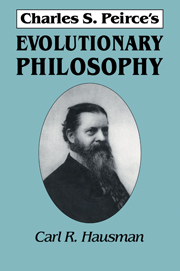
In this systematic introduction to the philosophy of Charles S. Peirce, the author focuses on four of Peirce's fundamental conceptions: pragmatism and Peirce's development of it into what he called 'pragmaticism'; his theory of signs; his phenomenology; and his theory that continuity is of prime importance for philosophy. He argues that at the centre of Peirce's philosophical project is a unique form of metaphysical realism, whereby continuity and evolutionary change are both necessary for our understanding of experience. In his final chapter Professor Hausman applies this version of realism to contemporary controversies between anti-realists and anti–idealists. Peirce's views are compared to those of such contemporary figures as Davidson, Putnam, and Rorty. The book will be of particular interest to philosophers concerned with American philosophy and current debates on realism as well as linguists working in semiotics.