To save content items to your account,
please confirm that you agree to abide by our usage policies.
If this is the first time you use this feature, you will be asked to authorise Cambridge Core to connect with your account.
Find out more about saving content to .
To save content items to your Kindle, first ensure no-reply@cambridge.org
is added to your Approved Personal Document E-mail List under your Personal Document Settings
on the Manage Your Content and Devices page of your Amazon account. Then enter the ‘name’ part
of your Kindle email address below.
Find out more about saving to your Kindle.
Note you can select to save to either the @free.kindle.com or @kindle.com variations.
‘@free.kindle.com’ emails are free but can only be saved to your device when it is connected to wi-fi.
‘@kindle.com’ emails can be delivered even when you are not connected to wi-fi, but note that service fees apply.
In Chapter 7, “Leading the Mind Back and Up to God: The Reduction of the Arts to Theology and the Itinerarium,” I compare the hierarchial ascent of the mind Bonaventure sets out in the Itinerarium with Bonaventure’s earlier attempt to show how all learning should lead back to God in the second of the two addresses he gave during his inception as regent master at the University of Paris, a text he revised shortly after becoming minister general which has come down to us as The Reduction of the Arts to Theology. A second benefit of making this comparison with Bonaventure’s earlier text is that it provides an example of how Bonaventure felt free to shift imagery in the middle of a text. In The Reduction of the Arts to Theology, he shifts from a structure based on four “lights” (below, above, inside, outside) to one based on the seven “days” of creation. Similarly, in the final two chapters of the Itinerarium, he stops using his original image of the six wings of the Seraph and shifts instead to using the imagery of the four wings of the Cherubim that surrounded the Ark of the Covenant.
In Chapter 10, I discuss the final three chapters of the Itinerarium (chapters 5, 6, and 7). The first two correspond to the third pair of the Seraph’s wings, those above his head, representing the vision of God we get looking “above” our minds to the transcendental properties “Being” (chapter 5) and “Goodness” (chapter 6). To make the contrasting points he wishes to make about the unity and Trinity of God, however, Bonaventure decides he must switch his imagery from the third pair of Seraph wings to the pair of wings on each of the two Cherubim that were said to surround the Ark of the Covenant in the Temple. After these two chapters, Bonaventure adds a short concluding chapter (chapter 7) that corresponds to the image of Christ crucified that St. Francis saw in center of the seraph’s wings. At this stage of the ascent, all intellectual effort must cease and those journeying who wish to ascend must simply rest in the mystery of God’s love.
Although, early on, Bonaventure associates the basic threefold division of the Itinerarium with a biblical thema verse from Psalm 85:11, the Itinerarium is more famous for its use of the image of the six wings of the Seraph angel St. Francis saw in a vision on Mt. Alverna as a structuring device. Incorporating visual imagery into a theological treatise was not uncommon in the Middle Ages. The Victorines were especially adept at the practice, and Bonaventure was clearly influenced by them. But the way Bonaventure used the parts of a visual image as a structuring device was new. It resembled the way a sermo modernus-style preacher would use the parts a thema verse as a structuring device. As I will show in Chapter 6, “Imagery as a Structuring Device,” this skill was something Bonaventure learned during his training in writing sermo modernus-style prologues at the University of Paris. I provide several examples, but most prominently, I describe how Bonaventure used visual imagery to structure the amazingly complex and beautiful prologue to his Commentary on the Sentences of Peter Lombard.
Since Bonaventure could not generate an entire treatise out of one Psalm verse, instead we find in each chapter of the Itinerarium a host of divisions and sub-divisions borrowed from earlier texts. Sometimes he borrowed divisions from his own earlier works, especially his Commentary on the Sentences of Peter Lombard. But in many cases, he borrowed divisions from other works, especially those of the Victorines and St. Augustine. In Chapter 3, “Where Did Bonaventure Get His Divisions?” I trace the sources of Bonaventure’s subsidiary divisions within each section of the Itinerarium and show how tracing these divisions back to their sources can help the reader better understand what Bonaventure is trying to accomplish. I give special attention to the sources of Bonaventure’s key distinction between “vestiges,” “images,” and “likenesses” of God and the distinction between “seeing through” and “seeing in.”
In Chapter 1, “Bonaventure, the Franciscans, and the Homiletic Revolution of the Thirteenth Century,” I provide some historical and cultural context of the Itinerarium. I argue for the cultural importance of what has been called the “homiletic revolution of the thirteenth century,” especially in the education of students in sacred doctrine at the University of Paris. Since learning to preach using the sermo modernus style was an important part of Bonaventure’s formation at Paris and it was a skill in which he had become proficient, he made creative use of it when he wrote the Itinerarium. Gaining a better understanding of the style, therefore, can help us better appreciate and understand Bonaventure’s text. I also make clear in this chapter why I believe Bonaventure is best understood as both a faithful Franciscan and a dedicated student of scholastic theology and that these two are not mutually exclusive in ways that are sometimes assumed. So, for example, the Itinerarium is both a profound work of Christian mysticism as well as a sophisticated expression of scholastic thought. Bonaventure shows that the two are not mutually exclusive.
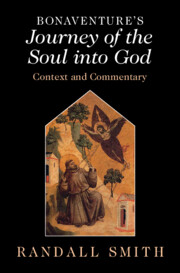
Saint Bonaventure's Journey of the Soul into God is one of the most important works in the Christian mystical tradition. Highly regarded for it clarity, rational organization, and subtle insights, it is also one of the key theological treatises of the high Middle Ages. In this volume, Randall Smith provides the first comprehensive commentary in English of Bonaventure's classic text. He situates the work within its historical, intellectual, and cultural contexts, showing how a consideration of Bonaventure's sources helps us appreciate his text. Smith also provides an extended analysis not only of the intellectual content of the Journey of the Soul into God, but also its structure and creative use of imagery. Analyzing how Bonaventure employed and adapted the methods of thirteenth century sermo modernus-style of preaching to produce a deftly condensed work, he demonstrates how his text is at once a profound work of mysticism as well as a sophisticated and thoughtful work of medieval theology.
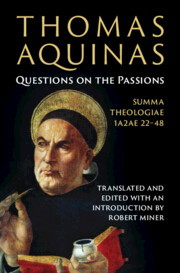
Thomas Aquinas's Questions on the passions form part of the Summa Theologiae, Aquinas's best-known work. This first standalone edition shows, through a translation that is both rigorously accurate and mirrors the rapid tempo of Aquinas's Latin, what Aquinas says in his landmark treatment of the passions. Aquinas sets the parameters and terms of debate for numerous later theorists of the passions, including Descartes, Hobbes, Spinoza and Hume. Some have alleged that Paul and later Christians have (in Nietzsche's words) “an evil eye for the passions,” judging them as 'dirty, disfiguring and heartbreaking'. Yet readers of the present translation will perceive that Aquinas regards the passions as part of created nature, and thereby good in their essence. As they encounter Aquinas's treatment, they will also deepen their knowledge of particular passions-including love, hatred, desire, aversion, pleasure, sorrow, hope, despair, fear, and anger.
One should next consider the passions of the soul in particular. And first, the passions of the Desiring Power; second, the passions of the Energizing Power. The first consideration will be threefold, for we will first consider love and hatred; second, desire (concupiscentia) and aversion; and third, pleasure and sorrow.
One should next consider the effects of pleasure. And about this point, four queries are raised. (1) Whether enlarging belongs to pleasure. (2) Whether pleasure causes thirst or longing for itself. (3) Whether pleasure hinders the use of reason. (4) Whether pleasure completes activity.
One should next consider fear, first, and daring, second. About fear, there are four points that should be considered. First, fear itself; second, its object; third, its cause; fourth, its effect.
About the first point, four queries are raised. (1) Whether fear is a passion of the soul. (2) Whether it is a specific passion. (3) Whether there is a natural fear. (4) On the species of fear.
One should next consider the goodness and evilness of pain or sorrow. And about this point, four queries are raised. (1) Whether every sorrow is evil. (2) Whether it can be a noble good (bonum honestum). (3) Whether it can be a useful good. (4) Whether the body’s pain is the height of evil.
One should next consider pain and sorrow. And about this matter, one should first consider sorrow or pain in itself; second, its causes; third, its effects; fourth, its remedies; fifth, its goodness or evilness.
About the first point, eight queries are raised. (1) Whether pain is a passion of the soul. (2) Whether sorrow is the same as pain. (3) Whether sorrow or pain is contrary to pleasure. (4) Whether every sorrow is contrary to every pleasure. (5) Whether there is a sorrow that is contrary to the pleasure of contemplation. (6) Whether sorrow is to be fled more than pleasure is to be desired. (7) Whether exterior pain is greater than interior pain. (8) On the species of sorrow.
One should next consider pleasure and sorrow. About pleasure, four points should be considered: first, pleasure in itself; second, the causes of pleasure; third, its effects; fourth, its goodness and evilness. About the first point, eight queries are raised. (1) Whether pleasure is a passion. (2) Whether it exists in time. (3) Whether it differs from joy. (4) Whether it is in the intellectual appetite. (5) On a comparison of pleasures of the higher appetite to the pleasure of the lower appetite. (6) On a comparison of sensible pleasures to one another. (7) Whether any pleasure is non-natural. (8) Whether pleasure can be contrary to pleasure.
One should next consider the effects of love. And about this six queries are raised. (1) Whether union is an effect of love. (2) Whether mutual indwelling is. (3) Whether ecstasy is an effect of love. (4) Whether zeal is. (5) Whether love is a passion that wounds the lover. (6) Whether love is the cause of everything that the lover does.