To save content items to your account,
please confirm that you agree to abide by our usage policies.
If this is the first time you use this feature, you will be asked to authorise Cambridge Core to connect with your account.
Find out more about saving content to .
To save content items to your Kindle, first ensure no-reply@cambridge.org
is added to your Approved Personal Document E-mail List under your Personal Document Settings
on the Manage Your Content and Devices page of your Amazon account. Then enter the ‘name’ part
of your Kindle email address below.
Find out more about saving to your Kindle.
Note you can select to save to either the @free.kindle.com or @kindle.com variations.
‘@free.kindle.com’ emails are free but can only be saved to your device when it is connected to wi-fi.
‘@kindle.com’ emails can be delivered even when you are not connected to wi-fi, but note that service fees apply.
In this text, Albert deals with Augustine’s theory of the image of the Trinity. An examination of this theory leads him to an investigation of the relation between the soul and its powers. Albert contends that the soul and its powers are distinct. He maintains that the soul’s powers are propria, that is, necessary accidents, and following Avicenna he claims that they “flow” from the essence of the soul. In this text, Albert also considers the identity theory, on which the soul and its powers are the same entity but rejects it because it “borders on heresy”. He argues that the identification of the soul and its powers is perilously close to the identification of essence and power in God. Finally, Albert invokes the Boethian notion of a “power-whole” (totum potentiale) to develop his own account of the soul and its powers and to make sense of the Augustinian claim that our rational soul is an image of the Trinity. Albert was one of the main defenders of the distinction theory in the second half of the thirteenth century, and his version of this theory influenced Aquinas.
In this text, Godfrey asks whether a created substance can be the immediate principle of its operation. ‘Power’ and ‘immediate principle of operation’ are synonymous terms here. Hence, the question that Godfrey raises is this: is a substance a power? Godfrey’s answer is nuanced. Like Albert and Aquinas, Godfrey adheres to the view that powers like sight and the intellect are propria or necessary accidents distinct from the soul. However, he openly rejects Aquinas’ Category Argument for the distinction theory because he finds Henry’s regress argument against the claim that a power must be in the same category as its act convincing. The regress argument also leads Godfrey to argue that there is, in addition to such powers as the intellect and sight, what we might call a higher-order power of the soul. This higher-order power is the soul’s power to bear such powers as the intellect and sight. Unlike the intellect and sight, this power to bear powers is identical to the soul, Godfrey thinks. Thus, Godfrey defends the Thomistic distinction theory; but he also makes a concession to Henry by arguing that the soul is at least one power through its essence, namely, a higher-order power.
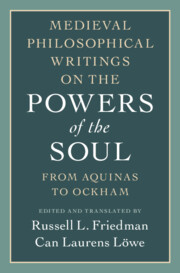
Philosophers of the thirteenth and fourteenth centuries held that organisms are alive by virtue of possessing a soul, and that the soul endows an organism with various powers. This volume presents a rich selection of key medieval Aristotelian texts on the relation between the soul and its powers, most of them previously untranslated and written by thinkers whose accounts of the soul and its powers are not well known. Each text can be seen as part of a lively medieval debate, responding to or criticizing another text also found in the volume. An introduction situates this debate in its broader medieval context, and the detailed explanatory notes and glossary of terms and arguments make the texts accessible to a wide range of readers including non-experts. The result is a valuable resource for understanding how Aristotle's theory of the soul and its powers was received and transformed in the Middle Ages.
In Chapter 9, I discuss the next two chapters of the Itinerarium (Chapters 3 and 4), those that correspond to the second pair of the Seraph’s wings, those around the angel’s body. These represent the vision of God we get from looking at the image we find of God “inside” us in our intellectual powers — those made possible by reason alone (such as memory, understanding, and will) and those infused by grace (such as faith, hope, and love). I show why these two chapters are the most complex and difficult in the entire book.
After a preacher had made his threefold, fourfold, sevenfold, or ninefold division in a sermo modernus-style sermon, he then had to “dilate” each member of the division. In most cases, the division was chosen precisely because of the content the preacher wished to produce. There were specific methods that the preaching manuals of the day contained to teach prospective preachers how they might develop (“dilate”) the divisions within their sermon. In Chapter 5, “Dilatatio: Methods of ‘Unfolding’ a Sermon,” I show how Bonaventure used some of the common methods of dilatiatio to expand the divisions he employs in the Itinerarium into the discursive content of his text.
On his journey to the Franciscan General Council in 1259, Bonaventure, having recently been elected minister general of the Order, stopped off to make a spiritual retreat on Mt. Alverna, the place where St. Francis had seen a vision of a six-winged Seraph with an image of the crucified Christ at its center from which he received the stigmata. It was here that Bonaventure was inspired to write a six-stage ascent of the mind into God, associating each stage of the ascent with one of the six wings of the Searph. By creatively adapting contemporary preaching techniques of the so-called “modern sermon” or sermo modernus style, Bonaventure was able to craft a work of which Bernard McGinn would say: “Perhaps no other treatise of comparable size in the history of Western mysticism packs so much into one seamless whole.” I also broach an issue that has divided commentators on Bonaventure’s leadership of the Franciscan Order since the moment he took office as minister general. In helping to foster the Franciscans presence at the University of Paris and other leading universities, did Bonaventure lead the Order in a direction contrary to the spirit of St. Francis?
In Chapter 4, “Bonaventure and the Nine Choirs of Angels,” I examine one of the most condensed discussions in Bonaventure’s text. In Itinerarium 4.4, Bonaventure says that our spirit must be “brought into conformity with the heavenly Jerusalem.” But “no one enters that city,” he adds, “unless that city has first descended into the person’s heart by means of grace.” How does that happen? Well, the heavenly Jerusalem “descends into the heart,” according to Bonaventure, when “our spirit is adorned with nine orderly levels” – levels that correspond, as it turns out, to the nine choirs of angels. In this section, Bonaventure takes two major traditions regarding the nine choirs of angels – one that can be traced to the Celestial Hierarchy of Pseudo-Dionysius the Areopagite and the other to a homily by Pope St. Gregory the Great – and condenses them into nine words and nine short phrases. This chapter shows how remarkably concise Bonaventure could be using the methods he had learned for preaching.
The goal of the previous chapter was to show how Bonaventure made creative use of the methods of sermo modernus-style preaching when he composed the Itinerarium. The goal of that analysis was to help the reader understand the Itinerarium more fully. What can seem like a confusing jumble upon a first reading will often be revealed upon reflection to be part of an intricately beautiful structure.
In order to reveal how Bonaventure employed these various methods in different places in the Itinerarium, it was necessary to skip around in Bonaventure’s text, showing one method in one chapter and another method in another one. This approach to the text did not permit me to provide a coherent view of the whole. So, in this second section, I endeavor to provide an overview of the Itinerarium, chapter by chapter, from beginning to end.
In Chapter 8, I discuss the Preface and the first two chapters of the Itinerarium that correspond to the first pair of wings of the Seraph, those around his feet, representing the vision of God we get from looking at his vestiges “outside” in the visible realm.
In sermo modernus-style sermons, the structure was based on what was usually a threefold or fourfold divisio of an opening thema verse. This primary division was usually subject to further sub-divisions. In the Itinerarium, Bonaventure associates the basic threefold structure of the work — seeing “outside,” seeing “inside,” and seeing “above” — with the divisions of the verse from Job 85:11: “Lead me, O Lord, in your way / so that I might enter into your truth. / Let my heart rejoice that it may be in awe of your name.” To be led in the way of the Lord, says Bonaventure, is to “move through the vestiges which are bodily and temporal outside us.” To enter into the truth of God is to “enter into our mind which is the image of God.” And to rejoice in the knowledge of God and stand in awe of His name is to “pass beyond to that which is … above us by raising our eyes to the First Principle.” In Chapter 2, “Recognizing Divisions as the Framework of the Text,” I show how identifying the divisiones within each chapter helps to make the structure, content, and arguments of the Itinerarium clearer.