To save content items to your account,
please confirm that you agree to abide by our usage policies.
If this is the first time you use this feature, you will be asked to authorise Cambridge Core to connect with your account.
Find out more about saving content to .
To save content items to your Kindle, first ensure no-reply@cambridge.org
is added to your Approved Personal Document E-mail List under your Personal Document Settings
on the Manage Your Content and Devices page of your Amazon account. Then enter the ‘name’ part
of your Kindle email address below.
Find out more about saving to your Kindle.
Note you can select to save to either the @free.kindle.com or @kindle.com variations.
‘@free.kindle.com’ emails are free but can only be saved to your device when it is connected to wi-fi.
‘@kindle.com’ emails can be delivered even when you are not connected to wi-fi, but note that service fees apply.
On the Duty of Man and Citizen (1673) is Pufendorf's succinct and condensed presentation of the natural law political theory he developed in his monumental classic On the Law of Nature and Nations (1672). His theory was the most influential natural law philosophy of the seventeenth- and eighteenth-centuries. He advanced a compelling reply to Grotius and Hobbes, and in doing so, set the intellectual problems for theorists such as Locke, Hutcheson, Hume, Rousseau, and Smith. In the aftermath of the Thirty Years' War, Pufendorf sets forth a classic justification of the early modern enlightened state and of the proper relations of moral and political subjection to it. This lucid and historically sensitive translation by Michael Silverthorne, (a classicist and a specialist in Roman Law and early modern political thought) is the first since the early twentieth century. James Tully's introduction sets the text in its seventeenth-century context, summarises the main arguments, surveys recent literature on Pufendorf, and shows how Pufendorf transformed natural law theory into an independent discipline of juristic political philosophy which dominated reflection on politics until Kant.
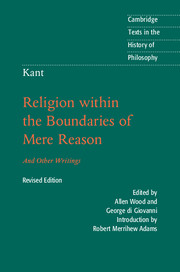
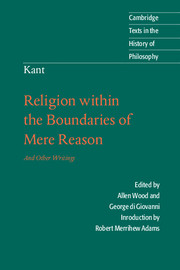
Religion within the Boundaries of Mere Reason is a key element of the system of philosophy which Kant introduced with his Critique of Pure Reason, and a work of major importance in the history of Western religious thought. It represents a great philosopher's attempt to spell out the form and content of a type of religion that would be grounded in moral reason and would meet the needs of ethical life. It includes sharply critical and boldly constructive discussions on topics not often treated by philosophers, including such traditional theological concepts as original sin and the salvation or 'justification' of a sinner, and the idea of the proper role of a church. This new edition includes slightly revised translations, a revised introduction with expanded discussion of certain key themes in the work, and up-to-date guidance on further reading.
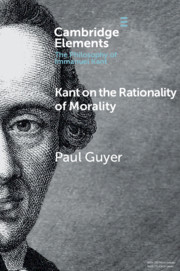
Kant claims that the fundamental principle of morality is given by pure reason itself. Many have interpreted Kant to derive this principle from a conception of pure practical reason (as opposed to merely prudential reasoning about the most effective means to empirically given ends). But Kant maintained that there is only one faculty of reason, although with both theoretical and practical applications. This Element shows how Kant attempted to derive the fundamental principle and goal of morality from the general principles of reason as such, defined by the principles of non-contradiction and sufficient reason and the ideal of systematicity.
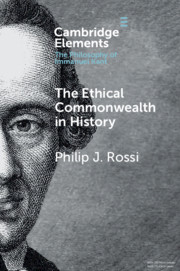
The 'ethical commonwealth', the central social element in Kant's account of religion, provides the church, as 'the moral people of God', with a role in establishing a cosmopolitan order of peace. This role functions within an interpretive realignment of Kant's critical project that articulates its central concern as anthropological: critically disciplined reason enables humanity to enact peacemaking as its moral vocation in history. Within this context, politics and religion are not peripheral elements in the critical project. They are, instead, complementary social modalities in which humanity enacts its moral vocation to bring lasting peace among all peoples.
Religion within the Boundaries of Mere Reason is a key element of the system of philosophy which Kant introduced with his Critique of Pure Reason, and a work of major importance in the history of Western religious thought. It represents a great philosopher's attempt to spell out the form and content of a type of religion that would be grounded in moral reason and would meet the needs of ethical life. It includes sharply critical and boldly constructive discussions on topics not often treated by philosophers, including such traditional theological concepts as original sin and the salvation or 'justification' of a sinner, and the idea of the proper role of a church. This volume presents it and three short essays that illuminate it in new translations by Allen Wood and George di Giovanni, with an introduction by Robert Merrihew Adams that locates it in its historical and philosophical context.
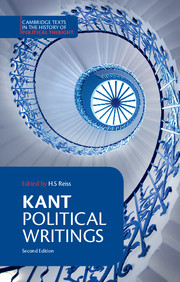
The original edition of Kant: Political Writings was first published in 1970, and has long been established as the principal English-language edition of this important body of writing. In this new, expanded edition, two important texts illustrating Kants's view of history are included for the first time: his reviews of Herder's Ideas on the Philosophy of The History of Mankind and Conjectures on the Beginning of Human History; as well as the essay What is Orientation in Thinking. In addition to a general introduction assessing Kant's political thought in terms of his fundamental principles of politics, this edition also contains such useful student aids as notes on the texts, a comprehensive bibliography, and a new postscript, looking at some of the principal issues in Kantian scholarship that have arisen since first publication.
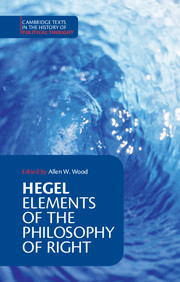
This book is a translation of a classic work of modern social and political thought, Elements of the Philosophy of Right. Hegel's last major published work, is an attempt to systematize ethical theory, natural right, the philosophy of law, political theory and the sociology of the modern state into the framework of Hegel's philosophy of history. Hegel's work has been interpreted in radically different ways, influencing many political movements from far right to far left, and is widely perceived as central to the communication tradition in modern ethical, social and political thought. This edition includes extensive editorial material informing the reader of the historical background of Hegel's text, and explaining his allusions to Roman law and other sources, making use of lecture materials which have only recently become available. The new translation is literal, readable and consistent, and will be informative and scholarly enough to serve the needs of students and specialists alike.
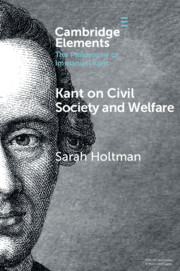
What justifies state-sponsored supports for individual welfare within a Kantian political system, as well as the purpose and extent of such supports and the form they may take, are vexed questions. This Element characterizes and assesses main contenders (including minimalist and middle-ground accounts) by examining the competing interpretations of Kant's larger political theory that found their social welfare claims. It then develops and defends an alternative based in civic respect. This emphasizes the perspective and institutional commitments that Kant's model of citizenship entails and what is required to respect each as both a person and a participant in joint governance.
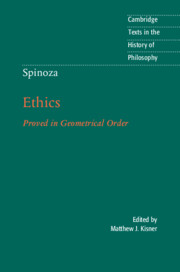
Spinoza's Ethics is one of the most significant texts of the early modern period, important to history, philosophy, Jewish studies and religious studies. It had a major influence on Enlightenment thinkers and the development of the modern world. In Ethics, Spinoza addresses the most fundamental perennial philosophical questions concerning the nature of God, human beings and a good life. His startling answers synthesize the longstanding traditions of ancient Greek and Jewish philosophy with the developments of the emerging scientific revolution. The resulting philosophical system casts out the willing, personal God of Abrahamic religions and takes up the challenge of reconceiving the natural world and human beings in an entirely secular way. This volume offers a new translation based on a new critical edition, reflecting the state of the art in Spinoza scholarship, and also includes an introduction, chronology and glossary to help make this notoriously difficult text accessible.