To save content items to your account,
please confirm that you agree to abide by our usage policies.
If this is the first time you use this feature, you will be asked to authorise Cambridge Core to connect with your account.
Find out more about saving content to .
To save content items to your Kindle, first ensure no-reply@cambridge.org
is added to your Approved Personal Document E-mail List under your Personal Document Settings
on the Manage Your Content and Devices page of your Amazon account. Then enter the ‘name’ part
of your Kindle email address below.
Find out more about saving to your Kindle.
Note you can select to save to either the @free.kindle.com or @kindle.com variations.
‘@free.kindle.com’ emails are free but can only be saved to your device when it is connected to wi-fi.
‘@kindle.com’ emails can be delivered even when you are not connected to wi-fi, but note that service fees apply.
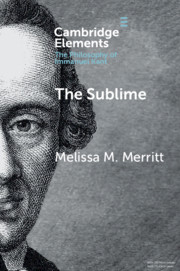
This Element considers Kant's account of the sublime in the context of his predecessors both in the Anglophone and German rationalist traditions. Since Kant says with evident endorsement that 'we call sublime that which is absolutely great' (Critique of the Power of Judgment, 5:248) and nothing in nature can in fact be absolutely great (it can only figure as such, in certain presentations), Kant concludes that strictly speaking what is sublime can only be the human calling (Bestimmung) to perfect our rational capacity according to the standard of virtue that is thought through the moral law. The Element takes account of the difference between respect and admiration as the two main varieties of sublime feeling, and concludes by considering the role of Stoicism in Kant's account of the sublime, particularly through the channel of Seneca.
This new edition of Aristotle's Nicomachean Ethics is an accurate, readable and accessible translation of one of the world's greatest ethical works. Based on lectures Aristotle gave in Athens in the fourth century BCE, Nicomachean Ethics is one of the most significant works in moral philosophy, and has profoundly influenced the whole course of subsequent philosophical endeavour. It offers seminal, practically oriented discussions of many central ethical issues, including the role of luck in human well-being, moral education, responsibility, courage, justice, moral weakness, friendship and pleasure, with an emphasis on the exercise of virtue as the key to human happiness. This second edition offers an updated editor's introduction and suggestions for further reading, and incorporates the line numbers as well as the page numbers of the Greek text. With its emphasis on accuracy and readability, it will enable readers without Greek to come as close as possible to Aristotle's work.
Volumes I and II provide a completely new translation of the philosophical works of Descartes, based on the best available Latin and French texts. Volume III contains 207 of Descartes' letters, over half of which have not been translated into English before. It incorporates, in its entirety, Anthony Kenny's celebrated translation of selected philosophical letters, first published in 1970. In conjunction with Volumes I and II it is designed to meet the widespread demand for a comprehensive, accurate and authoritative edition of Descartes' philosophical writings in clear and readable modern English.
This remarkable collection of almost 1,400 aphorisms was originally published in three instalments. The first (now Volume I) appeared in 1878, just before Nietzsche abandoned academic life, with a first supplement entitled The Assorted Opinions and Maxims following in 1879, and a second entitled The Wanderer and his Shadow a year later. In 1886 Nietzsche republished them together in a two-volume edition, with new prefaces to each volume. Both volumes are presented here in R. J. Hollingdale's distinguished translation (originally published in the series Cambridge Texts in German Philosophy) with a new introduction by Richard Schacht. In this wide-ranging work Nietzsche first employed his celebrated aphoristic style, so perfectly suited to his iconoclastic, penetrating and multi-faceted thought. Many themes of his later work make their initial appearance here, expressed with unforgettable liveliness and subtlety. Human, All Too Human well deserves its subtitle 'A Book for Free Spirits', and its original dedication to Voltaire, whose project of radical enlightenment here found a new champion.
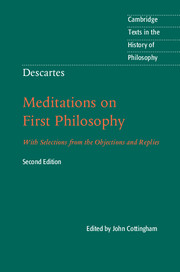
Descartes's Meditations on First Philosophy remains one of the most widely studied works of Western philosophy. This volume is a refreshed and updated edition of John Cottingham's bestselling 1996 edition, based on his translation in the acclaimed three-volume Cambridge edition of The Philosophical Writings of Descartes. It presents the complete text of Descartes's central metaphysical masterpiece, the Meditations, in clear, readable modern English, and it offers the reader additional material in a thematic abridgement of the Objections and Replies, providing a deeper understanding of how Descartes developed and clarified his arguments in response to critics. Cottingham also provides an updated introduction, together with a substantially revised bibliography, taking into account recent literature and developments in Descartes studies. The volume will be a vital resource for students reading the Meditations, as well as those studying Descartes and early modern philosophy.
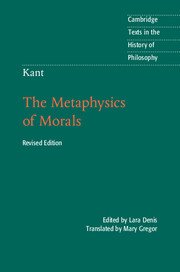
The Metaphysics of Morals is Kant's final major work in moral philosophy. In it, he presents the basic concepts and principles of right and virtue and the system of duties of human beings as such. The work comprises two parts: the Doctrine of Right concerns outer freedom and the rights of human beings against one another; the Doctrine of Virtue concerns inner freedom and the ethical duties of human beings to themselves and others. Mary Gregor's translation, lightly revised for this edition, is the only complete translation of the entire text, and includes extensive annotation on Kant's difficult and sometimes unfamiliar vocabulary. This edition includes numerous new footnotes, some of which address controversial aspects of Gregor's translation or offer alternatives. Lara Denis's introduction sets the work in context, explains its structure and themes, and introduces important interpretive debates. The volume also provides thorough guidance on further reading including online resources.
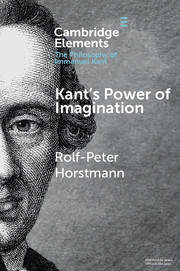
This Element is a study of how the power of imagination is, according to Kant, supposed to contribute to cognition. It is meant to be an immanent and a reconstructive endeavor, relying solely on Kant's own resources when he tries to determine what material, faculties, and operations are necessary for cognition of objects. The main discourse is divided into two sections. The first deals with Kant's views concerning the power of imagination as outlined in the A- and B- edition of the Critique of Pure Reason. The second focuses on the power of imagination in the first part of the Critique of Judgment.
The form of our self-consciousness is not space but only time: this is why our thinking does not, like our intuition, occur in three dimensions, but only in one, and thus in a line without breadth or depth. This gives rise to the greatest of the fundamental imperfections of our intellect. Namely, we can have cognition of things only successively and can be conscious only of one thing at a time, and in fact this one thing only under the condition that we forget everything else in the meantime, that is, have no consciousness of anything else, so that nothing else exists for us during this time. In this respect, our intellect can be compared to a telescope with a very narrow field of vision, because our consciousness is not lasting but transient. The intellect apprehends things only successively and must leave one thing behind in order to grasp another, retaining only ever fainter traces of what is left behind. The thought that engages me keenly now will necessarily have entirely slipped my mind in a little while: and if I get a good night's sleep in between, then I might never find it again unless I have some personal interest in it, i.e. it is connected to my will, which always carries the day.
This imperfection of the intellect is the basis for the rhapsodic and often fragmentary character of our train of thought, which I already mentioned at the end of the previous chapter, and gives rise to the inevitable scattering of our thoughts. Sometimes external sense impressions disturb and interrupt our thinking and keep forcing complete irrelevancies upon it, and sometimes one idea will bring in another through the ties of association and be displaced by it; and finally, sometimes the intellect itself will not be able to sustain one single idea for very long, but be rather like the eyes when, after staring for a long time at a single object, they no longer see it very clearly since the edges run together and become confused and everything finally becomes obscure – similarly, when constantly pondering a single topic for a long period of time, thinking gradually becomes confused and blunted and ends up completely stupefied.
In Chapter 7 I showed that, in the theoretical realm, starting from concepts leads to mediocre achievements, while superior achievements are drawn from intuition itself, as the well-spring of all cognition. But it is the other way around in the practical realm: here being determined by intuition is the way of animals, and this is unworthy of human beings whose actions are guided by concepts and who are thereby emancipated from the power of what lies before them in the intuitive present, the very present that has unconditional control over animals. A human being's actions can be called rational to the extent that he exercises this privilege, and it is only in this sense that we can we speak of practical reason, not in the Kantian sense, the untenability of which I discussed at length in the prize essay On the Basis of Morals.
However, it is not easy to be determined by concepts alone: the external world, as it lies before us with its intuitive reality, will intrude forcefully on even the strongest mind. But the human spirit shows its dignity and greatness precisely in vanquishing this impression, in negating its mocking illusion. So when someone's spirit is unmoved by the charms of pleasure and enjoyment, untouched by the threats and furies of enraged enemies, when his resolve is unshaken by the entreaties of misguided friends or the illusions surrounding him as a result of agreed-upon schemes, when his self-command is not shattered by the spite of fools and the masses so that he misjudges his own value – then he seems to stand under the influence of a spiritual world (it is the spiritual world of concepts) visible to himself alone, and that intuitive present that is open to everyone flees like a phantom before it. – On the other hand, what gives the external world and visible reality its great power over the mind is its proximity and immediacy. We can think of the needle of the compass that maintains its direction throughout the united effect of widely distributed natural forces across the entire earth, and yet can be disturbed and made to sway wildly by a tiny piece of iron that happens to come too close;
If the will to life presented itself merely as a drive for self-preservation, it would be only an affirmation of the individual appearance for the span of its natural duration. The worries and cares of such a life would not be great, and so existence would prove easy and cheerful. On the other hand, because the will wills life absolutely and for all time, it presents itself at the same time as the sex drive, which has an endless series of generations in view. This drive abolishes the carefree attitude, the cheerfulness and innocence that would accompany a merely individual existence by bringing disquiet and melancholy into consciousness, and misfortune, trouble and misery into the course of a life. – If however it is voluntarily repressed, as we see in rare exceptions, then this is the turninga of the will, which reverses itself. It then goes out in the individual, instead of going beyond him. But this can only take place through a painful violence that the individual inflicts on himself. But if it does happen, then the consciousness recoups that carefree cheerfulness of the merely individual existence and, indeed, is raised to a higher power. – On the other hand, when that most vehement of all drives and desires is satisfied, then a new being comes into existence, and thus a continuation of life with all its burdens, cares, needs and pains, admittedly in another individual – but, if the two who are distinct in appearance were distinct absolutely and in themselves, then where would eternal justice be? – Life presents itself as a task, a lesson to be worked out, and thus typically as a constant struggle against need. This is why everyone tries to get through it as well as he can: he gets through life like bonded labour to pay off a debt. But who has contracted this debt? – The one who begot him, in the enjoyment of sensuous pleasure. And so, for the pleasure of the one, the other must live, suffer, and die. We know and should recall in this context that space and time are the condition under which similar things are differentiated, a condition that I have in this sense termed the principle of individuation.
Not only philosophy but also the fine arts work at a fundamental level towards a solution to the problem of existence. In every mind that has ever devoted itself to the pure contemplation of the world there stirs a striving, however hidden and unconscious it may be, to grasp the true essence of things, of life, of existence. For this alone is of interest to the intellect as such, i.e. to the subject of cognition freed from the goals of the will and hence pure; in just the same way, the goals of the will are the only things of interest to the subject that cognizes as a mere individual. – This is why the result of every purely objective, and therefore every artistic grasp of things is one more expression of the essence of life and existence, one more answer to the question: ‘what is life?’ – Every true and successful work of art answers this question in its own way, with complete calm. But the arts speak only in the naïve and childish language of intuition, not in the abstract and serious language of reflection: their answer is therefore a fleeting image: not a lasting, universal cognition. And thus every artwork answers that question for intuition, every painting, every statue, every poem, every scene on stage: even music answers it; and in fact more profoundly than all the others since it expresses the innermost essence of life and existence in a language that is directly comprehensible even though it cannot be translated into the language of reason. All the other arts hold an intuitive image before the questioner and say: ‘look here, this is life!’ – Their answer, as correct as it might be, still only ever grants a temporary, not a total and final, satisfaction. Because they only ever offer a fragment, an example, instead of the rule, not the whole, which can only be given in the universality of the concept. To give a permanent and eternally satisfying answer to that question in the abstract, for the concept, and hence for reflection – this is the task of philosophy.
Now there is a large gap in these supplements because I already dealt with morality in the narrower sense in the two prize essays published under the title The Two Fundamental Problems of Ethics, and, as I have already mentioned, I am assuming that the reader is familiar with these essays so as to avoid needless repetition. Thus what remains to be presented is simply a small epilogue of isolated remarks that could not be articulated in the earlier essays, where the principal theme of the contents was prescribed by the Academies; least of all was I able to include any remarks that would require any standpoint higher than the one shared by all, and so this is where I was forced to remain. Thus it will not surprise the reader to find these remarks in a very fragmentary arrangement. These in turn are continued in the eighth and ninth chapters of the Second Volume of the Parerga. –
That moral investigations are incomparably more important than physical ones, indeed than all others, follows from the fact they concern the thing in itself almost directly, that is, they concern the appearance in which, immediately touched by the light of cognition, the thing in itself reveals its essence as will. Physical truths on the other hand remain entirely within the purview of representation, i.e. of appearance, and show merely how the lowest appearances of the will present themselves in representation in a lawful manner. – Further, the results gathered from considering the world from the physical side will offer us no solace, however broadly and cheerfully such an investigation is pursued: solace comes from the moral side alone, since here the depths of our own inner being come into consideration.
My philosophy is however the only one that grants morality its full and complete rights: for a human being's deeds really only belong to and are attributable to him if his essence is his own will, which makes him, in the strictest sense, his own work. On the other hand, as soon as he has a different origin or is the work of a being other than himself, all of his guilt falls back onto this origin or author. Because ‘acting follows from being’.