To save content items to your account,
please confirm that you agree to abide by our usage policies.
If this is the first time you use this feature, you will be asked to authorise Cambridge Core to connect with your account.
Find out more about saving content to .
To save content items to your Kindle, first ensure no-reply@cambridge.org
is added to your Approved Personal Document E-mail List under your Personal Document Settings
on the Manage Your Content and Devices page of your Amazon account. Then enter the ‘name’ part
of your Kindle email address below.
Find out more about saving to your Kindle.
Note you can select to save to either the @free.kindle.com or @kindle.com variations.
‘@free.kindle.com’ emails are free but can only be saved to your device when it is connected to wi-fi.
‘@kindle.com’ emails can be delivered even when you are not connected to wi-fi, but note that service fees apply.
Practical principles are propositions that contain a general determination of the will, having under it several practical rules. They are subjective, or maxims, when the condition is regarded by the subject as holding only for his will; but they are objective, or practical laws, when the condition is cognized as objective, that is, as holding for the will of every rational being.
Remark
If it is assumed that pure reason can contain within itself a practical ground, that is, one sufficient to determine the will, then there are practical laws; otherwise all practical principles will be mere maxims. Within a pathologically affected will of a rational being there can be found a conflict of maxims with the practical laws cognized by himself. For example, someone can make it his maxim to let no insult pass unavenged and yet at the same time see that this is no practical law but only his maxim – that, on the contrary, as being in one and the same maxim a rule for the will of every rational being it could not harmonize with itself. In cognition of nature the principles of what happens (e.g., the principle of equality of action and reaction in the communication of motion) are at the same time laws of nature; for there the use of reason is theoretical and determined by the constitution of the object. In practical 5:20cognition – that is, cognition having to do only with determining grounds of the will – the principles that one makes for oneself are not yet laws to which one is unavoidably subject, because reason, in the practical, has to do with the subject, namely with his faculty of desire, to whose special constitution the rule can variously conform. A practical rule is always a product of reason because it prescribes action as a means to an effect, which is its purpose. But for a being in whom reason quite alone is not the determining ground of the will, this rule is an imperative, that is, a rule indicated by an “ought,” which expresses objective necessitation to the action and signifies that if reason completely determined the will the action would without fail take place in accordance with this rule.
Why this Critique is not entitled a Critique of Pure Practical Reason but simply a Critique of Practical Reason generally, although its parallelism with the speculative seems to require the first, is sufficiently explained in this treatise. It has merely to show that there is pure practical reason, and for this purpose it criticizes reason’s entire practical faculty. If it succeeds in this it has no need to criticize the pure faculty itself in order to see whether reason is merely making a claim in which it presumptuously oversteps itself (as does happen with speculative reason). For, if as pure reason it is really practical, it proves its reality and that of its concepts by what it does and all subtle reasoning against the possibility of its being practical is futile.
With this faculty transcendental freedom is also established, taken indeed in that absolute sense in which speculative reason needed it, in its use of the concept of causality, in order to rescue itself from the antinomy into which it unavoidably falls when it wants to think the unconditioned in the series of causal connection; this concept, however, it could put forward only problematically, as not impossible to think, without assuring it objective reality, and only lest the supposed impossibility of what it must at least allow to be thinkable call its being into question and plunge it into an abyss of skepticism.
The theoretical use of reason was concerned with objects of the cognitive faculty only, and a critique of it with regard to this use really dealt only with the pure cognitive faculty, since this raised the suspicion, which was afterwards confirmed, that it might easily lose itself beyond its boundaries, among unattainable objects or even among contradictory concepts. It is quite different with the practical use of reason. In this, reason is concerned with the determining grounds of the will, which is a faculty either of producing objects corresponding to representations or of determining itself to effect such objects (whether the physical power is sufficient or not), that is, of determining its causality. For, in that, reason can at least suffice to determine the will and always has objective reality insofar as volition alone is at issue. The first question here, then, is whether pure reason of itself alone suffices to determine the will or whether it can be a determining ground of the will only as empirically conditioned. Now there enters here a concept of causality justified by the Critique of Pure Reason although not capable of being presented empirically, namely that of freedom; and if we can now discover grounds for proving that this property does in fact belong to the human will (and so to the will of all rational beings as well), then it will not only be shown that pure reason can be practical but that it alone, and not reason empirically limited, is unconditionally practical. Consequendy, we shall not have to do a critique of pure practical reason but only of practical reason as such. For, pure reason, 5:16once it is shown to exist, needs no critique. It is pure reason that itself contains the standard for the critical examination of every use of it. It is therefore incumbent upon the Critique of Practical Reason as such to prevent empirically conditioned reason from presuming that it, alone and exclusively, furnishes the determining ground of the will. If it is proved that there is pure reason, its use is alone immanent; the empirically conditioned use, which lays claim to absolute rule is on the contrary transcendent and expresses itself in demands and commands that go quite beyond its sphere – precisely the opposite relation from what could be said of pure reason in its speculative use.
The Critique of Practical Reason, published in 1788, is the second of Kant’s three Critiques, falling between the Critique of Pure Reason (first edition: 1781, second edition: 1787) and the Critique of Judgment (1790). It is also the second of his three major works devoted to moral theory, along with the Groundwork of the Metaphysics of Morals (1785) and the Metaphysics of Morals (1797). These works develop an account of morality that reacts to those found in both the empiricist and the rationalist traditions, and together they constitute Kant’s lasting contribution to moral theory.
Certain remarks in the Groundwork suggest that Kant did not originally plan a separate critique of practical reason. He notes that although a critique of practical reason is the only foundation for a metaphysics of morals (i.e. a systematic classification of human duties on a priori grounds), the need for critique is less pressing in the case of practical reason than it is for speculative reason, and that an outline of such a critique would suffice for his purposes. In moral thought, ordinary reason is more easily brought “to a high degree of correctness and precision” in that authoritative practical principles are revealed through the workings of ordinary moral consciousness, while in its “pure but theoretical use, reason is wholly dialectical,” tending to make illusory and illegitimate metaphysical claims. Furthermore, executing a critique of practical reason would introduce complexities not absolutely necessary to a presentation of the basic principle of duty [G 4: 391]. The idea of writing a separate critique of practical reason appears to have occurred to Kant while he was revising the Critique of Pure Reason for its second edition.
Pure reason always has its dialectic, whether it is considered in its speculative or in its practical use; for it requires the absolute totality of conditions for a given conditioned, and this can be found only in things in themselves. Since, however, all concepts of things must be referred to intuitions which, for us human beings cannot be other than sensible and hence do not let objects be cognized as things in themselves but only as appearances, in whose series of the conditioned and conditions the unconditioned can never be found, an unavoidable illusion arises from the application of this rational idea of the totality of conditions (and so of the unconditioned) to appearances as if they were things in themselves (for, in the absence of a warning critique they are always held to be such), an illusion which, however, would never be noticed as deceptive if it were not revealed by a conflict of reason with itself in the application to appearance of its basic principle of presupposing the unconditioned for everything conditioned. By this, however, reason is forced to investigate this illusion – whence it arises and how it can be removed – and this can be done only through a complete critical examination of the whole pure faculty of reason; thus the antinomy of pure reason, which becomes evident in its dialectic, is in fact the most beneficial error into which human reason could ever have fallen, inasmuch as it finally drives us to search for the key to escape from this labyrinth; and when this key is found, it further discovers what we did not seek and yet need, namely a view into a higher, immutable order of things in which we already are and in which we can henceforth be directed, by determinate precepts, to carry on our existence in accordance with the highest vocation of reason.
The doctrine of the method of pure practical reason cannot be understood as the 5:151way to proceed (in reflection as well as in exposition) with pure practical principles with a view to scientific cognition of them, which alone is properly called method elsewhere, in the theoretical (for popular cognition needs a manner but science a method, i.e., a procedure in accordance with principles of reason by which alone the manifold of a cognition can become a system). Here the doctrine of method is understood, instead, as the way in which one can provide the laws of pure practical reason with access to the human mind and influence on its maxims, that is, the way in which one can make objectively practical reason subjectively practical as well.
It is now clear that those determining grounds of the will which alone make maxims properly moral and give them a moral worth – the immediate representation of the law and the objectively necessary observance of it as duty – must be represented as the proper incentives to action, since otherwise legality of actions would be produced but not morality of dispositions. But it is not so clear, and on the contrary must at first glance seem to everyone quite improbable, that even subjectively that presentation of pure virtue can have more power over the human mind and can provide a far stronger incentive to effect even that legality of actions and to bring forth stronger resolutions to prefer the law to every other consideration, from pure respect for it, than all the deceptive allurement of enjoyment and, in general, everything that may be counted as happiness, or even all threats of pain and troubles can produce.
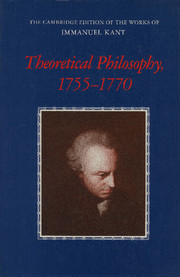
This is the first volume of the first ever comprehensive edition of the works of Immanuel Kant in English translation. The eleven essays in this volume constitute Kant's theoretical, pre-critical philosophical writings from 1755 to 1770. Several of these pieces have never been translated into English before; others have long been unavailable in English. We can trace in these works the development of Kant's thought to the eventual emergence in 1770 of the two chief tenets of his mature philosophy: the subjectivity of space and time, and the phenomena-noumena distinction. The volume has been furnished with substantial editorial apparatus, including a general introduction to the main themes of Kant's early thought, introduction to the individual works and résumés of their contents, linguistic and factual notes, bibliographies, a glossary of key terms, and biographical-bibliographical sketches of persons mentioned by Kant.