To save content items to your account,
please confirm that you agree to abide by our usage policies.
If this is the first time you use this feature, you will be asked to authorise Cambridge Core to connect with your account.
Find out more about saving content to .
To save content items to your Kindle, first ensure no-reply@cambridge.org
is added to your Approved Personal Document E-mail List under your Personal Document Settings
on the Manage Your Content and Devices page of your Amazon account. Then enter the ‘name’ part
of your Kindle email address below.
Find out more about saving to your Kindle.
Note you can select to save to either the @free.kindle.com or @kindle.com variations.
‘@free.kindle.com’ emails are free but can only be saved to your device when it is connected to wi-fi.
‘@kindle.com’ emails can be delivered even when you are not connected to wi-fi, but note that service fees apply.
During the very last year of what he himself described “as the best [eighteen] years of his life” spent at the University of Padua, Galileo first observed the heavens with a telescope. In order to appreciate the marvel and the true significance of those observations we must appreciate both the intellectual climate in Europe and the critical intellectual period through which Galileo himself was passing at the time those observations were made. Through his studies on motion Galileo had come to have serious doubts about the Aristotelian concept of nature. What he sensed was lacking was a true physics. He was very acute, therefore, when he came to sense the significance of his observations of the moon, of the phases of Venus, of the moons of Jupiter and of the Milky Way. The preconceptions of the Aristotelians were crumbling before his eyes. He had remained silent long enough, over a three month period, in his contemplations of the heavens. It was time to organize his thoughts and tell what he had seen and what he thought it meant. It was time to publish! In so doing he would become one of the pioneers of modern science. For the first time in over 2,000 years new significant observational data had been put at the disposition of anyone who cared to think, not in abstract preconceptions but in obedience to what the universe had to say about itself.
Let me first express my warmest acknowledgements to Cesare Barbieri for having taken the initiative of convening this symposium. These two days offered a unique opportunity to celebrate the scientific achievements and the legacy of Galileo Galilei. It allowed not only celebrating the scientist but also the philosopher and the human being. It was a fantastic journey in the past, present and future exploration of our universe and a fantastic retrospection into the Renaissance world which no better city than Padova would be able to offer. During these two days we could listen to a well balanced and well prepared set of excellent papers and presentations. All participants should be congratulated for their very active interactions during the discussions in the aula and also during coffee and lunch breaks.
In the first part of this paper we briefly discuss some historical constraints useful for understanding when Galileo for the first time aimed his telescope to the Moon which most probably was the first astronomical object observed by the Scientist. In the second part we discuss the dates of the observations on which the etchings, published in the Sidereus Nuncius, are based. It results that the five etchings refer to observations performed in December 1609 and January 1610. The measurement of the position, of some peculiar structures of the lunar surface clearly represented by Galileo in the etchings, shows that he was very careful in trying to produce a faithful graphical rendering of what he was observing.
The review contains the most recent data on near-Earth objects such as their sizes and densities, rotation and shapes, taxonomy and mineralogy, optical properties and structure of their surfaces, binary systems among the NEOs and internal structure of asteroids and comets constituted the NEO population.
By the beginning of 2010 the total number of natural satellites and multiple systems in the Solar System was equal to 350, including: 168 satellites of large planets, 119 multiple asteroids (including main-belt and near-Earth asteroids, Mars-crossers and Jupiter Trojan asteroids) and 63 multiple transneptunian and Kuiper-belt objects. Meanwhile, we cannot count precisely how many moons in total have been discovered to date due to the deficiency of accepted definitions.
We present the various activities and infrastructure dedicated to educational scientific and technological outreach of the MCT/Laboratório Nacional de Astrofísica, Brazil and how useful they are in diminishing the scientific illiteracy of the layman, the young, the senior citizens and the handicapped. We also explore the future endeavors and commitments that scientists and educators are to face in order to bring enlightenment.
Recent studies have demonstrated the benefits of using electrodynamic tethers (EDT) for the exploration of the inner region of the Jovian system. Intense planetary magnetic field and reasonable environmental plasma density make the electrodynamic interaction of the conductive tether with the plasmasphere strong. The interaction is responsible for a Lorentz force that can be conveniently used for propellantless maneuvers and extraction of electrical power for on board use. Jupiter and the four Galilean Moons represent an exceptional gravitational environment for the study of the orbital dynamics of an EDT. The dynamics of such a system was analyzed using a 3-body model, consisting of the planet plus one of its moons (Io in this work) and the EDT itself. New and interesting features appear, like for example the possibility to place the tether in equilibrium with respect to a frame co-rotating with the moon at points that do not coincide with the classical Lagrangian points for non-null electrodynamic forces.
The discovery of Io and her fellow Medicean Stars clearly altered the course of science as a whole. It is equally clear that the discovery of Io's tidal heating has altered the course of planetary science. One of the most directly observable consequences of Io's tidal heating is the prodigious escape of a ton per second of volcanically-supplied gases. I will review how studies of Io's escaping atmosphere since 1972 have advanced our deep understanding of Io itself, and helped formulate our perspective on planetary evolution in our solar system and beyond.
A comparison of the Jovian and Saturnian rings is made by reviewing the recent advances in planetary spacecraft exploration and theoretical study. Two main issues are addressed, namely, the different structures of these two planetary ring systems and the water ice composition of the Saturnian rings. It is suggested that answers might be found by invoking tidal capture of Trans-Neptunian Objects with highly differentiated structures even though catastrophic breakup of pre-existing satellites in the ring regions remains a real possibility. Erosion mechanisms such as meteoroid impact, photo-sputtering, orbital instability of charged dust particles and thermal evaporation acting at different time scales could lead to the preservation of the Saturnian ring system but not the Jovian ring system of large mass originally.
Galileo's work had a profound influence on our understanding of the question of “other worlds” and the possibility of other intelligent life in the universe. When he saw the Moon with its mountains, and Jupiter with its moons, he implicitly recognized that these were physical places and thus could themselves be possible abodes for life. But some ancient and medieval scholars had already suggested as much, though without the empirical backing that Galileo's observations provided. Thus perhaps an even more important influence on the development of these ideas is that Galileo made them popular with the educated public, rather than merely the speculations of specialists. By inciting the popular imagination to take seriously the possibility of other worlds, he engaged subsequent generations of philosophers and storytellers to explore the possibilities and implications of life on those worlds.
Galileo's support to the Copernican theory was decisive for the revolutionary astronomical discoveries he achieved in 1610. We trace the origins of Galileo's conversion to the Copernican theory, discussing in particular the Dialogo de Cecco di Ronchitti da Bruzene in perpuosito de La Stella Nuova. Later developments of Galileo's works are briefly treated.
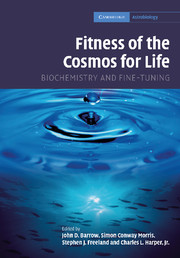
This highly interdisciplinary 2007 book highlights many of the ways in which chemistry plays a crucial role in making life an evolutionary possibility in the universe. Cosmologists and particle physicists have often explored how the observed laws and constants of nature lie within a narrow range that allows complexity and life to evolve and adapt. Here, these anthropic considerations are diversified in a host of new ways to identify the most sensitive features of biochemistry and astrobiology. Celebrating the classic 1913 work of Lawrence J. Henderson, The Fitness of the Environment for Life, this book looks at the delicate balance between chemistry and the ambient conditions in the universe that permit complex chemical networks and structures to exist. It will appeal to a broad range of scientists, academics, and others interested in the origin and existence of life in our universe.
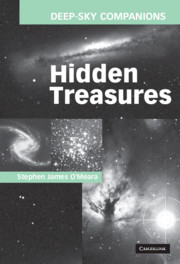
Stephen O'Meara's new and exciting observing guide spotlights an original selection of 109 deep-sky objects that will appeal to sky-watchers worldwide. His 'hidden treasures' include a wonderful assortment of galaxies, open clusters, planetary nebulae and more, all of which have been carefully chosen based on their popularity and ease of observing. None of these objects are included in either the Messier or the Caldwell catalogs, and all are visible in a 4-inch telescope under dark skies. Stunning photographs and beautiful drawings accompany detailed visual descriptions of the objects, which include their rich histories and astrophysical significance. The author's original finder charts are designed to help observers get to their targets fast and efficiently.
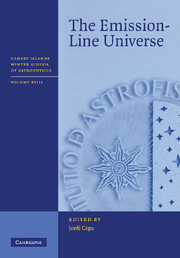
Emission lines provide a powerful tool to study the physical properties and chemical compositions of astrophysical objects in the Universe, from the first stars to objects in our galaxy. The analysis of emission lines allows us to estimate the star formation rate and initial mass function of ionizing stellar populations, and the properties of active galactic nuclei. This book presents lectures from the eighteenth Winter School of the Canary Islands Astrophysics Institute (IAC), devoted to emission lines and the astrophysical objects that produce them. Written by prestigious researchers and experienced observers, it covers the formation of emission lines and the different sources that produce them. It shows how emission lines in different wavelengths, from ultraviolet to near infrared, can provide essential information on understanding the formation and evolution of astrophysical objects. It also includes practical tutorials for data reduction, making this a valuable reference for researchers and graduate students.
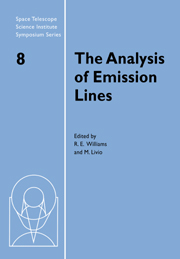
What can emission lines tell us about an astrophysical object? A workshop at the Space Telescope Science Institute was dedicated to address just this question – for a host of objects (including planetary nebulae and active galactic nuclei) across a broad range of wavelengths (from the infrared through to gamma-rays). Thirteen review articles from internationally renowned experts are presented in this volume. They provide an edited and coherent overview of the latest technical data, techniques in and applications of the study of emission lines from a variety of objects. Chapters include the theory of radiative transfer, photoionising shocks, and emission lines from stellar winds, as well as useful summaries of abundance determinations, atomic data, and diagnostics for IR, UV, gamma-ray and molecular lines. Together these review articles provide an overview of the analysis of emission lines. They summarise current knowledge, highlight outstanding problems and provide focus for fruitful future research. In this way they provide an excellent introduction for graduate students and reference for professionals.
I discuss the role played by short-duration eruptive mass loss in the evolution of very massive stars. Giant eruptions of Luminous Blue Variables (LBVs) like the 19th century event of η Carinae can remove large quantities of mass almost instantaneously, making them significant in stellar evolution. They can potentially remove much more mass from the star than line-driven winds, especially if stellar winds are highly clumped such that previous estimates of O-star mass-loss rates need to be revised downward. When seen in other galaxies as “supernova impostors,” these LBV eruptions typically last for less than a decade, and they can remove of order 10 M⊙ as indicated by massive nebulae around LBVs. Such extreme mass-loss rates cannot be driven by radiation pressure on spectral lines, because the lines will completely saturate during the events. Instead, these outbursts must either be continuum-driven super-Eddington winds or outright hydrodynamic explosions, both of which are insensitive to metallicity. As such, this eruptive mode of mass loss could also play a pivotal role in the evolution and ultimate fate of massive metal-poor stars in the early universe. If they occur in these Population III stars, such eruptions would also profoundly affect the chemical yield and types of remnants from early supernovae and hypernovae thought to be the origin of long gamma-ray bursts.
Nonrotating stars that end their lives with masses 140 M⊙ ≤ M* ≤ 260 M⊙ should explode as pair-production supernovae (PPSNe). Here I review the physical properties of these objects, as well as the prospects for them to be observationally constrained.
In very massive stars, much of the pressure support comes from the radiation field, meaning that they are loosely bound, and that (d lgp/d lg Ρ)adiabatic near the center is close to the minimum value necessary for stability. Near the end of C/O burning, the central temperature increases to the point that photons begin to be converted into electron–positron pairs, softening the equation of state below this critical value. The result is a runaway collapse, followed by explosive burning that completely obliterates the loosely bound star. While these explosions can be up to 100 times more energetic than core collapse and Type Ia supernovae, their peak luminosities are only slightly greater. However, due both to copious Ni56 production and hydrogen recombination, they are brighter much longer, and remain observable for ≈1 year.
Since metal enrichment is a local process, PPSNe should occur in pockets of metal-free gas over a broad range of redshifts, greatly enhancing their detectability, and distributing their nucleosynthetic products about the Milky Way. This means that measurements of the abundances of metal-free stars should be thought of as directly constraining these objects.
By
Rolf. P. Kudritzki, Institute for Astronomy, University of Hawaii, 2680 Woodlawn Drive, Honolulu, HI 96822, USA,
Miguel. A. Urbaneja, Institute for Astronomy, University of Hawaii, 2680 Woodlawn Drive, Honolulu, HI 96822, USA
Edited by
Mario Livio, Space Telescope Science Institute, Baltimore,Eva Villaver, Space Telescope Science Institute, Baltimore
In recent years a new generation of model atmosphere codes, which include the effects of metal line blanketing of millions of spectral lines in NLTE, has been used to re-determine the properties of massive stars through quantitative spectral analysis methods applied to optical, IR and UV spectra. This has resulted in a significant change of the effective temperature scale of early-type stars and a revision of mass-loss rates. Observed mass-loss rates and effective temperatures depend strongly on metallicity, both in agreement with theoretical predictions. The new model atmospheres, in conjunction with the new generation of 10-m-class telescopes equipped with efficient multi-object spectrographs, have made it possible to study blue supergiants in galaxies far beyond the Local Group in spectroscopic detail to determine accurate chemical composition, extinction and distances. A new distance determination method, the flux-weighted gravity–luminosity relationship, is discussed as a very promising complement to existing stellar distance indicators.
Observationally, there are still fundamental uncertainties in the determination of stellar mass-loss rates, which are caused by evidence that the winds are inhomogeneous and clumped. This may lead to major revisions of the observed rates of mass loss.
Introduction
Hot massive stars are cosmic engines of fundamental importance, not only in the local, but also in the early universe. A first generation of very massive stars has very likely influenced the formation and evolution of the first building blocks of galaxies.